Patricia shared a hilarious tale about her Pomeranian eating an entire Thanksgiving turkey off the counter while the family was saying grace. “We heard this crash and looked up to see Mr.
Whiskers dragging a fifteen-pound turkey across the kitchen floor.
The veterinary adventure that followed cost more than the cruise we’re on now.”
Carlos contributed stories from his years at sea, including the time a passenger tried to smuggle a full-size parrot onto the ship in a tennis ball container. “The bird started squawking during security screening.
The passenger insisted it was a ‘mechanical toy.’ Security was not amused.”
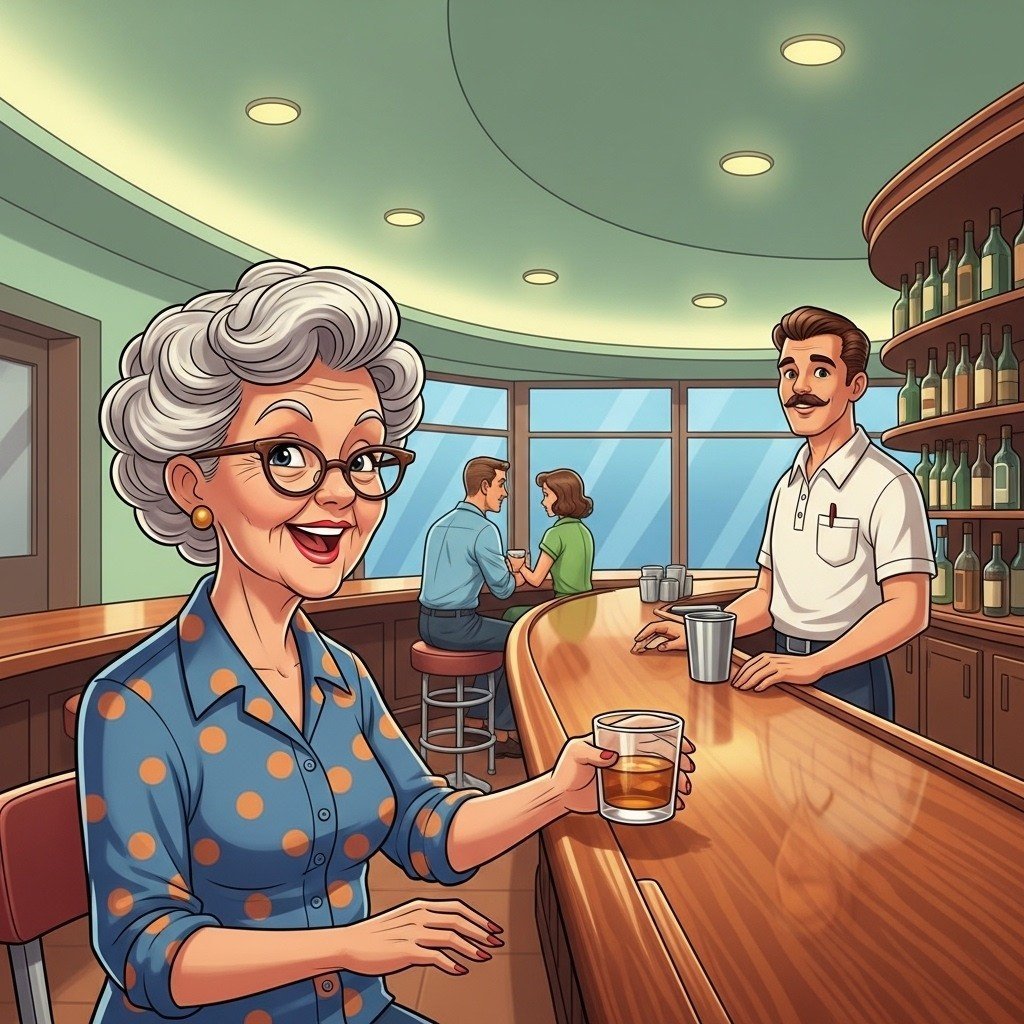
As the evening wore on and the bar grew more crowded, Maggie glanced at her watch—a vintage Cartier that had been her husband’s gift for their fiftieth anniversary. “Goodness, it’s nearly eight,” she said.
“I should head to dinner.”
“Are you dining alone?” Patricia asked.
“You’re welcome to join my husband and me. He’s probably finished losing our vacation budget by now.”
“That’s very kind, but I have a table reservation,” Maggie said. “Though perhaps we’ll see each other around the ship.
It’s not that big, despite appearances.”
“I’d like that,” Patricia said warmly.
Winston stood and offered his hand. “It’s been a genuine pleasure, Mrs.
Thornton. Happy birthday once again.”
“Thank you, Winston.
Enjoy your evening.”
Carlos came around the bar to help her down from the stool—unnecessary, but gallant.
“Mrs. Thornton, this was the highlight of my shift. Thank you for the laugh.”
“Thank you for the free drink,” Maggie said with a wink.
“And the excellent service.”
She made her way through the bar, nodding at a few people who had clearly overheard the “two drops of water” punchline and were still smiling about it.
Dinner and Reflection
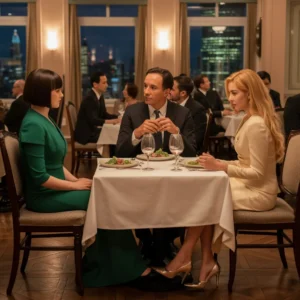
The dining room was on Deck 5, and Maggie took the elevator down, sharing the space with a young couple who couldn’t stop taking selfies. She smiled at them indulgently.
Young love was exhausting, but it was also beautiful in its own frantic way. The maître d’ greeted her by name—she’d tipped him well on the first night—and led her to a small table by the window.
The ocean was dark now, just an endless black punctuated by the ship’s lights reflecting on the water.
“Your waiter will be with you shortly, Mrs. Thornton. May I bring you something from the bar while you wait?”
“Just water, please,” Maggie said.
“Still, not sparkling.
And perhaps not too much of it.”
The maître d’ smiled politely, not getting the joke, and walked away. Maggie settled into her chair, spreading the linen napkin across her lap.
She looked around the dining room—couples celebrating anniversaries, families with restless teenagers, groups of friends who’d probably been planning this trip for years. She was alone, but she wasn’t lonely.
There was a difference, she’d learned.
Her husband Edward had been gone for seven years now. Their three children were scattered across the country with lives and families of their own. They’d wanted to come on this cruise with her, had practically insisted, but Maggie had refused.
“I’m eighty, not dead,” she’d told her daughter Catherine.
“I can still take a cruise by myself. Besides, you have enough to worry about with the twins starting college.”
In truth, she’d wanted this time alone.
Time to think, to remember, to simply be without anyone hovering or worrying or treating her like she might shatter at any moment. The waiter arrived—a young woman named Sofia—and took her order.
Maggie chose the sea bass and a simple salad, along with a glass of Chardonnay that she actually would drink with more than two drops of water.
While she waited for her meal, she pulled out her phone. Her grandson had taught her how to use it properly, and she’d become surprisingly adept at texting and even occasionally posting on Facebook, much to her children’s amusement. She opened her messages and found seventeen birthday wishes.
She responded to each one personally, taking her time, adding little details that showed she was thinking of each person individually.
To her grandson Tyler: Thank you, sweetheart. I’m on the cruise ship and just made some new friends at the bar.
Told them your grandmother’s famous joke about the water. They loved it.
Miss you.
To her daughter Catherine: Beautiful day at sea. Don’t worry about me—I’m eating well, sleeping well, and not falling overboard. Will call tomorrow.
To her son Michael: The ship has a library.
Can you believe it? An actual library at sea.
I found a first edition Hemingway. Your father would have been thrilled.
Her meal arrived, and it was excellent—perfectly cooked fish with a light lemon sauce, fresh vegetables that actually had flavor.
She ate slowly, savoring each bite, watching the other diners, eavesdropping shamelessly on the conversations around her. A couple three tables over was having an argument in hushed, tense voices. Newlyweds, Maggie guessed, or close to it.
They hadn’t yet learned that some arguments weren’t worth having, that being right mattered less than being kind.
A family with two young children was struggling to keep the kids entertained. The mother looked exhausted, the father was on his phone, and the children were doing that particular whine that only small children can achieve.
Maggie remembered those days—Edward trying to wrangle three kids under five while she attempted to have one adult conversation with the waiter. It had been chaos.
It had been exhausting.
It had been wonderful. She thought about the years that followed—the graduations and weddings, the grandchildren arriving one by one, the trips they’d taken, the quiet evenings reading side by side, the way Edward’s hand always found hers without thinking. She thought about the year he got sick, the doctors’ appointments, the treatments that didn’t work, the final months when he’d insisted on staying home instead of going to a hospital.
“I want to die in my own bed,” he’d said.
“With you beside me. Not hooked up to machines in some sterile room.”
And that’s how it had happened.
Peacefully, on a Tuesday morning in April, with spring sunlight streaming through their bedroom window and Maggie holding his hand. “Thank you,” he’d whispered, his voice barely audible.
“For forty-three years of everything.”
Those were his last words.
Thank you. Maggie had cried, of course. Had grieved deeply and thoroughly.
But she’d also felt grateful—grateful they’d had so many years, grateful he hadn’t suffered long, grateful for the life they’d built together.
And now, seven years later, she could sit in a ship’s dining room and think about him without the sharp pain that used to accompany every memory. The grief was still there, but it had softened into something more bearable—a gentle ache, like an old injury that bothered you in certain weather.
The Deck Walk
After dinner, Maggie decided to take a walk around the deck before retiring to her cabin. The night air was warm and slightly humid, the sky full of stars that you could never see in the city.
She found a quiet spot near the railing and stood there, listening to the ocean, feeling the gentle movement of the ship beneath her feet.
“Beautiful night,” a voice said beside her. She turned to find Winston, the British surgeon from the bar, standing a respectful distance away. “It is,” she agreed.
“I hope I’m not intruding.
I like to walk the deck after dinner. Helps with digestion.”
“Not at all.
I do the same.”
They stood in comfortable silence for a moment, watching the dark water slide past the ship’s hull. “Can I ask you something?” Winston said.
“And please tell me if I’m being too forward.”
“Ask away.
At eighty, I’m beyond being offended by questions.”
“Does it get easier?” he asked quietly. “Being alone. I know you mentioned you’re widowed as well.”
Maggie considered the question carefully.
She’d been asked variations of it before, usually by well-meaning friends who wanted reassurance that their own grief would eventually become manageable.
“Yes and no,” she said finally. “The acute pain fades.
That part gets easier. You stop expecting to see them in their chair or hear their voice in another room.
But the absence doesn’t go away.
You just learn to live around it, like a piece of furniture you can’t move.”
Winston nodded slowly. “That’s what I thought. Some days are better than others.”
“Some days are better than others,” Maggie agreed.
“But Winston, here’s what I’ve learned—and this is the wisdom of eighty years, so take it for what it’s worth.”