Not wild, just alive. His tail flagged, his head tossed like he was shaking off an old memory.
When he saw Dorothy, he trotted to the fence and nudged her shoulder with his nose. It was a gentle push, like a greeting.
Dorothy laughed, and the sound surprised her.
Then she blinked fast because tears came anyway.
“Well, good morning to you,” she said, voice shaking. “Welcome back.”
That afternoon, the phone rang again, and this time it was Sterling Moore himself. His voice was sharp and business-like, the kind of voice that sounded used to being obeyed.
“Miss Mallister,” he said.
“I understand my horse has been staying at your facility. I will be sending a trailer to pick him up next week. I found a retirement farm in Virginia that will take him.”
Dorothy’s stomach dropped.
She did not beg, but she did not stay quiet either.
“Mister Moore,” she said, “he is coming back to life here. He is connecting with our kids in a way I have never seen. Please come visit before you make a final choice.
Just come see.”
There was a pause, heavy and cold.
“Ms. Mallister,” Moore said, “that horse was bred and trained for one purpose. He cannot do it.
I do not see how playing with disabled children is a good use of his potential.”
Dorothy felt the words land like stones, but she kept her voice steady.
“With respect, sir, I think you are measuring the wrong kind of potential.”
Another pause.
“Fine,” Moore said at last. “I will come, but do not expect miracles.”
Five days later, a Mercedes rolled into the gravel lot like a silver fish in a muddy pond.
Dorothy stepped out of her rusty pickup, wiped her hands on her jeans, and watched the car stop. Sterling Moore climbed out wearing a suit that looked expensive, even with dust on it.
He was in his mid-50s, hair neat, face controlled. He looked around at the small barns, the worn fences, the faded sign, and his expression said everything he was trying not to say.
“This is it?” he asked.
Dorothy nodded.
“This is it.”
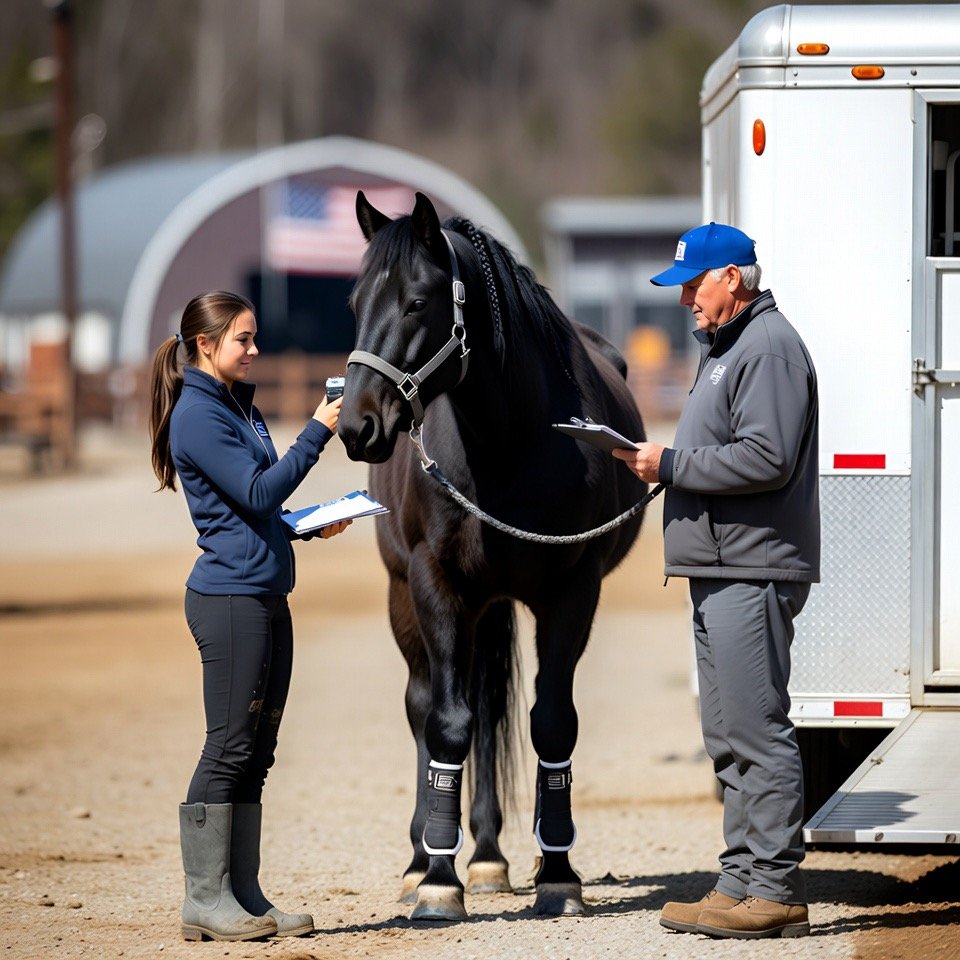
Moore looked toward the paddocks. Midnight stood near the fence like he had been waiting for a second.
Dorothy thought she saw Moore hesitate. Then he masked it with a quick glance away.
“I am not sure what I am supposed to see,” Moore said.
Dorothy pointed toward the riding arena.
“Then watch.”
Olivia was already setting up a session. Six children stood in the arena with helpers nearby.
Wesley was there. Hannah in her wheelchair. Carter with his hood down for once.
Ben holding a cone like it was treasure.
They were not wearing riding helmets because they were not riding. There was no saddle. No bridle, just a simple halter.
Midnight walked into the arena, calm and steady.
At first, Moore watched with crossed arms like a man inspecting a problem he planned to get rid of.
The kids began a game of follow the leader, walking in a slow line while Midnight followed, matching their pace.
They set cones in a simple path, and Midnight stepped through them like he understood the point was not to perform perfectly, but to play.
Then something happened that made Dorothy’s heart jump.
A helper dropped a metal bucket by accident. It hit the ground with a loud clang that echoed in the arena.
Every adult tensed.
Dorothy expected Midnight to spook. She expected panic because the papers said he was unpredictable.
Wesley froze, hands clamped over his ears. Midnight jerked his head up, his muscles tightened for one terrifying second. Dorothy took a step forward, ready to end the session and get the kids out.
But Midnight did not bolt.
He lowered his head toward Wesley.
He moved slow, careful, and stood close to the boy like a wall between Wesley and the noise.
Wesley’s breathing slowed as he leaned into the horse’s neck.
Olivia whispered, “Good boy,” but she did not touch the horse. She let him choose.
Moore’s arms slowly uncrossed. His eyes stayed locked on Midnight.
As the session continued, Moore saw more.
When Ben dropped a ball, Midnight picked it up and brought it back. When Hannah struggled to reach a cone, Midnight nudged it closer with his nose. When Carter stood still, trying to steady his breathing, Midnight stood beside him, quiet as a rock.
When the hour ended, Moore did not speak right away.
Dorothy watched him like she was watching a storm cloud decide where to break.
Finally, Moore muttered almost to himself.
“That is not possible.”
Dorothy kept her voice low.
“It is happening anyway.”
Moore took a slow breath and looked toward the paddock gate.
“I want to see him alone,” he said.
Dorothy’s chest tightened.
“All right,” she replied, though her hands felt cold.
As Moore walked toward Midnight’s paddock, Dorothy stayed behind the fence line with Olivia, watching every step. Because Dorothy knew one thing for sure.
If Midnight’s Verdict shut down again in front of this man, the trailer would come and the miracle would be over.
Sterling Moore stepped into the paddock like a man entering a room he did not understand. The ground was soft with old mud and straw.
The air smelled of hay and horses and work. He held himself stiff, shoulders tight in his expensive jacket, as if the dirt might climb up and ruin him.
Midnight’s Verdict stood a few yards away near the fence, calm and still. The horse did not turn away.
He did not pin his ears. He simply watched the man with quiet eyes.
Dorothy stayed outside the paddock with Olivia, close enough to step in if needed. Olivia’s hand hovered near the gate latch.
Dorothy did not speak. She knew this moment did not belong to her.
It belonged to the horse.
Moore cleared his throat.
“So,” he said, voice lower than before. “I’m told you’re a different animal now.”
Midnight did not move.
Moore took one careful step closer, then another.
He did not reach out right away. He stood there, looking up at the horse’s tall frame and the clean line of muscle, like he was finally seeing what he had bought and then written off.
“I paid a lot for you,” Moore said, and the words came out sounding strange even to him. “I expected results.
I expected proof. Ribbons. Wins.”
Midnight’s ears flicked once.
His head lowered a few inches. Dorothy felt her own breath catch.
Moore swallowed and tried again, softer this time.
“When my trainer called you a problem, I believed him. When buyers returned you, I believed them, too.
I thought you were broken.”
Midnight stepped forward, just one step, slow and steady. Dorothy saw Moore tense, but he did not back away. Then Midnight took another step and stopped close enough that Moore could feel his breath.
The horse raised his head slightly and pressed it against the man’s chest.
It was not a push.
It was not a shove. It was a simple heavy lean of trust. The kind a child gives when they stop fighting the world for a moment and decide to rest.
Moore froze.
His hands stayed at his sides like he did not know what to do with them.
Then his fingers lifted and touched the horse’s neck, awkward at first, then more sure.
Dorothy watched the exact moment the man changed. His face softened. His eyes lost their hard edge.
He blinked like he was trying to hide something he did not want to feel.
When Moore finally stepped back, his shirt was marked with horsehair and dust. He looked at it, then looked at Dorothy and Olivia outside the gate.
“I need to ask you something,” Moore said.
Dorothy’s heart pounded.
“Go ahead.”
“If I donated Midnight’s Verdict to your facility,” Moore said slowly, “could you care for him long-term?”
Dorothy did not answer with excitement, even though it took all her strength not to. She knew how easily promises could turn into disappointment.
She took a breath and told the truth.
“Mr.
Moore,” she said with respect, “we are barely scraping by. I can feed our small therapy horses because they are easy keepers. Midnight eats like a king.
I cannot pay for his vet care, his farrier, his insurance, and everything else a horse like him needs.”
Moore nodded like he already expected that.
“What if I set up a trust,” he asked, “to cover his care for the rest of his life? And what if I added a yearly amount to support your programs? Enough that you do not have to fear losing this place every winter.”
Dorothy’s throat tightened.
“Why would you do that?” she asked, because she needed to hear the reason.