The first glass of sparkling wine tasted fine until the exact second I noticed my daughter’s face, because the kind of fear that lives in a six-year-old doesn’t belong at a party, and once you see it you can’t pretend the music is louder than the truth.
We were on the back terrace of my coastal home outside Chatham, Massachusetts, where the salt air usually calmed me down and the ocean horizon usually reminded me that problems had edges, but that evening everything felt staged and sharp, like the whole property had been polished for strangers instead of lived in by a family.
It was supposed to be our engagement celebration, and the yard had been transformed into something that looked like a magazine spread, with white tents, warm string lights, too many servers in black vests, and a guest list that my fiancée, Brielle Sutter, had insisted was “small” only because she didn’t like admitting she’d invited nearly everyone who might ever matter to her.
Brielle stood beside me with her hand curled around my arm, her nails immaculate and her smile practiced, and she leaned in as if she were whispering something sweet when what she actually said was, “Adrian, shoulders back, and please stop looking around like you’re checking exits.”
I kept my voice even because raising it would have turned the moment into a spectacle, and I had already learned that Brielle collected spectacles the way some people collected jewelry. “I’m not checking exits,” I said, forcing my gaze to stay on her for a beat. “I’m looking for Lila.”
Brielle’s eyes flicked toward the crowd and then back to me, bright and cold at the same time under lashes that could have fanned a candle flame.
“She’s fine,” she said, with that familiar impatience that sounded like a door closing.
“Nina is watching her.”
Our nanny, Nina, was near the bar trying to politely untangle herself from a man who’d clearly had one drink too many, which would have been funny on any other night, and I could already feel irritation rising in my chest, not at Nina, but at the fact that adults always found ways to make children someone else’s responsibility.
Brielle tightened her grip on my arm and angled her face toward a camera I hadn’t even noticed, because someone always had a camera. “This is our night,” she murmured.
“Be present, Adrian.”
I did the thing I’d gotten good at doing over the years, which was smiling while my stomach turned, and I told myself, like I had told myself a hundred times since I’d met her, that she was under pressure, that she wanted things to look perfect, that I was lucky to have found someone who could move through wealth and attention as if she belonged there.
Before my wife had passed when Lila was still a toddler, I used to believe that love was loud and obvious, but grief taught me love could also be quiet and stubborn, and loneliness taught me how easy it was to confuse charm with care if you wanted a second chance badly enough.
I spotted Lila near the dessert table, half-hidden behind a cluster of adults who were talking about markets and coastal property values as if those things were weather, and she looked small and stiff in a bright pink dress that didn’t belong on her body or in her spirit.
Lila was a sneakers-and-mud kind of kid, the kind who came home with interesting rocks in her pockets and questions in her mouth, and she had never once asked to be dressed like a doll for strangers to admire.
When she saw me looking, her shoulders lifted the way they did when she was trying not to cry, and she didn’t wave because Brielle had been teaching her, gently on the surface and sharply underneath, that “proper” children didn’t call attention to themselves.
I started to step away from Brielle, but Brielle’s hand stayed on my arm as if she could anchor me to the image she wanted. “Don’t,” she said softly, still smiling for the crowd.
“If you run to her every time she looks uncomfortable, she’ll never learn.”
“She’s six,” I replied, and even as I said it I felt how tired I was of saying it, because it was the simplest fact in the world and it never seemed to matter.
Then Lila’s voice cut through the soft music like a bright bell.
“Dad!”
I turned, and there she was, moving fast across the stone patio, not graceful in those stiff shoes, but determined in the way children are determined when they’ve found something wonderful and they can’t keep it inside themselves.
Her hands were cupped carefully around a fat, muddy frog, and her face was glowing with the kind of delight you can’t buy, which was the kind of delight Brielle always seemed to find inconvenient.
“Look!” Lila called, breathless.
“It was by the little pond, and it’s so big, and I think it likes me.”
Brielle went rigid beside me, as if the air itself had offended her. “Is that real,” she whispered, and there was disgust in her voice that she didn’t even bother to hide. “Please tell me that’s not real.”
“It’s a frog,” Lila said proudly as she came close, looking up at Brielle with the anxious hope of a child who wanted to be liked by the woman she’d been told would become family.
“See, Brielle, it’s not scary, it’s just squishy.”
Everything that happened next felt slow and awful, like time had decided to punish me by making sure I noticed every detail.
Lila’s foot caught the hem of her dress, the dress that was too long because it was chosen for how it photographed instead of how it fit, and she pitched forward as her hands opened on instinct.
The frog flew, landed against Brielle’s chest, and slid down her expensive silk like a smudge of swamp and pond muck, while Lila grabbed at Brielle’s skirt with wet hands to keep herself from falling.
Brielle’s scream wasn’t surprise, it was rage, and it went sharp across the terrace as the music stuttered and the guests turned as one.
“Get it off,” Brielle shrieked, flinging her arms, swatting the frog away as if it were an insult.
“Get away from me, now.”
Lila froze, her whole body locked in place, and her voice came out thin and shaky. “I’m sorry,” she whispered.
“I didn’t mean to, I just—”
Brielle’s face twisted, her perfect smile gone so completely it was like a mask had fallen into the dirt. “You ruin everything,” she snapped, staring at the stain as if the stain were a personal attack.
“Do you understand how much this cost, and what you just did.”
I stepped between them without thinking, because my body already knew what my mind didn’t want to admit.
“Enough,” I said, low. “It’s a dress, she tripped, and she’s a child.”
Brielle’s eyes flashed, and she shook her head like I was the one embarrassing her. “It’s not a dress,” she hissed.
“It’s the entire evening, and she always does this, she always has to make it about her.”
Lila lifted her hand toward Brielle like a tiny peace offering, trembling so hard her fingers couldn’t stay straight.
“Brielle, I can clean it,” she said, trying to be helpful in the way children are helpful when they’re scared. “I can wash—”
Brielle flinched as if Lila’s hand were something dirty, and she spat, “Don’t touch me.”
I saw it before it happened, which somehow made it worse, because there are moments when you understand what someone is capable of right before they prove it, and your body goes cold because you realize you’ve been living with a stranger.
Brielle shoved Lila.
It wasn’t a swat, and it wasn’t a careless bump, and it wasn’t some misunderstanding you could smooth over later with apologies and gifts, because she put both hands on my daughter’s chest and pushed with force, sending Lila stumbling backward toward the deep end of the pool.
My voice tore out of me, raw and instant.
“No, Lila.”
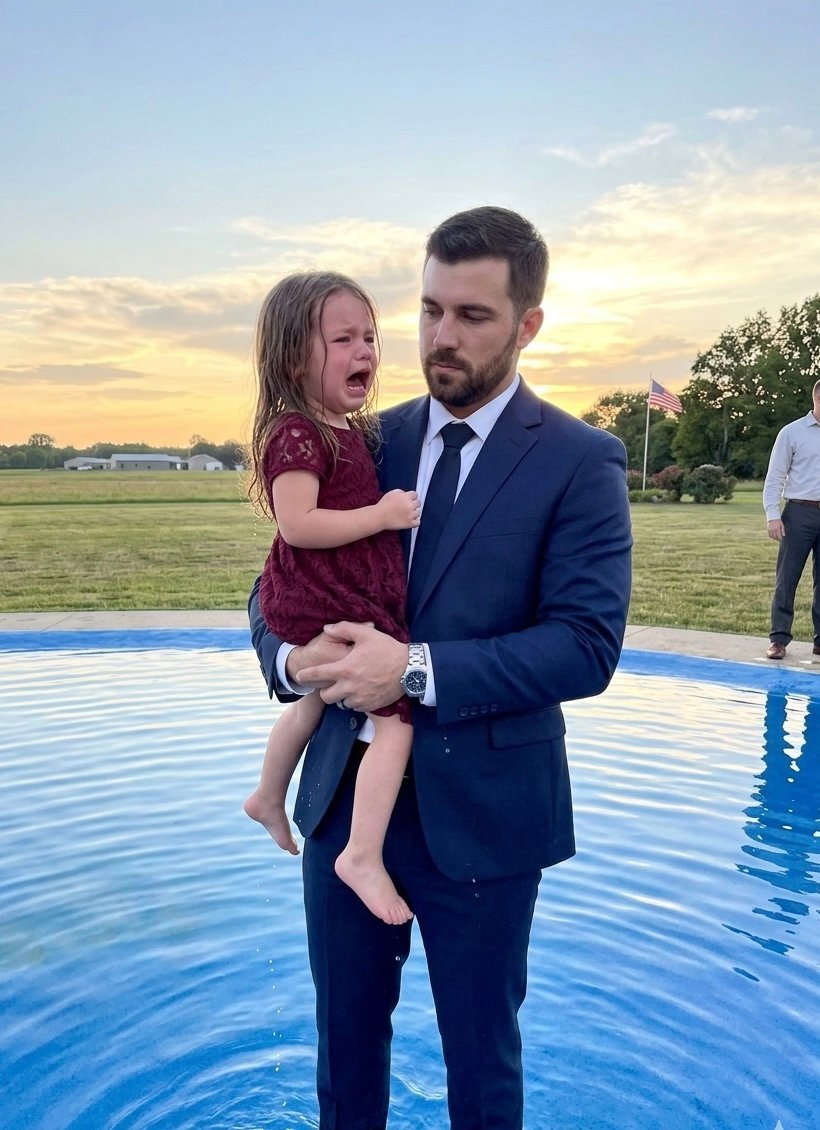
But stone was slick, and shoes were stiff, and Lila’s arms windmilled as she tried to catch her balance, and then she went over the edge with a splash that sounded too big for a child’s body.
The pool’s deep end was where the adults liked to pose beside the lights, and the water there was darker, and for a terrible heartbeat I couldn’t see her.