Something in me wondered if this would be the moment she truly looked. But then Scott called from the hallway that they were running late, Emma came clattering down the stairs half-zipped into a jacket, and the moment passed like so many moments do—not with resolution, but with interruption.
As soon as the garage door closed and their SUV backed out of the driveway, I began.
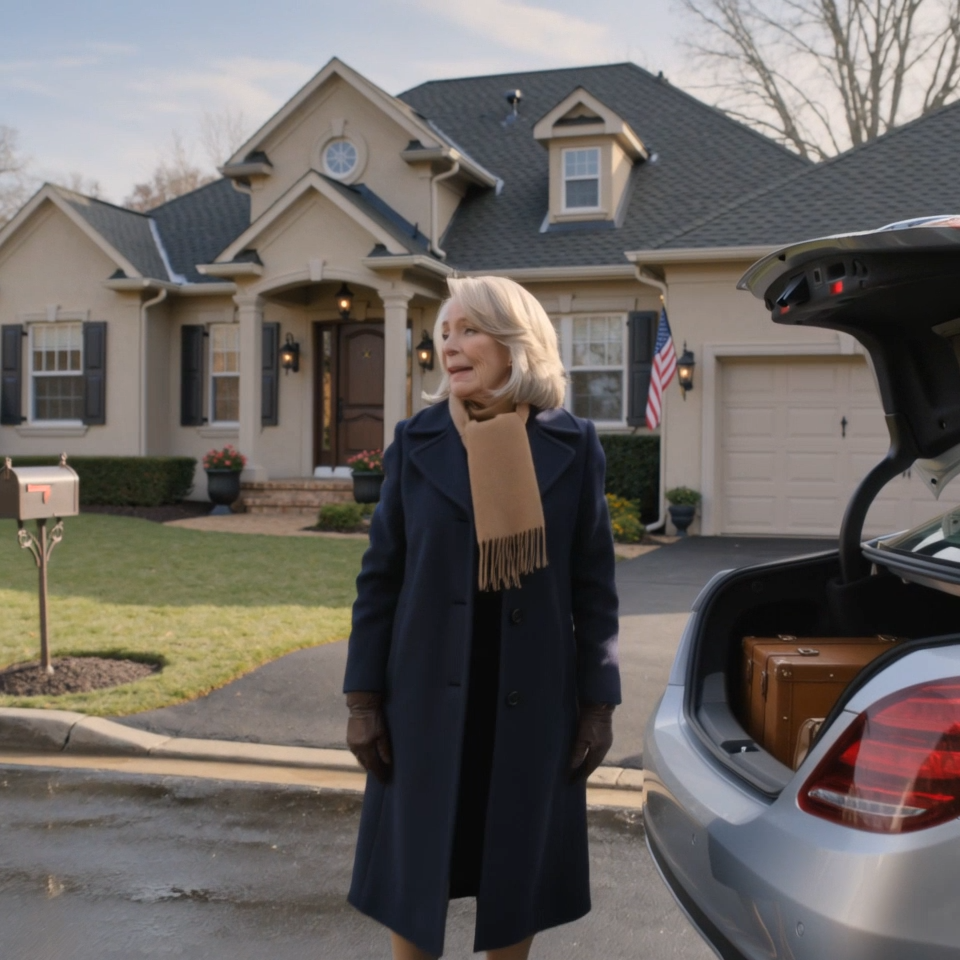
Four trips to the car.
One for the clothing and toiletries.
One for the photographs, the quilt, and the folder of papers.
One for the kitchen box with my knives, mixing bowl, and two mugs I liked.
One for the smaller things that make a space feel less borrowed: the brass reading lamp, Tom’s watch, my Bible though I rarely opened it, the little tin of buttons my mother kept and I kept after her for reasons that never had anything to do with buttons.
When the car was loaded, I stood in the kitchen for a moment longer than I needed to. The house was very quiet.
A bowl of clementines sat on the island.
Emma’s science vocabulary words were still clipped to the refrigerator under a magnet from Hilton Head. On the counter, I placed the two envelopes side by side.
Carol. Scott.
I set my house key next to them.
Then I walked out through the garage, lowered the door behind me, got into my car, and drove north.
I did not cry then either.
I thought about Tom, though.
I thought about the back porch on Clover Hill Road and how, in his last months, he used to sit out there in the early evenings no matter the weather, wrapped in an old fleece pullover, his coffee cooling untouched beside him.
I would bring the mug out anyway, because rituals matter even when appetite doesn’t.
Sometimes I sat beside him and we said almost nothing. By then there was nothing left to prove, explain, or tidy up between us. That is one of the great privileges of a long marriage.
At its best, it eventually makes performance unnecessary.
I thought, not for the first time, how different things might have been if he had still been alive.
Scott would never have tried what he tried if Tom had been sitting at that kitchen table. Not because men respect other men more than women—though some do—but because Tom had a way of making ambition look a little embarrassed in his presence.
I was on the interstate for about forty minutes before my grip on the steering wheel loosened.
An hour in, I stopped at a rest area and bought a cup of coffee from a vending machine that somehow managed to be both weak and burnt. I drank it anyway, standing outside in the cold while trucks rushed past on the highway.
A woman with a small terrier in a red harness nodded at me as she walked by, and I nodded back.
The sky had begun to clear. Actual sunlight lay in pale strips across the wet pavement.
That, too, felt like information.
I called Daniel from the road.
He answered on the second ring.
“Mom?”
“Hi, honey.”
Something in my voice must have alerted him, because the next thing he said was, “What happened?”
So I told him. All of it.
The invitation, the questions about the money, the folder, the phone call in the hallway, the attorney, the apartment, the fact that I was already on my way.
He was silent for a while after I finished.
I could hear city traffic faintly behind him, the different texture of Portland noise filtering through the phone.
Then he said, very quietly, “Mom, I’m so sorry.”
Not defensive. Not skeptical.
Not eager to solve the emotional mess in one clean sentence. Just sorry.
I closed my eyes for a moment.
“I’m all right,” I said.
“I know you are,” he replied.
“But I’m still sorry.”
He asked where I was going, and I told him about Hearthstone Gardens.
“Call me when you get there.”
“I will.”
“And Mom?”
“Yes?”
“You did the right thing.”
There are times in life when you don’t need applause or advice or a lecture about what should happen next.
You just need one other human being to say that sentence into the air where you can hear it.
My phone lit up with Carol’s name at 11:47 that morning.
I let it ring.
She called again at 12:15.
Then Scott called once from his number, and I let that go too.
Carol called a third time at 1:30. I had just taken an exit with a diner, a gas station, and a farm supply store. I parked in front of the diner, turned off the engine, and listened to the voicemail.
The first message was confused.
“Mom, please call me.
I came home and your things are gone and I found your letter and I don’t—please call me.”
In the background I could hear the faint echo of kitchen space, the acoustics of tile and anger.
The second message came thirty minutes later.
By then she had read the letter.
Her voice was less confused and more broken open.
“Mom, I didn’t know about any phone call. I didn’t know he said that.
I swear I didn’t. Please come back so we can talk.
Please.
You can’t just leave like this.”
Her voice cracked once near the end. I sat there with the phone in my hand and listened to my daughter cry.
It is a terrible thing to hear your child cry, even when your child is old enough to have a child of her own. Some instincts never retire.
And because life is inconveniently complicated, I believed it was possible she was telling the truth.
I believed it was possible she had not known the full extent of what Scott intended.
I believed it was possible she had called her participation concern because that was easier to live with than calling it surrender.
But I also knew this: she had been present for three weeks of conversations in which her husband repeatedly tried to position himself between me and my own money. She had heard him talk about efficiency, protection, simplification.
She had echoed his concern about my age and my savings account and my need to think ahead. Not once had she said, “Mom, this is your money and your decision, and whatever you choose, we support you.”
Not once.
There are truths that live in what people fail to say.
I put the phone in my purse, went inside the diner, and took a booth by the window.
It was the sort of place that sold pie under glass and had laminated specials printed in a font nobody had updated since 1996.
There was a row of trucker caps for sale near the register and a Christmas garland already draped over the pie case even though it was still November.
I ordered chicken noodle soup and a grilled cheese sandwich and drank two cups of regular coffee that was infinitely better than the highway machine version.
At the next table, a young couple were trying to manage two toddlers and a basket of French fries. One child wanted ketchup. The other wanted the ketchup packet the first child had.
The mother had the thousand-yard focus of a woman who had not eaten a hot meal in three years.
The father was slicing a grilled cheese into impossible small pieces while apologizing to the waitress for nothing at all.
I watched them and thought: that looks exhausting.
Then I thought: that also looks like life.
The full, inconvenient, noisy, ordinary kind.
And I missed it.
I arrived at Hearthstone Gardens a little after three in the afternoon.
The entrance drive curved past low brick buildings connected by covered walkways. Winter pansies were planted in urns near the lobby doors.
Not thriving exactly, but trying. The place did not smell like antiseptic or boiled vegetables or fear, which had been my secret dread.
It smelled like coffee, lemon polish, and somebody’s cinnamon candle.
Two women about my age were bent over a large jigsaw puzzle near the front windows, arguing amiably about whether a certain piece belonged in a barn roof or a maple tree.
A man in his forties with a navy sweater and an unhurried manner introduced himself as Martin Alvarez, the director.
He shook my hand like I was moving into an apartment, not reporting for institutional storage.
“Take all the time you want,” he said.
He showed me the one-bedroom unit on the second floor.
The kitchen had a real window above the sink. Not a slit. A real window.
It looked onto a courtyard with a stone path, a small fountain, and rose beds trimmed down for winter.