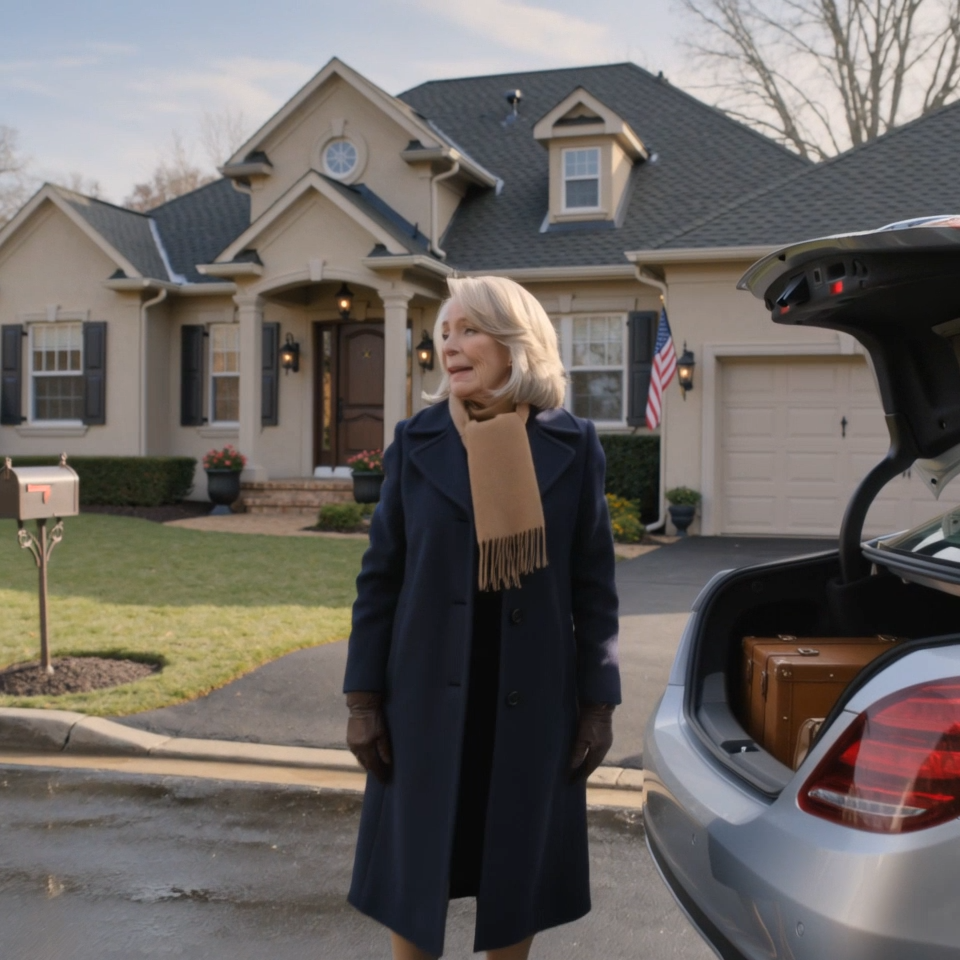
He apologized then, as if criticizing his sister in front of me required immediate moral cleanup. I told him there was no need.
Adults are responsible for the marriages they create and the homes they allow to be built around them. But responsibility is not the same as hopelessness, and I was not willing to give up on Carol.
He cried once that weekend, suddenly and briefly, while talking about Tom.
Not the loud kind of crying.
The kind that starts in a man’s face before he fully understands what is happening. I reached across the table and took his hand and said nothing, because sometimes silence is the only respectful thing left to offer grief when it has finally decided to speak.
Before he flew home, he stood in my kitchen, looked around the apartment, and said, “This feels like you.”
That sentence pleased me more than almost anything anyone had said in months.
By March, the first shoots had started in the courtyard beds, and Carol came to visit me alone.
She called the week before and asked if she could stop by on Saturday.
“Yes,” I said.
When she arrived, she stood just inside the door for a second longer than necessary, taking in the apartment. The books.
The quilt folded over the chair.
The framed photographs. The bowls of lemons and onions on the counter.
The stack of library books. The little potted basil by the window trying its best despite the season.
“You really settled in,” she said.
She had brought a bakery box from a place near her house.
Scones, it turned out.
Blueberry. Lemon poppy seed. One cinnamon chip for Emma, who was not there and therefore was not getting it.
We made coffee.
We sat at the table.
For a while we spoke about easy things.
Weather. Emma’s choir concert.
Daniel’s work. June’s arthritis.
Then the easy things ran out, as they always do when harder things have been waiting politely nearby.
Carol looked down at her mug.
“I should have said it was your decision,” she said.
I did not answer immediately.
She lifted her eyes.
“Back then. At the house. I should have said that.”
The word landed between us without drama.
Just weight.
She swallowed.
“I don’t think I understood how much I was letting him lead it.”
“You were.”
“I know that now.”
I watched her face. She looked tired in a way that had nothing to do with sleep.
“I wasn’t trying to take anything from you,” she said quietly.
“I thought—I honestly thought we were helping. You were alone.
You were grieving.
You had this money sitting there and—”
“And you got frightened,” I said.
She nodded.
“Yes.”
I wrapped both hands around my mug for warmth.
“Fear can make people controlling,” I said. “That doesn’t make the control harmless.”
She looked like she wanted to argue and knew she had no ground left to stand on.
After a moment she said, “Things are tense at home.”
I understood more from what she did not say than from what she did.
I did not ask for details.
“What do you want from me, Carol?” I asked gently.
Her eyes filled but she did not cry.
“I want you in my life,” she said. “I want Emma to have you.
I want…” She stopped and tried again.
“I want us not to be broken.”
That, at least, was honest.
“We are not broken,” I said. “But we are not the same either.”
“I know.”
I took a breath.
“I will have a relationship with you.
Gladly. I love you.
That has not changed.
But my finances are never again a family discussion. Not yours. Not Scott’s.
Not over dinner, not in a hallway, not dressed up as concern.
That part is closed.”
She wiped once under her eyes with the side of her thumb.
“And Carol?”
“You don’t get to say you didn’t know anything. You may not have known everything.
Those are different claims.”
She bowed her head slightly and nodded again.
We ate scones after that. Talked about Emma’s spring break.
The light changed in the kitchen.
When she left, she hugged me at the door. It was not a healing embrace. Those are mostly inventions of movies.
It was the hug of two women who loved each other and had, at last, stopped pretending love alone solved every other problem.
That was enough for one afternoon.
In late April, the roses began to leaf out.
In May, they bloomed.
Martin had not exaggerated.
Pale pink, climbing over the stone wall in soft, extravagant clusters, fragrant enough on warm afternoons that the air itself seemed gentler near them. The first day they opened fully, I stood at the sink window longer than my coffee required and watched a groundskeeper pause beside them the way people do beside things that turn out exactly as promised.
By then, Hearthstone no longer felt like a place I had moved to.
It felt like home.
Ruth and I walked most mornings together.
Same pace. Same circuit.
She had opinions about everything from municipal planning to terrible dialogue in prestige television, and because she had once supervised an entire high school faculty, she possessed a refined ability to detect nonsense in under ten seconds.
One afternoon in late May we sat in the courtyard with tea.
The fountain made its steady little water sound.
A warm breeze moved through the rose canes. Ruth was reading something on her tablet and making occasional noises of public disappointment at whatever article she had chosen.
I looked at the roses and thought about the long chain of events that had led me there. The hallway phone call.
The eleven careful days.
The drive north with my hands too tight on the wheel. The terrible vending machine coffee at the rest stop.
The diner. Daniel’s voice on the phone.
Patricia’s clean, unsentimental competence.
Carol’s face at my kitchen table in March. Emma asking if my apartment was nice.
I also thought about age.
There is a way people talk about aging in this country—as if life after a certain point becomes a narrowing corridor. As if those years are mainly about reduction.
Smaller circles.
Smaller needs. Smaller rights.
As if gratitude should replace preference. As if safety should replace authority.
As if an older person’s independence is negotiable so long as everyone involved uses soft voices and words like help.
I had half believed some of that myself during the last winter of Tom’s illness and the longer winter after his death.
I had thought, though I did not say it aloud, that perhaps my life had entered its diminished chapter.
I did not believe that anymore.
I was sixty-eight years old. I had an apartment with a kitchen window and a rose garden and a book club full of opinionated people who used the word insufferable with proper force. I had a son who had sat at my table and told me things he should have told me years earlier.
I had a daughter who, for all the hurt between us, had finally begun to speak without hiding behind politeness.
I had a granddaughter who was coming to stay for a weekend in June and had requested, very specifically, that we make my chicken soup together.
In early June, Carol drove Emma up on a Saturday morning.
Emma came in with an overnight bag, two books, a phone charger, and the sort of immediate ownership of space only thirteen-year-olds possess when they feel safe.
“Grandma,” she said, hugging me hard, “it smells good in here already.”
“That’s because I started the onions before you got here.”
She pulled back with a delighted expression. “So we’re really making it?”
“We are.”
Carol stood in the doorway behind her, holding Emma’s duffel strap for a moment before letting go.
She looked around the apartment the way she had in March, but this time there was something else in her face too. Relief, maybe.
Or recognition.
“This place really does suit you,” she said.
I met her eyes.
“It does.”
Emma had already wandered toward the sink window.
“Oh wow,” she said. “The roses are insane.”
Carol smiled faintly at that. For a moment, we were simply three women standing in a kitchen, looking out at flowers.
She stayed for coffee before heading back.
Ruth waved through the window from the courtyard path, and Emma whispered, “Is that your famous friend?”
“She is not famous,” I said.
Ruth opened the door without knocking properly and said, “I am absolutely famous in selected circles.”
Emma laughed.
Carol laughed too, and the sound of it—easy, unguarded, almost young—startled me.
When she left, she kissed Emma’s head, hugged me once, and said, “Call if you need anything.”
“I won’t,” I said.