I felt rage rise behind my eyes. They were trying to erase me. Then a county SUV appeared—headlights bouncing along the frost-covered road.
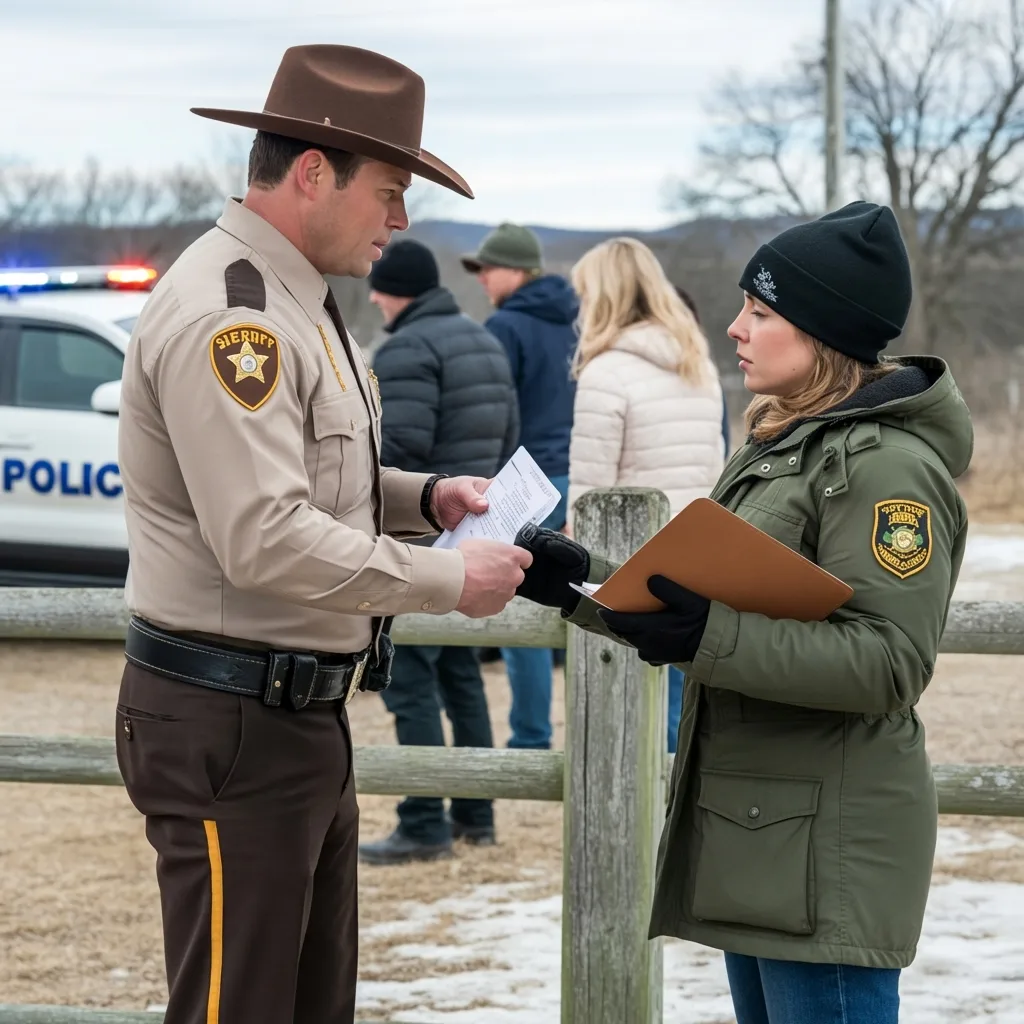
Walt stepped out, hat low, posture calm but authoritative.
“Morning, folks.”
Dad stiffened. “Sheriff, glad you’re here.
We were just trying to help my daughter. She’s confused.
She bought land that isn’t hers.”
Walt folded his arms.
“Mr. Carter, this is private property. Unless you’re the deed owner, you’re trespassing.”
Dad scoffed.
“It’s family property.
There’s been a misunderstanding.”
“The only misunderstanding,” Walt said evenly, “is the idea that you can bring a locksmith to force entry.” The locksmith packed up fast. The realtor cleared his throat.
“Mr. Carter, perhaps we should—”
Dad whirled on him.
“Don’t you start.”
Walt walked closer.
“I need all of you to step away from the gate.”
Evan sneered. “Or what? You’ll arrest us for standing here?”
“If you break that gate or attempt to enter again,” Walt said, tone now unmistakably serious, “I will arrest you.”
Dad’s face flushed red.
“This is ridiculous.
My daughter is unstable. She needs intervention, not a ranch.”
From behind my curtains, I actually laughed—bitterly, quietly.
Rachel’s voice whispered from my phone speaker: “When you’re ready, step out calmly.”
My heart pounded as I opened the front door and stepped into the cold. The crunch of snow under my boots echoed like a gunshot.
I walked the gravel path toward the gate, each step steady, deliberate.
When Dad finally saw me approaching, his mouth fell open. “Olivia,” he said, voice cracking. “You thought I wasn’t here,” I said softly.
“You thought you could take my home.”
He opened his mouth, closed it.
Evan mumbled, “We thought you were deployed.”
“I’m not,” I said. “And even if I were, this land would still be mine.”
Linda stepped forward weakly.
“We were just trying to help Evan.”
“What he needs,” I said calmly, “is accountability.”
Dad’s face twisted. “You ungrateful—”
“Enough,” Walt cut in sharply.
Rachel’s car pulled up, and she stepped out in her crisp uniform.
Dad’s eyes bulged. “Who is that?”
“Captain Rachel Monroe, Judge Advocate General’s Corps. I’m advising Ms.
Carter.”
Dad blinked.
“JAG? This is a family matter.”
“No,” Rachel said.
“This is a legal matter, and you’re in violation of property laws.”
The color drained from Dad’s face. For the first time in a long time, I felt something shift—not victory, not revenge, but control.
Rachel pulled a folder from her bag.
“Here is a certified copy of the deed in Ms. Carter’s name. We have documentation of your arrival with a locksmith and realtor this morning—audio and video.
If you attempt to challenge this ownership without legal basis, you’ll be opening yourselves to counterclaims and damages.”
Dad didn’t take the folder.
He just glared. Walt nodded approvingly.
“If this goes to court, none of it looks good for you.”
Dad shook his head. “We’re family.
You wouldn’t drag us into court.”
“You brought a stranger to change my locks,” I said.
“You tried to walk off with my house. Tell me again what family is supposed to look like.”
Linda’s shoulders sagged. “We didn’t know it would go this far.”
“That’s the thing,” I said.
“You never think it’ll go this far because you’re used to me backing down, bending, writing another check, taking another insult, swallowing another holiday alone so you don’t have to be uncomfortable.”
Dad exhaled.
“You’re overreacting.”
“You’re trying to fix your mistake by making it my problem,” I said. “And I’m done doing that.”
Walt checked his watch.
“Mr. Carter, I’m asking you one last time to leave this property line voluntarily.”
Dad looked from Walt to Rachel, then to me.
There was calculation in his eyes, but underneath, I glimpsed something else: age.
He suddenly looked worn down by stubborn pride and bad decisions. “We’re not done,” he muttered. “No,” I said.
“We’re not.
But from now on, we deal with each other honestly and on equal footing.”
At last, Dad turned away. Linda followed.
Evan lingered, staring past me at the house, then climbed into the truck. As their vehicle pulled away, the rumble faded into distance, replaced by the familiar quiet of the ranch.
Only this time, the quiet didn’t feel like emptiness—it felt like a line drawn.
Two days passed before the next contact—a text from Linda: “Can we please talk? It’s urgent.” I didn’t respond. Ten minutes later, my phone rang: Dad’s number.
I let it go to voicemail.
A second call, then a third. When the fourth came, I answered out of exhaustion.
“Olivia,” Dad said immediately, “you need to stop whatever legal action you’re taking.”
“I haven’t taken any legal action, Dad. Sheriff Hensley filed a trespass report because you trespassed.”
Dad huffed angrily.
“This is unnecessary.
We just want to talk.”
“You wanted to talk? You should have called before bringing a locksmith to my gate.”
Silence. Then he barreled forward.
“Fine.
We made a mistake. But Evan is in trouble.
Real trouble. He needs a place, and he believes—rightfully—that this land should have been his shot.”
“And what about my fresh start?” I asked quietly.
“Why is yours and Evan’s happiness always something I’m expected to sacrifice for?”
More silence.
Then, rougher: “Because you can handle things. He can’t.”
Ah. The old truth.
The unspoken rule: I was the dependable one, Evan the fragile one.
Therefore, my job to bend. “Dad,” I said gently, “you raised us both.
If Evan can’t handle life, that’s not on me.”
His voice broke into frustration. “Families solve things together.”
“Do they?
Because last time I checked, you solved Christmas by cutting me out.”
The line went quiet.
When he spoke again: “Fine. Come over. Let’s talk face to face.”
“I’m not driving two hours for another ambush,” I said.
“If you have something to say, say it now.”
I could hear him grinding his teeth.
“We want you to transfer the property into all our names—just temporarily—until Evan gets situated.”
“No,” I said. Dad exploded with anger, but I ended the call.
That night, Linda left a voicemail: “Olivia, your dad’s not telling the truth. Evan’s in deeper trouble than you know—debt, drinking, people he owes money to.
They pressured your father.
He thought if Evan got the land, he could use it as collateral. Your dad made promises he couldn’t keep. He’s embarrassed but scared too.”
I sat motionless.
Debt.
Pressure. Collateral.
A son drowning, a father making desperate choices, and a daughter who’d already spent a decade being everyone’s life raft. I wasn’t angry—I was tired.
The days after were strangely quiet.
No calls, no trucks, just winter settling deeper. Then, a week later, I heard tires crunching on snow. It was Evan’s truck—just him, alone.
He got out slowly, hands in his pockets, staring at the ground.
“Hey, Liv,” he said softly. Not Olivia.
Just hey. “Hey.
Does Dad know you’re here?”
“No. He’d be mad I came alone.”
We sat on the porch steps. Evan rubbed his hands together.
“I messed up,” he said.
“I did try to buy this place. When the developer talked about building cabins, I thought maybe I could manage rentals—something stable, something real.
But the loan fell apart. My credit’s terrible.
I didn’t tell Dad.
I just kept saying everything was fine.”
His breath shook. “When you bought it, I freaked out. Not because I thought you were stealing—I just saw the last thing I’d been hanging on to vanish.
And Dad told me it was yours to give me, that you’d do the right thing like you always do.”
“Meaning,” I said quietly, “he expected me to sacrifice again.”
Evan nodded miserably.
“And I let him because it was easier than admitting I’d failed.”
A long silence. Finally, he whispered, “I’m sorry, Liv.
For all of it.”
I blinked back tears. “I appreciate you saying that.
Really.”
He looked up, eyes red.
“I don’t expect you to forgive us overnight. I just didn’t want you thinking I hated you. I was jealous.
You made something of yourself.
You survived things I couldn’t imagine. It made me feel small.”
His honesty hit harder than anger ever had.
“Evan, I spent years trying to carry this family. I forgot that being strong doesn’t mean letting people walk over me.”
“Yeah,” he said.
“I get that now.”
We sat until the sun touched the pines.