On the Monday morning the men from the bank came to take the farm, Gerald Pratt was standing in his kitchen arguing with his son about bacon. It was not really about bacon. Michael had driven down from Cincinnati the night before because his father had gone quiet for three days — no calls returned, no texts answered — which meant one of two things: Gerald was on the tractor ignoring the world on purpose, or something was wrong and he was too stubborn to say so.
At seventy-six, Gerald still moved like a man who had something to prove, and every conversation between them was a tug-of-war between love and pride that neither man had ever quite learned to put down. “You can’t live out here alone forever,” Michael said from the stove, spatula in hand. “Not after the winter you just had.”
Gerald sat at the table in his work shirt, both hands wrapped around his coffee mug.
“I’m not alone. I’ve got livestock, fences, and a tractor that needs more attention than any woman ever did.”
Michael gave him a flat look. “Mom would’ve thrown a dish at you for that.”
Gerald’s mouth twitched.
The smile didn’t last. Dorothy had been gone three years, and the silence she left behind still sat in the corners of that house like furniture no one had the heart to move. “You’re not funny enough to be careless with your words,” Michael said.
“I raised you, didn’t I?”
“Barely. Mom did the hard parts.”
That one landed. Not because it was cruel, but because it was true enough to sting.
Gerald looked down at the table. Old wood, scarred with knife marks and dark rings from coffee mugs. A burn from a skillet Dorothy had once set down while yelling at both boys for wrestling in the kitchen.
Everything in that house carried fingerprints from the dead. Michael set a plate in front of him. “Eat.”
Gerald poked at the bacon.
“Too crisp.”
“You say that every time.”
“Because every time you ruin it.”
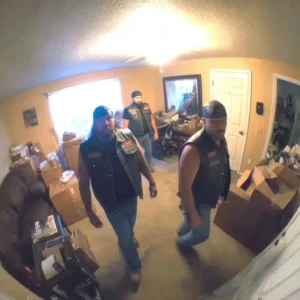
Both men turned when they heard tires on gravel. Three dark sedans rolled slowly up the long driveway, shiny enough to reflect the bare March trees. Gerald felt something in his chest go still.
Nobody came to a farm in three matching cars unless they were selling trouble. Michael stepped to the window first. “You expecting company?”
“No.”
The men got out one by one.
City shoes. Dark coats. Haircuts that cost more than Gerald’s tractor repairs.
One carried a leather briefcase. Another had a white envelope tucked under his arm like it was something proud. Gerald was already rising.
By the time he opened the front door, the three men had reached the porch. The one with the briefcase smiled like he was arriving at a chamber-of-commerce luncheon instead of at a farmhouse older than all three of them combined. “Mr.
Gerald Pratt?” the man said. “That depends who’s asking.”
“My name is Warren Keene. Counsel for Harrove Capital Group.
These gentlemen represent the bank’s rural asset enforcement division.”
Michael came to stand behind his father. “What bank?”
Keene’s smile never moved. “We’re here regarding a title dispute on this property.”
Gerald stared at him.
The wind moved across the back fields, bending the winter grass in long gray waves. “I got your letters,” Gerald said. “Then you understand the seriousness.”
“I understand you wrote words on paper.”
Keene adjusted his gloves.
“The property you occupy has been determined to fall within an unresolved legacy lien portfolio. We’re serving final notice before enforcement proceedings. If you cooperate, there may still be time to arrange a dignified transition.”
Michael made a sound somewhere between a laugh and a curse.
“A dignified transition? You’re standing on land my family has worked since my grandfather was a young man.”
The man with the envelope stepped forward. “These are legal documents, sir.”
Gerald took them but didn’t look down.
Behind him, inside the house, the clock over the sink ticked so loudly it seemed to belong to a different world. Keene kept talking. Men like him always did.
They spoke in polished paragraphs, in phrases designed to shrink a person inside his own home. Unlawful occupation. Outstanding encumbrance.
Immediate possession. Vacate within sixty days. Gerald let him finish every word.
He let every last syllable settle into the boards of the porch. Then he nodded once, turned without asking permission, and went back inside. “Dad?” Michael called.
Gerald did not answer. He walked through the kitchen, down the narrow hallway, into the bedroom he had shared with Dorothy for forty-five years. He went to the closet, knelt, and reached behind an old cedar chest to the tin box Dorothy had always called his “museum of things too important to trust to memory.”
Inside: tax receipts bundled with twine.
A photograph of his mother Ruth hanging laundry in 1958. Dorothy’s wedding gloves folded in tissue paper. And beneath all of it, an envelope gone yellow at the edges.
Written across the front in his father Raymond’s blocky handwriting were five words:
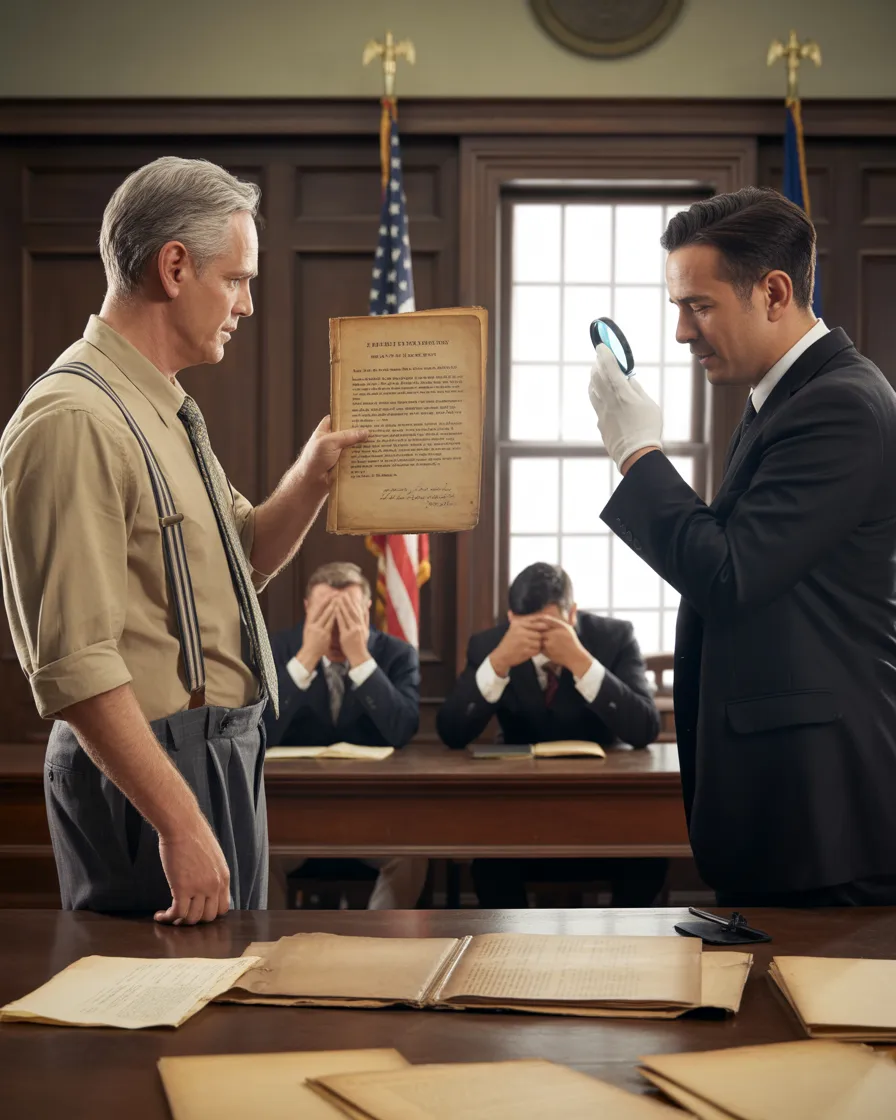
FOR GERALD. IF NEEDED. Gerald stood, took the envelope, and walked back to the porch.
Keene glanced at the old paper and smiled wider, as if it amused him. “What is that supposed to be?” he asked. Gerald’s face did not change.
“My father’s handwriting,” he said. “And the reason you’ll stop smiling.”
To understand why Gerald Pratt still owned that farm, you have to go back seventy years, to a summer when Kentucky heat lay over Calloway County like a wet blanket and a twenty-eight-year-old named Raymond Pratt was working other men’s land from sunup to dark and saving every dollar he could reach. Raymond and Ruth had been renting a two-room place with a leaking roof and a landlord who believed every repair could wait one more season.
Ruth was pregnant with Gerald then, though only the women in her family knew it. Raymond came home every evening with cracked hands and the stubborn belief that a man should sweat for his own soil, not someone else’s. The farm belonged to Carl Jessup, a widower with a bent back and no one in the world to leave the place to.
His wife was in the churchyard. His fields were going back to weeds. People in town said he’d been nearly rich once, which in rural Kentucky usually just meant he’d owned enough land to be envied.
Raymond came out to see him because someone at the feed store said Carl might sell a few acres. He found an old man sitting on an overturned bucket outside a sagging barn, watching crows circle a south field. “You Raymond Pratt?” Carl asked without standing.
“I am.”
“Know how to work tobacco?”
“Yes, sir.”
“Corn?”
“Fence?”
Carl squinted. “You know how to keep a promise?”
Raymond didn’t answer right away. He looked past Carl toward the creek cutting silver through the lower stretch, toward the oak on the hill and the house crouched against the horizon as if waiting to see whether this stranger meant what he said.
“I do,” Raymond said. That was how it began. Carl Jessup had one condition: whoever bought the land had to keep working it.
No speculators. No developers. No letting it go back to briars.
The land had fed him and his wife. He would not watch it die. The price he named sounded like a joke.
Two dollars. Not two dollars an acre. Two dollars total.
Carl did not need money. What he needed was certainty. Raymond stood silent when he heard it.
Ruth later said that when he came home and told her, his face looked less like a man who had bought land than a man who had narrowly escaped drowning. “You sure he means it?” she asked. “He means it.”
“You sure you heard right?”
“I’m poor, Ruth.
Not deaf.”
She laughed — bright and surprised — and set both hands over her belly without realizing she was doing it. Even then, neither of them believed in easy blessings. Raymond went back twice more.
He walked the property. He checked the boundary markers. He asked around town.
He sat at Carl’s table and drank bitter coffee while the old man went over names, fence lines, flood history, and what the land would demand from any man foolish enough to love it. At last Carl took him to the porch one late afternoon, the sky turning copper over the west field. “I’m not selling you dirt, son,” he said.
“I’m selling you years. If you stop working it, it’ll stop being yours even if the paper says otherwise.”
Raymond held out his hand. Carl took it.