
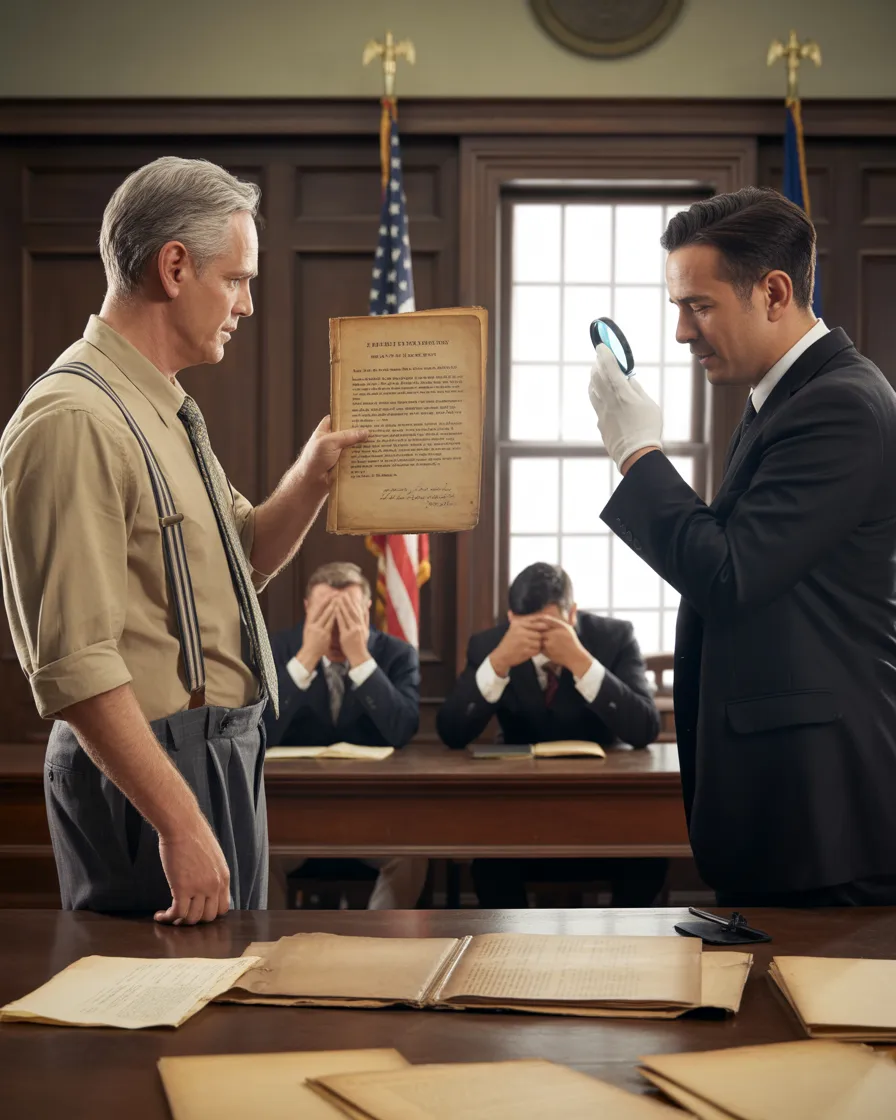
The packet looked impressive the way complexity does when it’s meant to substitute for truth. Patricia went through it line by line, yellow marker in hand. Gerald sat across from her desk with his hat on his knee, jaw set, saying little.
Page fourteen. Nothing useful. Page nineteen.
A reference to First Agricultural Bank of Western Kentucky. Page twenty-three. Assignment language.
Page twenty-seven. A portfolio notation. Then page thirty-one.
Patricia stopped. Completely stopped. The silence changed.
Gerald noticed it immediately. “What?”
She didn’t answer for three full seconds. She leaned closer, scanned the page again, and looked back to the top as if making sure she hadn’t imagined what she saw.
“Come around here,” she said. Gerald crossed behind the desk and braced one hand on the chair. Patricia tapped the paragraph with her pen.
The 1947 lien was real. First Agricultural Bank of Western Kentucky had placed it on the property in March of that year. Gerald’s stomach tightened.
Then Patricia slid the pen lower. A discharge notice. Dated September 1949.
Signed by the loan officer. Recorded. Paid in full.
Released from the property eighteen months before Carl Jessup sold the land to Raymond Pratt. Gerald stared. “So the lien was cleared,” he said.
“Yes.”
“In 1949.”
“And my father bought in 1952.”
He looked at her, and something colder than relief came into his expression. “So they knew.”
Patricia’s face stayed still. “That is exactly the right question.”
The discharge wasn’t hidden.
It wasn’t buried in microscopic type on some impossible attachment. It was sitting right there in their own chain-of-title materials, beneath the very lien they were using to threaten an old farmer off land his family had worked for seven decades. Gerald felt anger rise in him so sharp it was almost clean.
All those words. All that legal muscle. Men on his porch in polished shoes smiling at his age.
And the truth had been sitting in their own paperwork the whole time. Patricia copied page thirty-one twice. “When those men came to your place,” she said, “you showed them your father’s envelope.”
“And they laughed at the 1973 deed.”
“They did.”
Patricia set the copied page down.
“Then in court I’m going to enjoy educating them.”
She filed her response on a Thursday morning. Fourteen pages. Controlled, methodical, and professionally devastating.
She built every argument from Harrove’s own documents. No dramatic witnesses. No sentiment.
Just their paperwork turned against them, line by line. The central argument was simple enough to say in one breath: the 1947 lien had been fully discharged in September 1949. Carl Jessup sold clean land in 1952.
Raymond Pratt acquired valid title. The 1973 deed confirmed what was already true. Gerald inherited lawful ownership in 1974.
Harrove Capital Group had purchased, packaged, and attempted to enforce a claim that no longer legally existed. Then Patricia added something extra: a motion asking the court to consider whether Harrove had knowingly pursued a bad-faith claim, given that the discharge notice had been in its own possession at the time it threatened Gerald Pratt with removal. When Harrove’s counsel responded, the swagger was gone.
More hedging. More references to ongoing review. More suggestions that historical document interpretation could be complex.
Patricia snorted reading that phrase aloud. “Interpretation?” she said. “Paid in full is not a poem.”
Michael drove down the following weekend.
He found his father at the kitchen table with the copied page spread beside the salt shaker. “That it?” Michael said. Gerald nodded.
Michael read it, then read it again, then leaned back with a long slow exhale. “They tried to run you off land they knew was yours.”
Michael’s face tightened. “I should’ve come sooner.
When the first letter arrived.”
Gerald looked at him. “You came.”
They spent the afternoon sorting boxes in the barn. Under a shelf wrapped in feed sacks they found Dorothy’s handwriting on a lumber inventory from 1983, and a Polaroid of the second barn raising — Gerald on the roof, Dorothy below with one hand on her hip, both boys half-feral with summer dirt.
Michael held the photo a long time. “She kept everything,” he said. “She knew everything turned into evidence eventually,” Gerald said.
Ben called from Oklahoma after Michael finally reached him. He’d been gone long enough that his voice carried another region in it now, flatter vowels and rougher edges. “Mike says some company’s trying to take the farm,” he said.
“Tried,” Gerald answered. “Tried?”
“Lawyer found the lie.”
A pause. Then, quieter than Ben usually allowed himself: “You all right?”
Another pause.
“You need me home?”
Gerald looked around the kitchen where Dorothy used to stand with a dish towel over one shoulder issuing instructions like scripture. He thought of the fights with Ben. All the years both men had wasted mistaking bruised love for anger.
“Not for the fight,” Gerald said. “Maybe for after.”
Ben came. He arrived in a dust-coated truck with a duffel bag and the same wary posture he’d carried at seventeen when the whole world felt like accusation.
Gerald met him in the yard. For a second neither moved. “You look older,” Ben said.
“You look tired,” Gerald said. Michael laughed from the porch and somehow that broke whatever pride had kept frozen between them. Ben stepped forward and hugged his father hard, once, quickly, as if embarrassed by his own need.
That night the three men sat at Dorothy’s table eating beef stew. Near midnight Ben stared into his coffee and said, “I used to think you loved this place more than us.”
The words lay in the room. Gerald set his spoon down.
“I know,” he said. Ben looked up, surprised by the absence of fight in the answer. “Truth is,” Gerald continued, “I loved the place because it held all of you.
Your mother. My parents. You boys running these floors like wild dogs.
I didn’t know how to say that without sounding foolish.”
Michael looked away fast. Ben swallowed. “You sounded mean instead.”
“Yes.
I know that too.”
The clock ticked. Then Ben gave one crooked, broken smile. “It would’ve saved us all some time if you’d learned English sooner.”
Michael barked a laugh.
Gerald, after a moment, laughed too. It was the first good sound in the house in a long while. The courthouse in Murray was red brick and older than modern confidence, with polished wooden benches and floors that carried every footstep like memory.
Gerald arrived in his only dark suit — the one Dorothy had once said made him look like “a respectable man who’d rather be mending a gate.” Patricia met them on the steps holding her leather folder and a cup of coffee. “You sleep?” she asked. “No.”
“Good.
That means you’re normal.”
Inside, Harrove’s team was already there. Warren Keene in a navy suit too smooth to belong anywhere near a farm. Two younger attorneys.
The corporate representative Gerald recognized as one of the smiling men from his porch. Their expressions had changed. Less shine.
More caution. When Keene saw the Pratts, he gave a polite nod that contained no apology whatsoever. Gerald did not return it.
Judge Carol Reeves entered at nine sharp. Nineteen years on the bench, and she carried herself like a woman who had no time for theater dressed up as argument. Silver hair.
Clear eyes. A voice that never needed to rise to fill a room. Keene went first.
Twenty-two minutes about successor liability, historical encumbrances, portfolio acquisition law, unresolved defects, the complexity of postwar agricultural financing. Polished and smooth, almost musical in the way practiced lawyers sound when they hope rhythm will distract from weakness. Judge Reeves let him talk.
Gerald sat still beside Patricia with his hands folded. Michael watched the judge. Ben watched Keene the way a man measures a fence post he might want to kick over.
Keene finished and sat down. Patricia rose. No theatrics.
No raised voice. “Your Honor,” she said, “the plaintiff’s claim fails for one basic reason. The lien upon which this entire argument depends was discharged in September 1949, three years before the 1952 sale from Carl Jessup to Raymond Pratt, and twenty-five years before Mr.
Pratt inherited the property.”
She handed up copies. Judge Reeves took them. “The plaintiff did not merely make an error about this property’s legal status.
The plaintiff possessed the discharge documentation at the time it threatened my client with removal from his home. That documentation appears in the plaintiff’s own production materials.” A brief pause. “Page thirty-one.”
The courtroom went very quiet.
Judge Reeves read. A long moment passed. Then another.
She looked up at Keene. “Counselor. Are you aware that this discharge notice has been in your client’s possession since the time of acquisition?”
Keene’s pause lasted perhaps two seconds.