The Black Binder
You spend forty years on your feet in a hospital, and your body remembers every one of them. The knees go first, then the lower back, then the small bones in your feet that ache on cold mornings as if they are trying to remind you of all the floors you crossed at two in the morning carrying medication trays and clean linens for people too sick to care who brought them. I worked the night shift at Mercy General for the last fifteen of those years because nobody else wanted it, and because the pay differential meant I could keep the house after my husband died and still put Natalie through school without borrowing.
I never complained. Nurses who complain don’t last, and I lasted. I lasted until the day I turned seventy, signed my retirement papers, and drove home in the early morning dark for the final time, my hands still smelling faintly of antiseptic, my chest tight with something I could not immediately name.
It was relief, I think. Or maybe it was fear. They feel remarkably similar when you have spent your whole life being useful and suddenly nobody needs you to show up anywhere tomorrow.
The pension took three years of paperwork. Three years of forms that got lost, resubmitted, misfiled, found again. Three years of phone calls to offices where nobody seemed to know whose desk my file was sitting on.
When the bank finally called to say it had been approved, that three thousand dollars a month would begin depositing on the first of every month, I sat in my kitchen and cried into my coffee. Not because the amount was life changing. It wasn’t.
But because it meant that the system had acknowledged, at last, that my forty years of work had happened, that I had not imagined them, that I had earned something. I should have been happy. I was happy, for about two days.
Then the fear set in, low and familiar, like weather moving in from the west. Because I knew, the way you know certain things in your body before your mind catches up, that as soon as Natalie found out about that money, she would come. My daughter was not always this way.
I want to be clear about that, because it matters, because the story doesn’t make sense without understanding what was lost. When she was small, she used to sit on the kitchen floor while I cooked and ask me questions about everything. Why is the sky blue, why does bread rise, why do old people walk slowly.
She had a curiosity about her that felt like light filling a room. On Sunday mornings we would walk to the bakery on the corner and she would hold my hand the entire way, not because she needed to but because she wanted to, and the weight of her small fingers in mine was the most certain thing I knew. I don’t know exactly when it changed.
There was no single moment, no clean break. It was more like watching a garden go to seed, so slowly you don’t notice until one morning you look out the window and realize the whole thing has gone wild. She married Adrien when she was twenty six.
He was good looking and confident and full of plans that never quite materialized, the kind of man who talks about opportunity the way other people talk about the weather, constantly, and with the assumption that everyone finds it as fascinating as he does. I tried to like him. I tried for years.
But there was something behind his eyes that reminded me of the administrators at the hospital, the ones who knew the price of every piece of equipment but never once asked a nurse how she was holding up. After the wedding, the visits became less frequent and more purposeful. Natalie would call on Sundays, but the calls grew shorter, and there was always a pivot point in the conversation, always a moment when her voice would shift from casual to careful, the way it does when someone is working their way toward asking for something.
Could I help with the deposit on the apartment. Could I lend them something for the car repair. Could I cover the electric bill just this once because Adrien’s commission check was late again.
I said yes every time. I said yes because she was my daughter and because saying no to your own child feels like swallowing glass, and because I kept believing that this was temporary, that they were getting on their feet, that the next ask would be the last one. It never was.
Over five years, the loans added up to more than twenty three thousand dollars. I kept a small notebook in the kitchen drawer where I wrote down every amount and every date, not because I planned to use it but because the act of recording it made it real, made it something I could look at and say, yes, this happened, I did not imagine it. None of it was ever repaid.
When I mentioned repayment, gently, the way you mention a dentist appointment to a child, Natalie would sigh and say I was being difficult, and Adrien would remind me that family doesn’t keep score. The day I learned the pension had been approved, I sat by the kitchen window and watched the sun come up over the street, and I thought about that notebook in the drawer, and I thought about the empty black binder I had bought at the stationery store on the corner the previous week. I had bought it on impulse, without knowing exactly what it was for, the way you buy an umbrella on a clear day because something in the air tells you rain is coming.
Now I knew. If Natalie came for my money, I would be ready. I did not have to wait long.
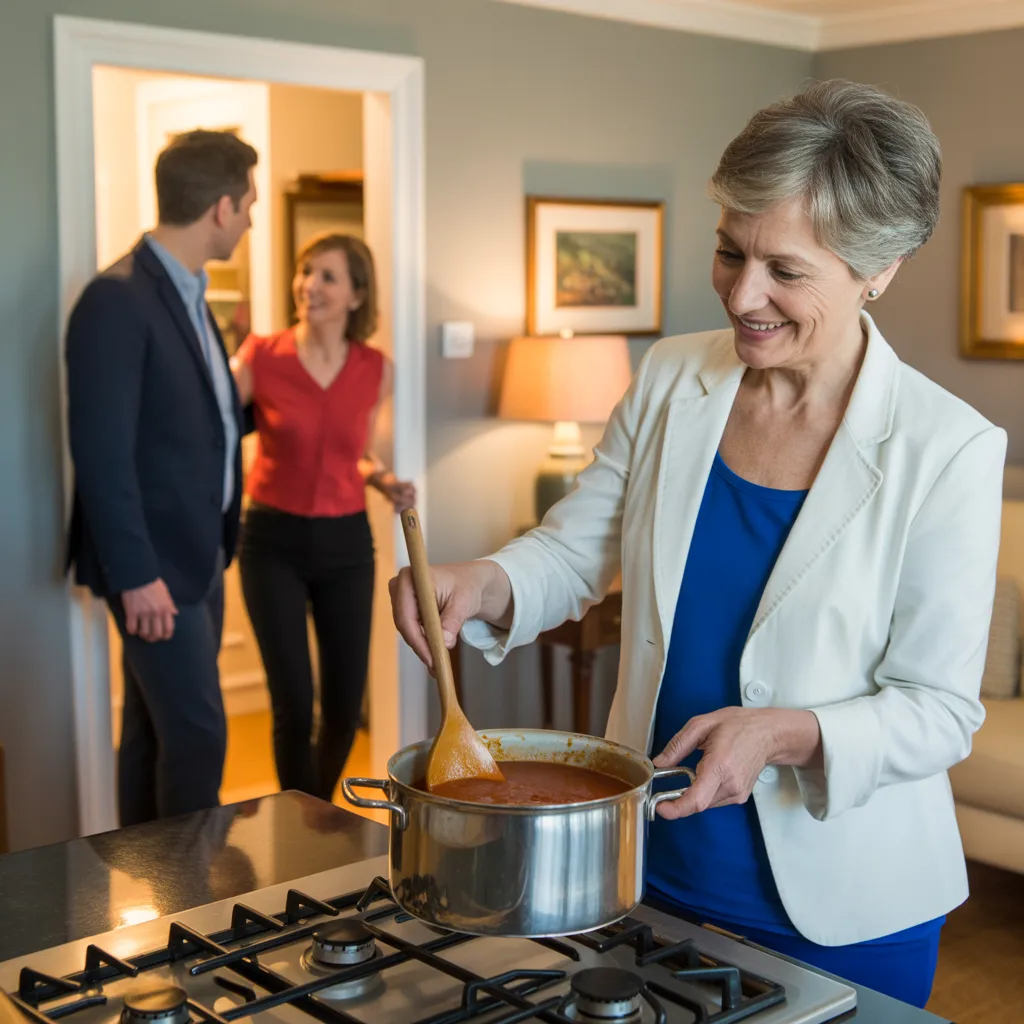
Three days later, on a Tuesday afternoon, I was in the kitchen making soup when I heard the front door open without a knock, without a doorbell, without any of the small courtesies that separate a visit from an intrusion. They had a key. I had given Natalie a copy years ago, during a time when I still believed she would use it to check on me, to bring groceries, to sit in the living room and talk the way we used to.
She used it now the way you use a tool, efficiently and without sentiment. “Mom!” she called from the living room. “We need to talk to you.”
I dried my hands on my apron and walked out.
Natalie was standing in the middle of the room with her arms crossed, scanning the furniture and the walls with the appraising look of someone walking through an open house. Adrien was already on the sofa, his legs stretched out, his shoes on my coffee table. That table was a gift from my husband.
He had found it at an estate sale the year before he got sick, refinished it himself in the garage over a weekend, and presented it to me on our anniversary with a ribbon tied around one leg. It was not worth much by anyone else’s standards, but I had polished it every week for fifteen years, and the sight of Adrien’s dirty shoes resting on its surface made something tighten in my chest. “Take your feet off that table,” I said.
He smiled but didn’t move. “Relax, Eleanor. It’s just furniture.”
Natalie sat beside him and got to the point.
“Mom, we found out your pension was approved. Three thousand a month, right? That’s a lot for one person.”
There it was.
The real reason for the visit, arriving without pretense, without even the thin courtesy of asking how I was feeling or whether I had eaten lunch. I sat in the chair across from them, keeping my back straight, my hands folded in my lap. Sometimes silence is the most informative thing you can offer a person, because it gives them room to show you exactly who they are.
Adrien leaned forward. “Here’s the thing, Eleanor. You’ve got the house paid off, your expenses are minimal, you don’t travel, you don’t have hobbies that cost anything.
Meanwhile, we have plans. We have a business opportunity. We need capital.
So what makes sense, what’s fair, is for you to give us fifteen hundred a month. Half. You keep the other half for your little expenses, and everybody wins.”
I looked at him.