
Behind that, signed testimonies from my neighbors. And at the back, the new will. Adrien dropped the binder on the table as if it had burned him.
“This can’t be legal. You can’t do this.”
“Everything in that binder has been reviewed by attorneys, notarized, and legally registered,” I said. “It is already done.”
Natalie stared at the will, at the line that read one thousand dollars, at the charitable organizations listed where her name should have been.
Her voice broke when she spoke. “You’re disinheriting me. I’m your daughter.
Your only daughter.”
“And you treated me like a cash register,” I said. I was surprised by how steady my voice was, how calm. The years of silence had not made me weak.
They had made me patient, and patience, it turned out, was its own kind of strength. “You came into my house and discussed selling it while I was sitting right here. You threatened to have me declared incompetent.
You told me to my face that you were waiting for me to die. What did you expect me to do?”
Adrien tried one last approach. His face softened into something meant to resemble concern.
“Look, Eleanor, I think we’re all a little upset. Why don’t we calm down and talk like adults?”
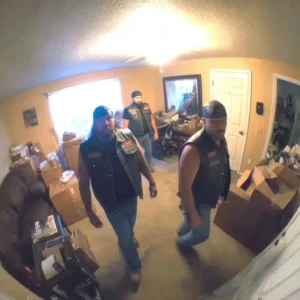
I pointed to the corners of the room where the cameras were installed. “Every word you’ve said today has been recorded.
Every threat, every insult, every attempt at intimidation. If you want to take this to court, I will be glad to submit the footage.”
Natalie followed my gaze and saw the cameras for the first time. Her expression went from anger to something close to vertigo, the look of a person who has just realized the ground beneath them is not where they thought it was.
“There’s a notice by the front door,” I told her. “You never read it because you never pay attention to anything in this house that doesn’t have a price tag.”
I held out my hand. “I want the key back.
Now.”
Natalie dug through her purse, pulled out the key, and threw it onto the table so hard it bounced and clattered to the floor. I bent slowly, picked it up, and held it in my palm. Such a small thing.
Such a small piece of metal to carry so much meaning. “Now leave,” I said. “And don’t come back unless you’re prepared to treat me like a human being.”
Natalie stood in the middle of my living room, shaking.
“You’re going to regret this. When you’re old and sick and alone, you’re going to remember this moment.”
“It’s not the money I’m choosing,” I told her. “It’s dignity.”
The door slammed behind them.
I stood in the silence and listened to their car pull away, and then I sat down and let my legs finally stop holding me up. Sarah appeared at the back door minutes later. She had been waiting, ready.
She found me sitting in the dim living room with tears on my cheeks, and she sat beside me and took my hand without saying anything, because sometimes the best thing a friend can do is simply be present while you absorb the weight of what you’ve done. “How do you feel?” she asked after a while. “Free,” I said.
“And terrified.”
Both things were true, and they would remain true for a long time. What followed was ugly. Natalie launched a campaign that was equal parts desperate and methodical.
She called neighbors and told them I had become cruel and controlling, that I had mistreated her for years and was now using my money to punish her. She posted on social media, using an old photograph of me looking tired and gaunt, writing a long narrative about a greedy mother who had abandoned her loving daughter. People I had never met left comments expressing sympathy for Natalie and contempt for me.
Acquaintances at the grocery store began avoiding my eyes. There were whispers when I passed. Adrien started appearing in places where I went, the pharmacy, the supermarket, the church.
He never approached directly, but he made sure I saw him. One afternoon he was leaning against my car when I came out of Sarah’s house. He blocked my path and told me Natalie was suffering, that she cried every night, that I was destroying my own daughter.
I took out my phone and began recording. He raised his hands and walked away, but his parting words were clear enough. “This is going to end badly for you, Eleanor.
Very badly.”
They filed a complaint with adult protective services, alleging I lived in unsanitary conditions and was a danger to myself. Two social workers appeared at my door. They walked through every room, inspected every surface, checked my refrigerator and my medicine cabinet.
The house was spotless, as it always was. The case was closed as unfounded within the hour. Then they sued me.
The filing alleged mental incompetence, manipulation by third parties, and outstanding debts for care they claimed to have provided for years. Katherine read the complaint with the expression of a woman who had been expecting exactly this letter on exactly this day. “This is what we prepared for,” she said.
“They have no evidence because none of it is true. We have everything.”
The night before the hearing, Natalie called from an unknown number. Her voice was different, younger, stripped of its usual hardness, and for a moment she sounded like the girl who used to hold my hand on the walk to the bakery.
“Mom, please. We can fix this. It doesn’t have to go to court.”
“You took me to court first,” I said.
“I’m only defending myself.”
There was a long pause. When she spoke again, the softness was gone. “Fine.
See you there.”
The courtroom was small and overlit. Sarah and four neighbors sat behind me. Katherine had her binder open on the table, organized with tabs and color coded labels, every document in its place.
Across the aisle, Natalie sat with her hands in her lap, staring at the surface of the table. Adrien sat beside her, his jaw tight, his leg bouncing. Their lawyer went first, presenting the allegations with the forced confidence of a man building a house on sand.
Katherine went second. She was methodical and unhurried. She played the audio recordings.
She presented the loan records. She submitted the medical evaluations, the neighbor testimonies, the surveillance footage. She laid out the timeline of harassment, the social media posts, the protective services complaint, the parking lot confrontation.
Each piece of evidence landed like a stone dropped into still water, and with each one I watched Natalie sink lower in her chair. The judge reviewed the materials for what felt like a very long time. Then he looked up.
“The allegations of mental incompetence against Mrs. Carter are completely unfounded,” he said. “The medical evaluations are recent, thorough, and conclusive.
The evidence presented by the defense demonstrates a clear pattern of financial manipulation and emotional coercion by the plaintiffs.”
He paused and let the silence hold. “I am dismissing this lawsuit in its entirety and ordering the plaintiffs to cover all legal costs. I am also issuing a temporary restraining order.
The plaintiffs may not approach within one hundred yards of Mrs. Carter’s residence or make contact with her in any form for the next six months.”
Natalie stood up. “She’s my mother.
You can’t forbid me from seeing my own mother.”
The judge looked at her evenly. “You forfeited a healthy relationship with your mother when you chose to view her only as a source of income. If you wish to restore that relationship in the future, you will need to demonstrate a genuine change.
Case closed.”
The gavel came down, and the sound filled the room like the period at the end of a very long sentence. In the months that followed, the news arrived in fragments, through Sarah, through neighbors, through the quiet channels of a small community where nothing stays hidden for long. The business Natalie and Adrien had planned to start never materialized, because it had never been real, because it had only ever been a justification wrapped around a demand.
Adrien lost his job. The new car was repossessed. They moved from their apartment to something smaller and cheaper, in a neighborhood where nobody knew them.
Natalie’s social media posts, which had once projected a life of aspiration and comfort, thinned out and eventually stopped altogether. I heard that Adrien took a construction job, the kind of work he had always considered beneath him. Natalie got hired as a cashier at a supermarket across town.