
“Because Richard showed up at my office again.
This time he didn’t come alone.”
I sat up straighter. “With who?”
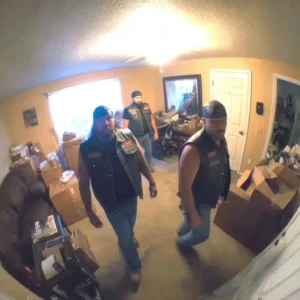
“An ugly-looking piece of intimidation,” she said. “A large man with a face that suggested poor judgment and worse company.
They wanted to know where you were.”
“What did you tell them?”
“That if anyone so much as touched you, me, or anybody connected to you, I’d devote the rest of my very energetic legal career to putting them where they belonged.”
She paused. “Diane, this is turning serious.”
I looked out at the dark water. “I know.”
The next morning there was a knock at my door, loud enough to make my heart jump.
I looked through the peephole expecting Richard or someone worse. Instead, I found a woman in plain clothes with a badge. “Are you Diane Miller?” she asked.
“Yes.”
“I’m Detective Olivia Hart. We need to talk about your son.”
I let her in and made coffee because some habits remain even when the world tilts. She sat on the sofa and spoke with calm precision.
“Mrs. Miller, your son is under investigation for financial fraud, falsified documents, and connections to a predatory lending network. We need to know whether you were aware of any of this.”
For a moment, it felt as though the room had become unsteady under me.
A part of me had always suspected that Richard’s success contained shadows he never explained properly. But suspicion and confirmation are different countries. “I knew he was in financial trouble,” I said.
“I didn’t know the rest.”
She asked why I had left home two months earlier. I told her everything: the loans, the manipulation, the pressure over the three hundred thousand dollars, the note, the flight, the fear. Then she asked, “Did he ever have you sign anything you didn’t fully understand?”
I thought back through years of forms and explanations given too quickly.
“Yes,” I said slowly. “He had me sign papers once, years ago. He said it would help him move funds in an emergency and protect me in old age.”
Olivia nodded grimly.
“We found suspicious transactions under accounts tied to your identity. Accounts you may not have known existed.”
I closed my eyes. Richard had not only manipulated me.
He had used me. After she left, I called Marissa. She booked a flight down the same day.
That afternoon, I received a text from Fernanda. He found out about our plan. I’m in the bedroom with the kids.
He’s breaking things. I called Olivia immediately. She sent officers to Richard’s house.
The next hours stretched long and ugly with waiting. By nightfall, I learned that Fernanda and the children were safe and Richard had been arrested after resisting police intervention. When Marissa arrived that night, she found me on the balcony staring into the dark.
“How do you feel?” she asked. “Guilty.”
She sat beside me. “If I hadn’t left, maybe things would be different.”
“No,” she said.
“If you hadn’t left, he would have taken you down with him. Maybe Fernanda and the kids too. You did what you had to do.”
The next morning, his picture was on the local news and then in the paper: businessman arrested in fraud case, broader criminal links under review.
He looked unfamiliar in that photograph, led away in handcuffs, stripped of the polished confidence he wore like a second skin. Later that day, Olivia called. “Your son wants to see you.
He says he’ll only talk to you.”
Marissa shook her head before I even responded. “You don’t owe him that.”
But I went anyway. The visitation room at the police station was too cold.
Fluorescent lights flattened everything, even regret. When Richard was brought in, he looked smaller than I remembered, as if the removal of status had altered his very frame. “Mom,” he said, and for the first time in years he sounded young.
I sat across from him and kept my hands in my lap. “You asked to see me.”
“I’m in serious trouble.”
“You don’t understand,” he said quickly. “Those people aren’t bluffing.”
“No,” I said, more calmly than I felt.
“You’re the one who doesn’t understand. I didn’t come here to give you money. That part is over.”
His expression changed at once, tenderness burning off like fog in harsh sun.
“You left me when I needed you most. You abandoned your family.”
“No,” I said. “I stopped helping you destroy yourself.”
He leaned forward.
“The house is still in my name. You have nothing.”
I stood. “I still have myself.
I almost lost that. I won’t lose it again.”
At the door I turned back once. “Fernanda and the children are safe.
They’ll have a chance to start over. So will I.”
When I walked back outside into the hard brightness of the Florida sun, I felt something lift from my shoulders. Not grief.
Not love. Something older than both. “Freedom,” I told Marissa when I got into the car.
Six months passed. Winter reached Florida softly, not with snow but with restless sea winds and gentler mornings. My apartment became a home.
Potted herbs lined the balcony. Embroidery hoops hung over the sofa. I taught myself to use video calls well enough to speak with my grandchildren every week.
Fernanda relocated to a quiet inland town near her parents. The children adapted more quickly than adults ever do. Lucas wanted to know when he could visit the beach.
Mariana asked whether the shells on my balcony came from the same ocean she saw on video. After one call, I sat listening to the surf and thinking how strange it was that peace could arrive so plainly. Then Richard’s lawyer called.
He had changed attorneys again. This one introduced himself in a voice too smooth for the message he carried. “Mrs.
Miller, your son is willing to cooperate with prosecutors, but he needs adequate representation to do so effectively.”
“How much?” I asked. A tiny pause. “Two hundred thousand dollars.”
I laughed.
“No.”
“Your son could face over a decade in prison.”
“As a mother,” I said, cutting in, “I have already done enough.”
The lawyer lowered his voice. “He wanted me to tell you he still has copies of documents you once signed. Documents that may draw you into his legal difficulties.”
For a second my stomach twisted.
Then something steadier took over. “Tell my son,” I said, “that extortion is not a strong rehabilitation strategy. I’m prepared to face whatever comes if it means ending this.”
I hung up and called Marissa.
“He’s bluffing,” she said. “The investigators already determined those signatures were obtained through coercion and concealment. His pattern is documented.”
I wanted to believe her completely.
Mostly, I did. But that night sleep came hard. The following morning, Olivia arrived with another officer.
“There’s been a new development. Richard tried to bribe a guard to smuggle a phone into his cell. The guard was already cooperating with an internal investigation.”
At the station, Olivia showed me the transcript of the call Richard had intended to make.
My mother has money put away. If I can’t pay, you know where to find her. The room seemed to narrow.
My son had been willing to put my safety in the path of men he owed, all to save himself. Back at my apartment, Marissa was waiting. “I can find you a place with security,” she said immediately.
“A gated building. Guards. Cameras.”
I looked around my apartment: the curtains I had sewn myself, the basil on the windowsill, the patch of Gulf blue visible from the living room, the small life I had built board by board and stitch by stitch.
“No,” I said. She frowned. “Diane—”
“I’m not running again.
I’ll be careful. I’ll do whatever Olivia says. But I’m not giving up the first home I ever chose for myself.”
In the days that followed, extra patrols were arranged.
New locks were installed. Cameras went up. Motion sensors blinked discreetly at night.
A week later, I received a court summons. Richard’s trial date had been set. The courthouse felt huge and impersonal when Marissa drove me there.
The prosecutor, a sharp-eyed woman in her fifties, shook my hand and told me my testimony mattered. “He’s trying to portray himself as manipulated and financially overwhelmed,” she said. “He’s always been talented at looking like the victim,” I replied.
When Richard entered under escort, he looked gaunt. Hollowed. He met my eyes with something close to pleading, but I held steady.
When my name was called, I walked to the witness stand on shaking legs. The prosecutor asked me to describe my relationship with the defendant. I looked directly at Richard.