He died doing it. For years I had been carrying grief. The ordinary devastating grief of losing the person who was supposed to be beside me for the rest of my life, the grief of watching my daughter grow up without her father, the grief that has no clean edges and no particular end.
Now something else moved in beside the grief. Not replacing it. Taking up its own space.
Grace had been listening without speaking. She said quietly, “Did they lie about Dad?”
I looked at her. “Not about him.
What they said about him was true.”
“Then about what?”
Ruiz answered. “About how complete the story they told was.”
Grace looked slightly sick. “So he died because someone above him made a bad call and then they told us a story that left that part out.”
Ruiz was silent long enough that the silence itself became the answer.
I spent the next few months asking questions. Not days. Months.
It took that long because the answers came in fragments and some of them were redacted and some offices responded once and then went quiet and some of what I needed I had to piece together from the overlapping corners of documents that didn’t quite line up with each other. Ruiz helped me where he was able to within the constraints of still being in uniform, which meant he helped more than he probably should have and less than I needed, but I was grateful for every bit of it. What I eventually assembled was not a complete picture.
I am not sure a complete picture exists anywhere in a form I will ever access. But what I had was enough to understand the shape of what had happened. Daniel had raised concerns and been overruled.
The men who overruled him had written a version of events afterward that honored the sacrifice without examining the decision that had made the sacrifice necessary. Later that spring, during the school’s annual service recognition event, the principal asked if I wanted to say a few words. I almost said no.
I had prepared remarks that were safe and brief and appropriate for a school auditorium. I had them folded in my jacket pocket. I had planned to say something measured about gratitude and service and being thankful for the school’s efforts to honor military families.
Then I walked to the front of the room and I saw Grace sitting in the front row with her father’s dog tags under her blouse, the chain just barely visible at her collarbone, and I took the folded paper out of my pocket and put it down on the podium without opening it. I stepped to the microphone and I said, “My husband was a hero. I am not using that word as ceremony.
I mean it as a plain factual statement about the kind of man he was and the choices he made. I am grateful that the people in this room are finally saying that out loud in front of my daughter, because she needed to hear it from more voices than just mine.”
I paused. “But I have learned something in the months since Captain Ruiz brought us Daniel’s file.
Heroism and institutional failure can exist in the same story. They are not opposites. They are not mutually exclusive.
The people on the ground can do everything right and still be failed by the decisions made by the people above them. Both of those things can be true about the same event.”
The room was completely still. “For years my family was given a version of my husband’s death that was accurate but incomplete.
The honor was real. The sacrifice was real. The courage was real.
But the decisions that put him in that position, and the questions that were raised before that mission went forward, and the concerns that were noted and set aside, that part of the story was left out. He deserves the full truth. So do the families of every person we ask to put on a uniform and go somewhere dangerous on behalf of the rest of us.
Honoring the fallen does not mean sanding the story down until it is easier for institutions to manage. Respect is not the same thing as simplification.”
My voice shook. I didn’t try to stop it.
“He was brave. He was funny. He burned pancakes and tried again.
He sang off-key in the car and didn’t care who heard. He loved his daughter more than he knew how to say and he said it anyway, constantly, in every letter home. If we are going to remember him, then we remember all of him.
Not just the parts that don’t implicate anyone.”
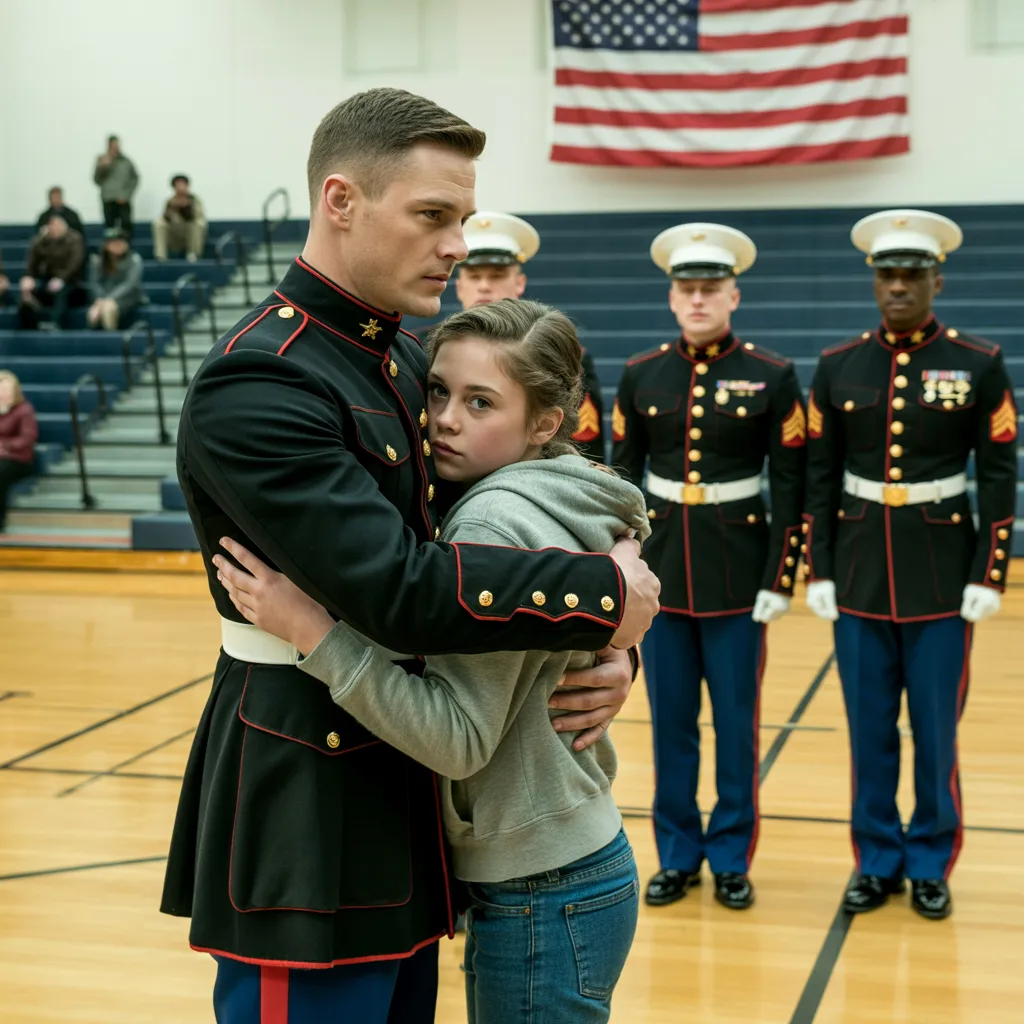
When I stepped back from the microphone there was a moment of absolute silence. Then Ruiz stood up from his chair and came to attention and saluted. Another Marine in the back of the room did the same.
Then a veteran in civilian clothes near the bleachers rose to his feet. After that, a local reporter called. Then a journalist from a larger paper.
Then two other families from Daniel’s unit contacted me, families I had not previously known, who said they had been carrying similar questions for similar years and had not known how to start asking them out loud. The school quietly removed Grace’s detention from her record. By that point it mattered considerably less than I had expected it to.
What mattered was what happened at home. Grace started asking different questions. Not how he died.
Not the tactical details or the administrative failures or the sequence of events on that particular day. Different questions entirely. How he laughed.
What he ordered at restaurants and whether he always ordered the same thing. Whether he was a fast driver or a slow one. What music he listened to when nobody was telling him what to play.
Whether he was ever frightened and what he did when he was. I told her everything I could remember. That he burned the same pancake recipe every Saturday morning for six years and kept a running tally of the ones that came out right versus the ones that had to be quietly disposed of and considered the bad ones character-building.
That he sang loud and off-key and treated it as a personal victory that he had never once been asked to stop. That he cried the first morning we brought Grace home from the hospital and spent the next two days insisting firmly to anyone who asked that he had not cried, while visibly emotional about it. That he got written reprimands for arguing with people who outranked him when he thought they were wrong about something that mattered, and he accepted the reprimands without apology because he thought the argument had been worth having.
That the last letter he sent before the mission described a night where a younger Marine in his unit had been homesick and Daniel had sat up with him for two hours talking about nothing in particular until the kid could sleep. That he was exactly the father Grace needed and she would keep finding that out in new ways for the rest of her life. One night Grace took the medal out of its box and pinned it carefully on the wall beside an old photograph of Daniel holding her as a toddler.
She stood in front of it for a long time. Then she said, “I think I know him better now than I did before all of this started.”
I stood beside her and looked at the man I loved, frozen young in a photograph, our daughter in his arms, both of them looking at the camera with the same expression, bright and a little startled, like they had just discovered something wonderful. “So do I,” I said.
That is where we are now. Not fixed. Not clean.
Not at the end of anything, because grief and love and the pursuit of a truth that keeps having more layers to it do not end tidily on a particular date. But clearer. And less alone in it.
My daughter is not carrying her father’s memory by herself anymore. She knows who he was, the real full version, the one with the pancakes and the off-key singing and the formal reprimands and the two hours he gave to a homesick kid because it was the right thing to do. She knows the kind of man who looked at a situation that was being mishandled and said so, even when it cost him, because he thought the people depending on him deserved better than silence.