It was Lorraine who taught me about the signature. One afternoon she brought up a bolt of ivory charmeuse and laid it on my cutting table like it was a patient. She watched me run my hand across it, then said, “Every bridal designer worth a damn leaves a mark.
Inside the corset, along the boning channel. Thread color that matches the lining, so nobody sees it unless they are looking. The ones who don’t sign their work get forgotten.
The ones who do, the dress remembers, even if the bride doesn’t.”
I started signing my pieces after that. A tiny monogram in silver thread, T.R., tucked inside the corset along the left boning channel. No one had ever found one.
No one had ever looked. Three months before the wedding, Whitney had called. Not FaceTime, not a text.
An actual phone call, which meant she wanted something that required vocal manipulation. “Drew proposed,” she said, like it was a weather report. “And I need a dress.”
Whitney had met Drew Hargrove at a charity gala in Beaufort.
The Hargroves owned a midsize logistics company, the kind of family that wintered in Sea Island and used summer as a verb. Whitney had been working as a marketing coordinator. Fine work, steady pay, nothing that would impress people who summer anywhere.
But Drew loved her, or loved the version of her that showed up at galas. The dress was supposed to be simple. It became, as custom dresses always do, everything.
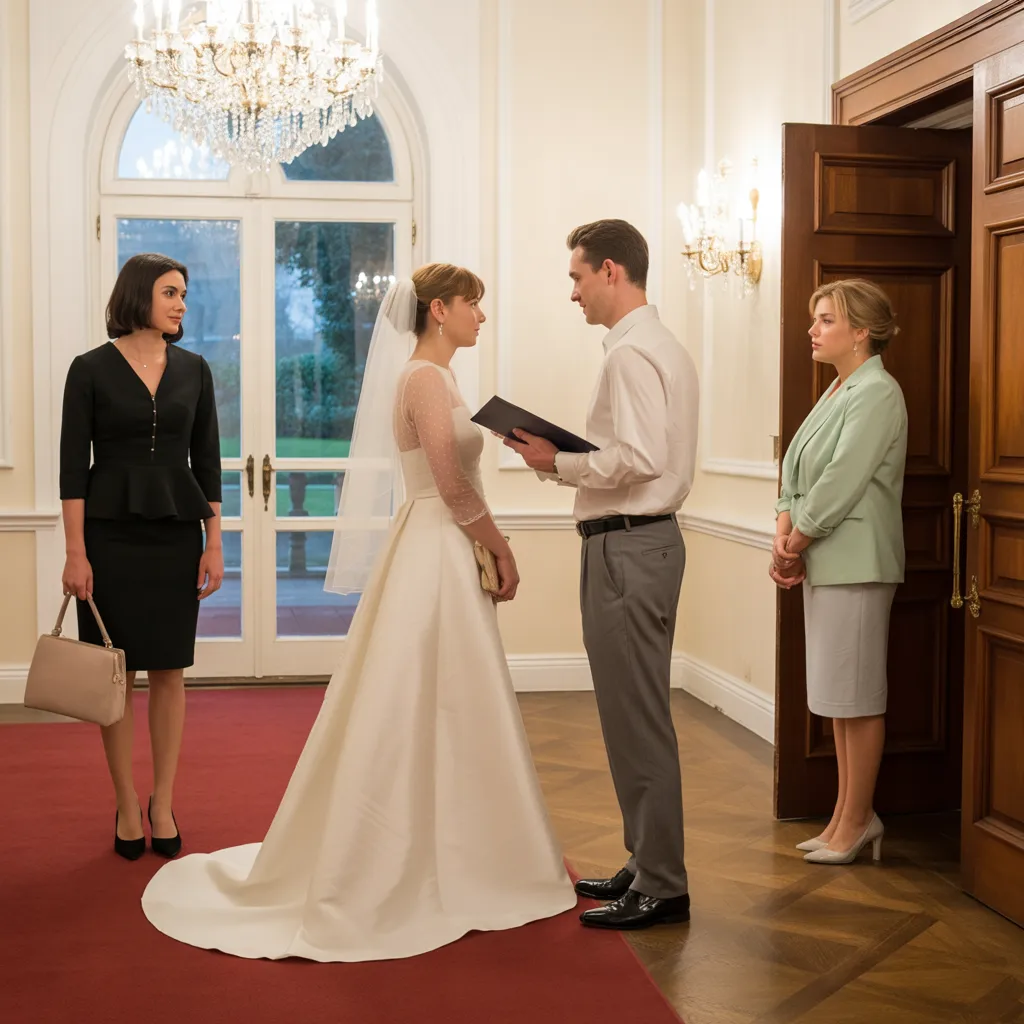
French Alençon lace bodice, hand-beaded with seed pearls. Silk charmeuse skirt cut on the bias so it would pour instead of hang. A cathedral train that needed its own zip code.
The real price was eighteen thousand four hundred dollars. Whitney’s price was zero, because Diane said this is what family does, Tessa, and I said yes because the dress was my last try. I did not say that out loud.
But I said it to myself in the mirror above my cutting table at one in the morning, pinning lace to the bodice form with hands that shook a little, not from exhaustion but from something closer to prayer. If I made this dress beautiful enough, if the lace fell right and the beading caught the light and Whitney looked the way she was supposed to look, maybe Diane would see it. Not the dress.
Me. Maybe she would look at the dress and, for once, trace the line backward from the beauty to the hands. She didn’t.
What she did was help Whitney lie. I finished the dress on a Tuesday at two in the morning. I held it up under the fluorescent light of my studio and it was the most beautiful thing I had ever made for the most ungrateful people I had ever known.
The studio was dark when I got back from the wedding parking lot. I turned on the light and it buzzed and stammered, the way it had been doing for two weeks. I kept forgetting to replace it.
The way you keep forgetting things that only matter to you. The mannequin stood bare in the corner where the dress used to hang. Headless, armless, the color of old cream.
I had bought it secondhand from a bridal shop that went under during COVID, and its left shoulder sat slightly higher than the right, which meant everything I draped on it pulled a quarter inch to the east. I had adjusted for that tilt so many times I sometimes adjusted for it in dresses on different mannequins. Habit is a strange kind of loyalty.
I sat at the cutting table and opened my phone. The group chat had twenty-three new messages, photos mostly. Whitney in front of the altar, Whitney and Drew, Whitney and Diane cheek to cheek holding champagne.
The dress moved through every photo like a living thing. The train fanned across stone tile, the bodice caught afternoon light through stained glass, the skirt swayed with a weight that only real charmeuse has. No one in the chat mentioned the designer.
No one mentioned me. There were forty-seven emoji reactions and not one had my name next to it. I had been erased so completely it looked effortless.
I set the phone face down and pressed my palm flat against the bolt of ivory charmeuse Lorraine had left for me that week. The fabric was cool and impossibly smooth. I held my hand there and the coolness traveled up through my wrist and into the part of my chest that had gone flat in the parking lot, and for a moment the two temperatures matched, and that was almost worse than crying.
A knock at the studio door. I hadn’t locked it, which was either careless or hopeful. Lorraine came in carrying two cups of coffee.
She set one in front of me without asking. She looked at the bare mannequin, then at me. “So,” she said.
“They wore it.”
“They wore it. And they told the man at the door I wasn’t good enough to watch.”
She sat down across from me and looked at me over the rims of her glasses, the look she reserved for bad hemlines and worse decisions. “When are you going to send the invoice?” she said.
“It was free, Lorraine. Family rate.”
“Nothing is free, baby. You just haven’t counted the cost yet.”
She looked at the wall behind me where I had framed my business license next to a photo of my first commission.
Below it, on a shelf, sat the stack of letterhead I had designed myself. Tessa Ror Atelier, clean serif type, a single needle trailing a curved thread. Five hundred sheets printed two years ago.
Maybe thirty used, all for strangers, never for family. “You know what the difference is between a seamstress and a designer?” she said. I waited.
“A seamstress takes orders. A designer names her price.”
She finished her coffee, stood up, and left. The door clicked behind her.
I pulled the letterhead toward me and looked at my own name for a long time. I did not send the invoice that night. First I needed to do the actual math, not the emotional kind I had been running for twenty-nine years where the answer was always the same: deficit.
I mean the dollars and hours, the labor and materials, the number I would quote a stranger who walked through the door. Consultation fees, materials itemized to the last pearl, labor at ninety-two days and an average of nine hours per day at my standard rate for custom bridal work. What I would charge any stranger who walked through the door.
Grand total: $18,400. I stared at the number. It looked enormous and completely fair at the same time.
Like seeing your own reflection after a long absence and thinking, oh. That is what I look like. I opened my invoicing software and started typing.
Tessa Ror Atelier. Logo, single needle, curved thread. Addressed to Whitney Ror Hargrove.
Itemized: consultation, materials, labor. Total due: $18,400. Payment terms: Net 30.
I CC’d Diane. Not because she owed the money, but because she owed the acknowledgment. She had orchestrated the free labor.
She had stood at the door and smiled. She should see what free looks like when it comes with a number attached. Lorraine stopped by around four the next afternoon.
She stood behind me and looked at the laptop screen. She put her hand on my shoulder and squeezed once. “Now you’re a designer,” she said.
I hit send at 9:47 on a Monday morning. By 9:52, my phone was ringing. Diane Ror does not yell.
I want to clarify that because people assume that a certain kind of mother is a screamer, that there is a volume to the damage, something you can point to. Diane does not yell. She modulates.
She lowers her voice to a register that makes you lean in, and once you are leaning in, you have already conceded something. “What do you think you’re doing?” she said. Not a question.
A deposition. “Billing for services rendered,” I said. I was standing at my cutting table with the phone on speaker, both hands pressed flat on the surface.
I had learned a long time ago that if my hands were occupied, my voice stayed steady. Empty hands made me vulnerable. “You made a dress for your sister’s wedding.”
“A gift that cost me ninety-two days and eighteen thousand dollars in labor and materials.”
“And your sister gave you the honor of dressing her on the most important day of her life.”
“She gave me the honor from a building I wasn’t allowed to enter.”
She exhaled.
The exhale. Then: “If you don’t withdraw this invoice, you are no longer part of this family.”