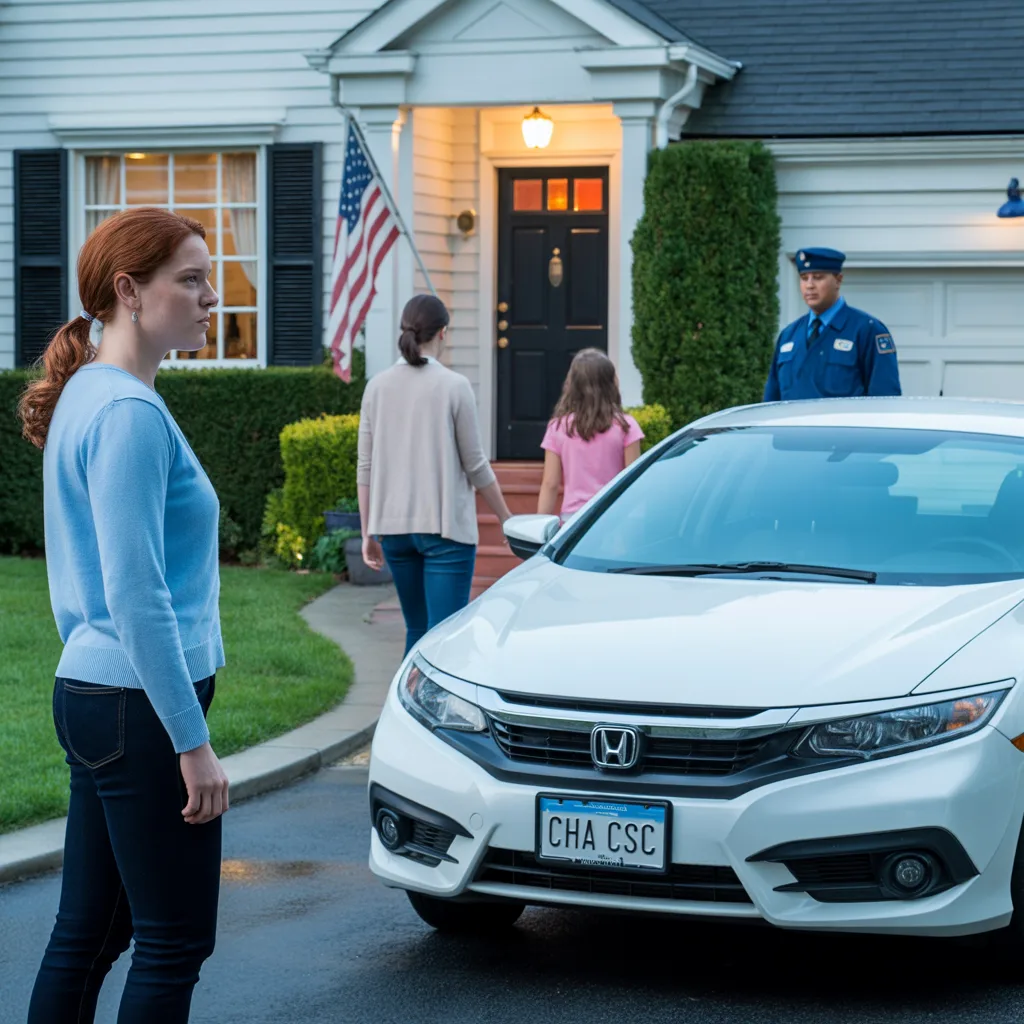
My mother had followed everyone outside still holding her mug, the white one with the chipped handle she used every evening. When the driver said my name her fingers had gone slack and the mug dropped and broke into three clean pieces and the coffee spread across the welcome mat and onto her shoes. She did not bend down.
She did not move. She stared at the 4Runner like it had fallen from the sky. My father was behind her.
His reaction was different. He looked at the truck, looked at Ruth, and laughed. Not loudly and not cruelly, just a short quiet sound from somewhere deep, the laugh of a man watching someone do the thing he had been too afraid to do himself for eighteen years.
Paige came out last, phone half-raised, her eyes moving from the 4Runner to her Civic parked on the other side of the driveway. Back to the 4Runner. The size difference alone told the story.
She lowered her phone without taking a picture and did not say anything and swallowed once. Aunt Brenda gripped Glenn’s arm. Ruth, you didn’t.
Mrs. Whitfield, holding her purse with both hands, said quietly and clearly: about time. Uncle Glenn stood behind Grandma Ruth with his arms crossed and the grin of a man who has kept a very good secret for a long time and is now watching it arrive in a blue Toyota in his sister’s driveway.
I looked down at the tag tied with twine. Grandma’s handwriting, small careful letters. You were always worth it.
Grandma. It took my mother about forty-five seconds to complete the transition from shock to damage control. I had watched this transition many times.
The spine straightening, the chin lifting, the voice finding the register between indignation and authority that usually brought the house in line. She stepped forward over the broken cup. Mother, this is too much.
You cannot buy my daughter a car without consulting me. She is eighteen, Ruth said. The title is in her name.
That stopped my mother mid-sentence. The language landed the way Ruth had intended it to land. Title.
Name. Legal. The language of things that cannot be undone by a phone call or a guilt trip or a Sunday dinner conversation framed as concern.
You cannot just, Mom started. I can and I did, Ruth said. Her voice was level and without drama.
The same way she sold houses for thirty years and closed deals that other people said were impossible. The same way you say a thing when you have done your planning and your paperwork and the conversation is actually over before it begins. The same way you bought Paige a car without asking me.
The porch went quiet. Even the Whitfields’ dog had stopped. Mom turned to my father.
Keith. Say something. And Keith Foresight, the man who had said almost nothing meaningful in two years of watching his daughter ride the Route 7 bus in the dark at 5:45 in the morning, looked at his wife and then at his mother-in-law and then at me and said three words.
She is right. It was not loud. It was not dramatic.
But it arrived in the room the way certain small things arrive, with the weight of everything they have been waiting to say. My mother looked around the porch. Glenn.
Brenda. Tom. Mrs.
Whitfield. Not a single face was positioned on her side. She bent down, picked up the three pieces of her broken mug one by one, very carefully, and walked inside.
The screen door closed behind her with a soft click that sounded like the end of something. The tow-truck driver lowered the 4Runner off the flatbed with a hydraulic whine that echoed down Maple Hill. Neighbors across the road had come out onto their porches to watch.
Glenn guided the truck into the open spot beside Paige’s Civic, which suddenly looked as though it belonged to a different conversation entirely. When the tow truck pulled away I hugged Grandma Ruth. Not the quick hug of someone completing a social obligation.
I put my arms around her and held on and felt her hand pat my back twice, firm and steady, the way she did everything. You earned this by being who you are, she said close to my ear. Do not let anyone tell you different.
I pulled back. My eyes were wet but I was not crying, not exactly. It was more that my body was releasing things that had been compressed into a posture I had maintained for two years and could now, for the first time, set down.
Go sit in it, Glenn said. That is the rule. I opened the driver’s door.
The new-car smell hit me immediately, that clean chemical scent that means nobody has lived in this space yet. The leather seats were cool. The dashboard lit up in blue and white.
My hands found the steering wheel and my fingers were shaking. Not from fear. From the specific weight of being seen by someone after years of being invisible to the people who were supposed to see you first.
On the passenger seat, another envelope. Ruth’s handwriting on the front. Open at home.
I did not wait. Inside was the vehicle registration, completed, six months of insurance prepaid, and a small card with the name and address of Wallace and Pratt written in her careful script. Below it, one line.
Monday, 8:00 a.m. Do not be late. The next morning my mother was waiting in the kitchen at the table with her hands wrapped around a new mug.
She had replaced the broken one overnight, which told me something about how she processed loss. She had the look of someone who had been awake since five rehearsing a conversation. Your grandmother is overstepping, she said.
She is trying to make me look bad in front of the family. I poured my coffee, took my time with the cream, sat down. She is not making you look anything, I said.
She is doing what you did not. That was not fair. I think you believe that.
Her eyes went genuinely red. Not constructed. Real tears forming at the edges, which landed differently than I expected.
I had prepared for the manufactured version. The real thing was harder to sit across from. So what now?
she said. You hate me? No.
I love you. But I am keeping the car, and I am driving to my internship on Monday, and I am not going to apologize for Grandma seeing what you did not want anyone to see. She sat with that.
The kitchen clock ticked. The refrigerator hummed. Outside, Mr.
Whitfield started his lawn mower. My mother wiped her eyes with the back of her hand, put her mug in the sink, and said she needed some time. Take it, I said.
I am not going anywhere. She left the kitchen. I sat with my coffee and waited for my hands to stop shaking.
They took a while. My father found me in the garage an hour later, sitting on the workbench with no task in front of him for the first time I could remember. I should have said something a long time ago, he told me.
I leaned against the doorframe. Yeah, I said. You should have.
He started to explain and I told him I knew what he had been afraid of. Being quiet is not the same as being neutral, I said. It is picking a side, and you picked hers every time.
He did not argue. He did not deflect. He sat with it the way a person sits with something accurate.
You are right, he said. I am proud of you. I told him it was worth something, but it would have been worth more two years ago.
He nodded and swallowed and his jaw worked in the way it worked when he was pushing something down that would otherwise come out of his face. We stood in the garage in the cleared air of something finally said between two people who communicated best when their hands were occupied. Then he asked whether I needed help checking the tire pressure on the 4Runner, and I said yes, and we did that together in the afternoon light, and it was the longest useful conversation we had ever had.
Paige knocked on my door that night. Two soft taps, a pause, a third. The knock of someone who was not sure she was welcome.
I told her to come in. She sat on the edge of my bed in her cheerleading hoodie without makeup, which meant she was operating without armor. I did not know it was that bad, she said.