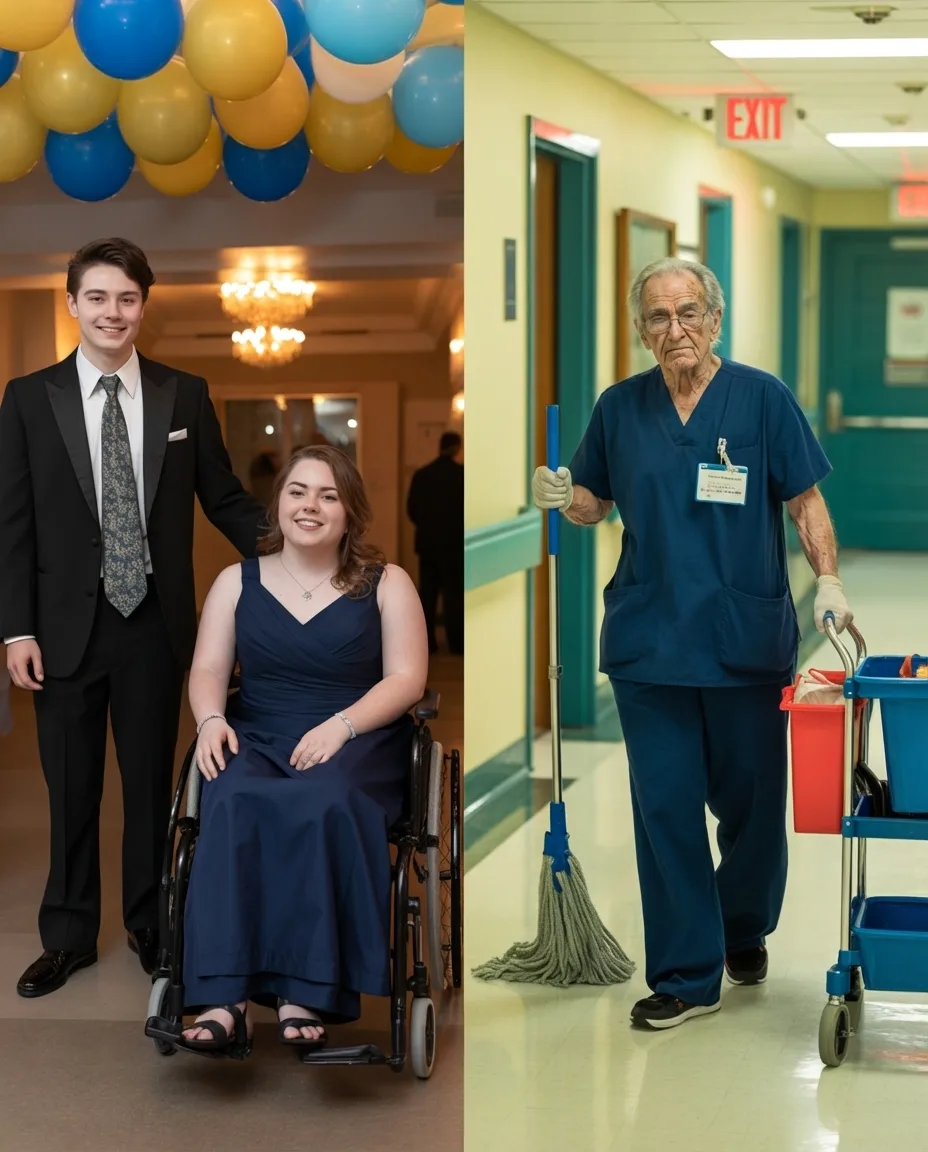
That was all. After graduation, Emily’s family relocated for the extended rehabilitation programs that the next two years would require. Whatever thread might have connected her to Marcus snapped with the distance the way these things do, and she assumed that was simply the ending of that story: one good moment, one song, a boy who was kind once at exactly the right time.
She filed it away as precisely that and tried not to add more to it than it was. She carried it anyway. The rehabilitation was long and honest and uncinematic.
She learned to transfer from the chair without assistance. She learned to walk short distances with braces and eventually longer ones without them. She learned, more slowly than any of the physical skills, that the people around her tended to conflate surviving with being finished, to mistake the absence of visible struggle for the end of interior work.
She was not finished. She would not be finished with the interior work for years more, and even then it would be ongoing rather than complete. She also developed, gradually and with real fury, a catalogued understanding of how badly most buildings failed the people inside them.
The ramp placed beside the loading dock entrance because it was easier than redesigning the front of the building. The accessible bathroom that technically met code and practically announced to anyone who needed it that their presence was an afterthought rather than an expectation. The doors and routes and entrances designed for legal compliance rather than human welcome.
She paid attention to every one of these failures with the detailed memory of someone who had no choice but to pay attention because her body required it. That fury turned out to be constructive. She studied architecture because she was angry, and anger is an underrated creative fuel when it has somewhere to go.
She worked through school taking drafting positions that no one else wanted, the kind of work that lands on the desk of the person with the least negotiating leverage. She fought her way into firms that found her ideas considerably more useful than they found her limp, which was a form of progress she recognized without celebrating. She spent years learning where the doors were in rooms that kept suggesting the doors were not her responsibility, and she catalogued every instance of this with the detailed, unglamorous memory of someone who had no choice but to pay attention.
The specific failures she documented: ramps positioned beside service entrances and loading docks because moving them to the front would have required redesigning a facade. Accessible bathrooms that technically cleared code minimums and practically communicated to anyone who needed them that their presence had been accounted for but not anticipated with any warmth. Elevator buttons placed at heights calibrated for the standing user, with the accessible controls added as obvious afterthoughts.
Entrance doors heavy enough to require genuine strength to open, attended by small brass plates that said push with a kind of performative helpfulness that did not help. She spent years cataloguing these things. Then she started her own firm, because she was tired of justifying to other people why the spaces human beings occupy should actually accommodate the full range of human beings who might need to use them.
By the time she was fifty, she had more financial stability than she had been able to imagine for herself at seventeen, a respected architectural practice, and a genuine reputation for designing public spaces that did not quietly exclude whole categories of people from the experience of full participation. Her work had been written about in terms she found slightly embarrassing and entirely beside the point. What mattered was that her buildings felt like welcome when you entered them.
That was the whole measure. She had also, in all that time, never entirely stopped thinking about one song at a high school prom. The coffee shop was close to a job site, which was why she had ducked in that particular Tuesday morning.
She misjudged the lid on a takeaway cup and the whole thing cascaded down her hand and across the counter in one committed disaster. A man in faded blue scrubs under a café apron looked over from the busing station across the room, picked up a mop, and came toward her. He had a pronounced limp in his left leg, permanent in the way that certain injuries become permanent when they are not rested when rest was required.
He cleaned the spill. Gathered napkins. Told the cashier to make her another coffee.
When she said she could pay for it herself, he waved that off and began counting coins from his apron pocket before the cashier intervened. That was when she stopped watching his hands and looked at his face. Older, clearly.
Life had put its years on him in the visible way it does when rest has been repeatedly postponed. Broader through the shoulders. A permanent tiredness behind the eyes that accumulates when sleep keeps getting treated as optional.
But the quality of attention in his face was the same, that direct, specific warmth that did not announce itself or look for acknowledgment. She went back the following afternoon. He was wiping tables near the windows.
When he reached hers, she said, as steadily as she could for a sentence she had been rehearsing for twenty-four hours, “Thirty years ago, you asked a girl in a wheelchair to dance at prom.”
His hand stopped on the table. He looked up slowly, and she watched the recognition arrive in pieces, assembling itself from the parts that time had not rearranged: her eyes first, then her voice, then the memory folding into place behind both. He sat down without asking permission.
“Emily,” he said. Her name sounded like something that had been somewhere specific all this time and had just found its way back. He shook his head, looking at her with the expression of a man who has been restless about a feeling he could not locate.
“I knew it. Last week, when you were in here. I knew there was something I couldn’t place.”
He told her what had happened to him in pieces and across several visits.
His mother had gotten sick that same summer, the kind of illness that rearranges everything, that turns temporary into indefinite and converts a future into a series of immediate crises with no clear end. His father was not in the picture, a fact he delivered without editorializing, in the tone of someone who has processed that particular absence into neutral territory. The college scholarships, the athletic prospects, the ordinary forward momentum of an eighteen-year-old with decent odds at a reasonable life, all of it stopped mattering in the specific way that things stop mattering when someone you love needs you to show up right now and right now keeps extending itself indefinitely.
“I kept thinking it was temporary,” he said. “A few months, maybe a year.”
He said it with a short, dry laugh that was not really amused. “And then?” she asked.
“And then I looked up and I was fifty.”
He had worked whatever jobs were available to a man without a degree in a city that rewards credentials and punishes their absence: warehouse shifts, delivery routes, care facility orderly work, building maintenance, the café. Whatever kept rent paid and his mother adequately cared for. Along the way he had wrecked his knee in a warehouse accident and kept working on it long past the point when rest might have made a difference, until the injury became a permanent condition rather than a setback that could be recovered from.
He had stopped counting the years since he had slept without pain the way you stop counting certain anniversaries because the number has ceased to carry any useful information. Over the following week she kept coming back, and he kept telling her more, measuring each disclosure carefully, checking her face afterward to see whether she was pulling away. She was not.
When she said, “Let me help,” he shut down with the speed of someone who had been on the receiving end of offers that arrived with strings attached. “No.”
“It doesn’t have to be—”
“That’s what people with money always say right before it’s charity.”
She changed approach. Her firm was halfway through designing an adaptive recreation center for the city.
They needed community consultants specifically, people who understood from the inside what it felt like to be athletic and injured and proud, people who knew what it meant when your body stopped responding the way you had built your identity around it, people who could speak to that experience without performing it for a professional audience. She asked Marcus if he would sit in on one planning meeting. Paid.
No obligations after that. Just one afternoon. He tried to refuse.