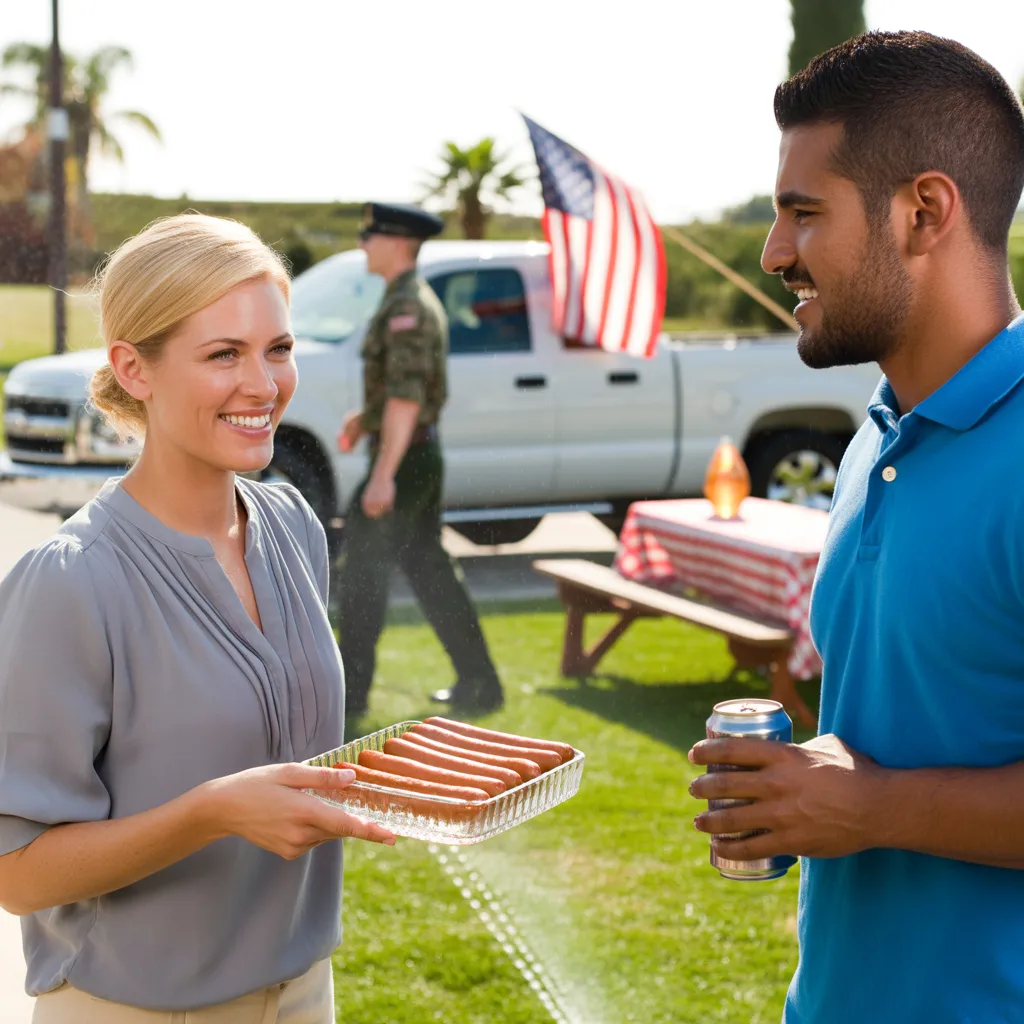
I did not need to. I nodded, the same slow nod my father would have given, the one that says I hear you, I see you, that is enough. Michael sat down on the porch step.
He put the beer on the ground and did not look up. The sprinkler hissed. The music played.
And for the first time in eighteen years, the silence in that backyard was not mine. It was his. I picked up the brisket dish from the patio table and walked to the rental car and sat in the passenger seat with the windows down and the engine off.
Derek came out five minutes later and got in and sat with both hands on the wheel. He said, you saved Brandon. Not a question.
A reckoning. I told him the short version. An intercept at 0300 hours.
A coded transmission on a frequency we had been tracking. A convoy rerouted. One vehicle already gone.
Eleven minutes. He asked why I had never told him. I said it was classified.
I said I did not know Brandon was in that convoy until tonight. Both things were true, and the combination of them produced in Derek the specific quality of grief that arrives when the story you believed about your own life turns out to be missing a piece that changes the meaning of everything else. He pulled the car to the shoulder of the highway twenty minutes into the drive and put his forehead on the steering wheel.
He said his father had been treating me like garbage for eighteen years and I had saved his son. The way he said it was not about fairness in the ordinary sense. It was the reckoning of a man confronting the distance between the world he had been living in and the world that had actually been there all along.
I put my hand on his back. There was nothing to say that would make it smaller or easier to hold, so I said nothing, and we sat there on the shoulder of the Arizona highway until Derek was ready to drive again. That night, after Derek fell asleep, I sat on the back porch of our hotel room and called my father.
He was eighty-one and living in a retirement community outside Lexington, his body failing in the various ways that bodies fail after decades of service, but his mind still sharp, his humor still intact, his capacity for the specific kind of conversation that requires no explanation or preamble still fully available to him. I did not tell him what had happened at the cookout. I asked him something I had never asked him before.
I asked: Did you ever get tired of people not knowing what you did? He was quiet for a long time. Then he said: Every day.
But I didn’t do it for them. I did it for the ones who came home. I leaned back in the chair and looked at the Arizona sky, which was wide and dark and full of stars that you cannot see in places where there are too many other lights competing.
I said, yeah. Me too. He said, go to bed, Chrissy.
I said, yes, Sergeant Major. He laughed, and I hung up, and sat for a while longer in the warm dark. The weeks that followed had the quality of an aftershock, the secondary trembling after the primary event.
The family group chat was active in the way of people processing something in real time, collectively and individually, the various voices all arriving at the same underlying question, which was how they had stood in that backyard for so many years while Michael dismissed me and had not said anything, and what that said about them. Megan texted to apologize. She said she should have said something years earlier and had been a coward.
I told her she had not been a coward. She had been surviving him. I understood what that meant.
Brandon texted Derek directly and said he had known for two years, since he pulled the declassified report, and had been afraid of what Michael would do with the information. He said it was on him that he had not spoken sooner. Michael was silent.
For a man who had spent his entire life being the loudest voice in every room he entered, the silence was its own communication. It meant he knew. Not just that he was wrong at the gate, but that he had been wrong for a long time, and that everyone had now witnessed it, and that the performance of authority he had been maintaining for decades had cracked in front of an audience he could not dismiss.
I told Derek, two weeks after the cookout, what I needed. I sat him down at our kitchen table the way my father used to sit me down when something required full attention, and I told him plainly that I was not going back to his father’s house until Michael apologized. Not a vague sorry about that.
A real acknowledgment of what he had done, not just at the gate but for the eighteen years before it. Derek did not argue. He said he would talk to his father.
I said: don’t fight him for me. Just tell him the truth. He can’t handle the truth.
That’s his problem. Derek drove to Tucson the following Saturday and found Michael in the garage doing what Michael did when he was avoiding something, which was work on his truck. He told his father I was not coming back until there was a real apology.
Michael said one thing from twenty years ago didn’t erase the fact that I thought I was better than his family. Derek told his father I had never said that. He told him that Michael had said it, every holiday, every dinner, every time he introduced me as Derek’s wife like I didn’t have a career or a rank or a name.
He said I was a lieutenant colonel, and that I outranked every veteran Michael had ever hired. Michael’s face went red. He said he had built the family and didn’t need an Army officer telling him how to run his house.
Derek said there was a difference between building and controlling, and he left. Linda called me in early October. She was always gentle, always trying to find the path that reduced damage, the woman who had spent forty years navigating a husband who believed his voice was the only one that mattered.
She asked if I could come for Thanksgiving just to keep the peace. I told her I loved her. I told her embarrassment was not an apology.
I told her Michael had stood at that gate and told me I was not family in front of everyone, and he needed to fix that in front of everyone. Michael told Linda that if Christina wanted to come to Thanksgiving, she could stop making a big deal out of nothing. Derek and I spent Thanksgiving in Kentucky with my father.
It was the right place to be. My father was weaker than the last time I had seen him, slower getting out of his chair, his breathing more effortful, more afternoons spent in his recliner with a blanket across his legs. But his mind was there, fully and precisely there, and on Thanksgiving morning we sat on his small patio overlooking the bare oak trees and the parking lot and he asked about Derek’s family.
I said it was complicated. He said family always is. I said this was a different kind of complicated, and I told him the broad shape of it, Michael at the gate, Brandon’s arrival, what Brandon said, what changed in the yard.
My father listened without interrupting, which was always how he listened to things that mattered. When I finished he was quiet for a long time and then he said I had done right by not fighting Michael at the gate. He said my mother would have been proud of that.
I asked what about him. He said he was proud of everything I had ever done, including the things he would never know about. That was enough.
It was more than enough. By December, the family had quietly reorganized itself around the fault line the cookout had revealed. Megan stopped going to Michael’s Sunday dinners.
Brandon was not returning his father’s calls. The cousins who had been at the cookout and had looked away when Michael said what he said at the gate were now living in the discomfort of having witnessed something they had not intervened in, which is a specific and not particularly comfortable thing to live with. Michael, I was told through Linda and Derek, sat in his garage one night holding a framed photograph of Brandon in his boot camp uniform.