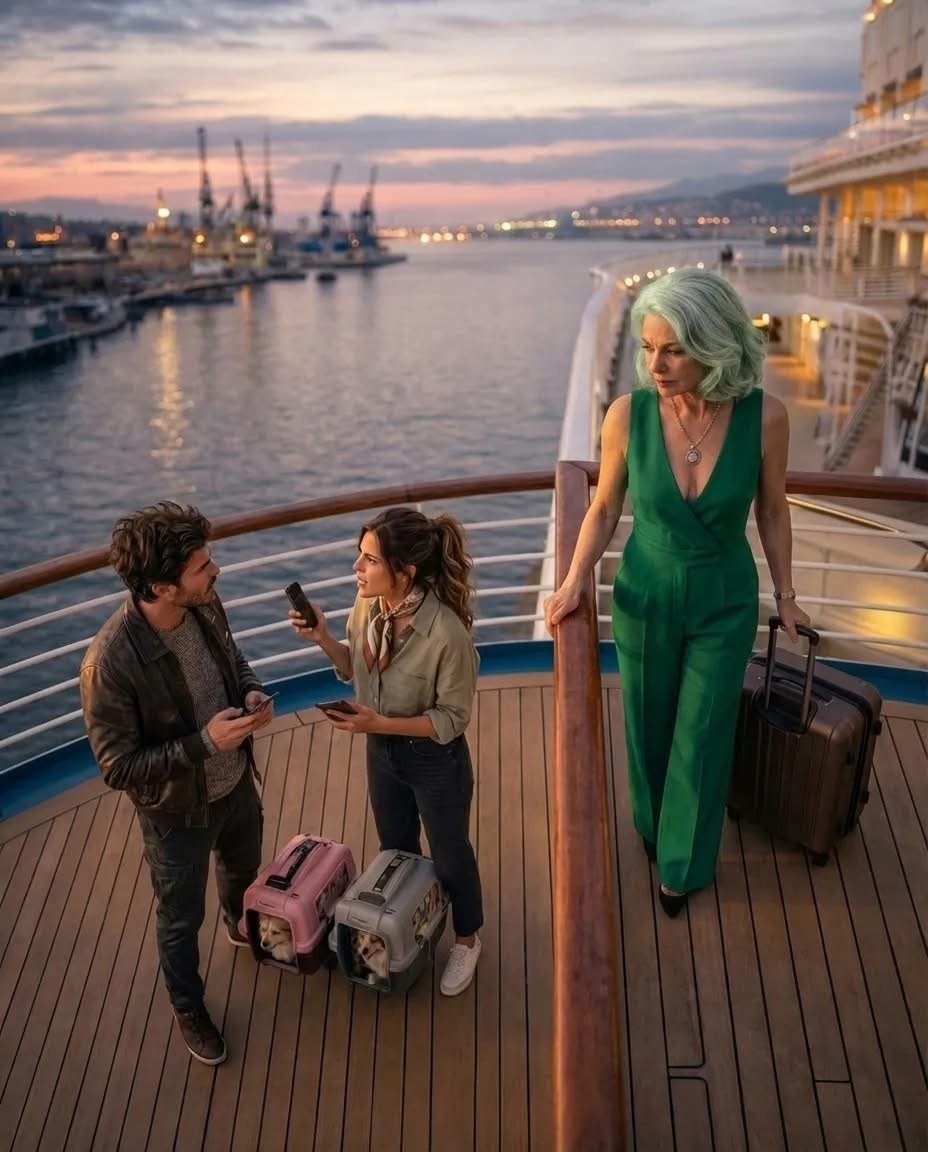
When Julián d:ied of a heart attack, everyone in Valencia assumed that the widow, Carmen Ortega, would stay still—sad and available for whatever was needed. I helped organize the funeral myself, accepted hugs, endured empty condolences, and let my children, Daniel and Lucía, speak in front of me as if they had already assigned me a new role: the useful mother, the on-call grandmother, the woman who waits for phone calls and solves domestic problems.
I didn’t tell them that three months before my husband’s death I had secretly bought a ticket for a year-long cruise through the Mediterranean, Asia, and Latin America. I hadn’t done it out of madness or whim.
I had done it because for years I had felt that my life had been reduced to taking care of everyone except myself.
During the week after the burial, Daniel came to the house twice.
The first time was to review inheritance paperwork with an urgency that left me cold. The second time he arrived with his wife, Marta, carrying two pet carriers and an unbearable smile.
Inside were two small dogs, nervous and noisy, which they said they had bought “so the girls could learn responsibility.” But the girls barely paid attention to them. The real one responsible would be me.
Daniel said it in the kitchen while I was making coffee:
“Now that Dad isn’t here, you can keep them every time we travel.
After all, you’re alone and it’ll be good for you to have company.”
He didn’t even ask.
He decided it.
Marta added, “Besides, it’ll keep you busy.”
I felt a sharp, clean stab of anger that gave me back my breath. They were dividing up my future as if it were an empty room in the family house.
I smiled. I didn’t argue.
I didn’t cry.
I didn’t raise my voice. I simply stroked one of the carriers and asked calmly,
“Every time you travel?”
Daniel, confident, shrugged.
“Of course.
You’ve always been the one who solves everything.”
He said it proudly, as if it were a compliment. But it was a sentence.
That night I opened the drawer where I kept my passport, the ticket, and the printed reservation.
I looked at the ship’s departure time in Barcelona: 6:10 a.m.
on Friday.
Less than thirty-six hours away.
Then my phone rang. It was Daniel.
And when I answered, I heard the sentence that made me take the final decision:
“Mum, don’t make any strange plans. On Friday we’ll leave you the keys and the dogs.”
I barely slept that night.
Not because of doubt, but because of clarity.
Some decisions are not born from courage but from accumulated exhaustion. I wasn’t running away from my children; I was escaping the exact place they wanted to reduce me to.
At seven on Thursday morning I called my sister Elena, the only person I could tell the truth to without having to justify myself.
“I’m leaving tomorrow,” I said.
There was a brief silence, then a small laugh—disbelieving and happy.
“Finally, Carmen,” she replied.
“Finally.”
She spent the morning with me closing practical matters.
I paid the bills, organized documents, and prepared a folder with certificates, deeds, and contact numbers. I wasn’t disappearing; I was leaving like an adult woman who sets boundaries.
I also called a temporary dog boarding facility near the city and asked about availability, rates, and conditions.
There was space.
I reserved two places for a month under the name Daniel Ruiz Ortega and asked them to send confirmation by email. Then I printed everything.
At noon Daniel called again to say they would leave early Friday for the airport. He talked about a resort in Tenerife, about how exhausted they were, about how much they needed to “disconnect.” I listened silently until he added:
“We’ll leave you food for the dogs and a list with their schedule.”
That sentence turned my stomach.
Not once did he ask if I wanted to, if I could, or if I had any plans.
I ended the call with a “we’ll see” that he didn’t even try to decipher.
In the afternoon I packed a medium suitcase—elegant and practical.
I packed light dresses, medication, two novels, a notebook, and the blue scarf I wore the day I met Julián.
I wasn’t leaving out of hatred for him. I was leaving because even in the good years I had forgotten who I was before becoming a wife, a mother, a caregiver, and everyone’s universal solution.
In the bedroom mirror I studied myself with new attention.
I was still beautiful in a calm, mature, steady way. I didn’t need permission to exist outside other people’s needs.
At eleven that night, when I had already booked a taxi for 3:30 a.m., Daniel sent me a message:
“Mum, remember the girls were really excited about you taking care of the dogs.
Don’t let us down.”
I read it three times.
It didn’t say we love you.
It didn’t say thank you.
It didn’t say are you okay.
It said: don’t let us down.
I took a deep breath, opened my laptop, and wrote a note.
Not an apology—a truth.
I left it on the dining table next to the reservation for the dog boarding facility and a single key to my house.
Then I turned off all the lights, sat in the darkness, and waited for dawn like someone waiting for the first heartbeat of a new life.
The taxi arrived at 3:38 a.m.
Valencia slept under warm humidity, and I left with my suitcase without making noise—even though I was no longer obligated to protect anyone’s sleep.
Before closing the door, I looked one last time at the hallway, at the console table where for years I had left other people’s backpacks, other people’s letters, other people’s problems.
Then I locked the door and dropped the key into the inside mailbox, just as I had decided.
On the drive to Barcelona I didn’t feel guilt.
I felt something stranger, almost unbearable because it was so unfamiliar:
relief.
At 7:15 a.m., already on board, my phone began vibrating endlessly. First Daniel. Then Lucía.
Then Marta.
Then Daniel again and again until the screen filled with notifications.
I didn’t answer immediately.
I sat near a huge window overlooking the harbor waking up and ordered a coffee.
When I finally opened the messages, Daniel’s first one was a photo of the dogs in the car with the words:
“Where are you?”
The second:
“Mum, this isn’t funny.”
The third:
“The girls are crying.”
And the fourth—the only honest one of all:
“How could you do this to us?”
So I called.
Daniel answered furious. At first he didn’t let me speak.
“You left us stranded.
We’re already at your door. What are we supposed to do?”
I waited until he finished and replied with a calmness that surprised even me:
“The same thing I’ve done my whole life, son: figure it out.”
There was a heavy silence.
Then I told him that on the table he would find the address of a dog boarding facility paid for one month, that my personal documents were not to be touched, that I would not cancel my trip, and that from that day on any help I gave would be voluntary, not imposed.
He spat out the words:
“You’re going on a cruise now, with Dad barely dead?”
And I answered:
“Precisely now.
Because I’m still alive.”
He hung up.
Half an hour later Lucía texted me.
Her message wasn’t kind, but it was less cruel:
“You could have warned us.”
I replied:
“I’ve been warning you for twenty years in other ways, and no one listened.”
She never answered again.
When the ship began to pull away from the pier, I felt a mixture of grief, fear, and freedom.
Julián had died—that was real and painful.
But it was also real that I had not died with him.
I rested my hand on the railing, breathed the salty air, and watched the city grow smaller. I didn’t know whether my children would take weeks or years to understand it. Maybe they never would completely.
But for the first time in a very long time, that was no longer going to decide my life.
If anyone has ever tried to turn you into an obligation with legs, now you understand why Carmen didn’t stay.
Sometimes the most scandalous act isn’t leaving.
It’s refusing to continue being used.