My grandpa raised me alone after I lost my parents. When he passed away last week, I found a letter hidden under his toolbox that read: “Dig beneath the weeping willow in the backyard. There’s a private matter I’ve been hiding from you for 22 years.” What I unearthed was only the beginning of something much bigger.
My name’s Nolan.
I’m 22, and for as long as I can remember, it was just Grandpa Earl and me in that old farmhouse outside Cedar Hollow. Creaky floors.
Radio humming in the kitchen every morning. The smell of coffee that never quite left the walls.
We weren’t rich, but it was our home.
The kind of home where every crack in the ceiling told a story, and every squeaky floorboard felt like a greeting. My parents passed away in a car crash when I was three. Grandpa stepped in without hesitation.
He traded his quiet retirement for sleepless nights, scraped knees, and school projects.
He never complained. Not once.
My cousin, Marla, was already 16 when it happened. She’d visit maybe twice a year, always in a hurry, always checking her watch.
But the second Grandpa passed away last week, she showed up as if she’d been circling the property for months.
She walked into the funeral home, shook hands, and accepted condolences meant for me. Later, after we’d lowered Grandpa into the ground, Marla cornered me by the coffee table at the farmhouse. “We should sell this place,” she said, stirring sugar into her cup without looking at me.
I blinked.
“What?”
“You’re young, Nolan. You’ll figure something out.
But this place?” Marla glanced around as if the walls offended her. “It’s falling apart.
Winter’s coming.
You can’t handle this alone.”
I wanted to explode, but I didn’t let it show. Marla kept going. “Did Grandpa leave a will?
Where did he keep important documents?”
She shrugged.
“Exactly! We shouldn’t waste time.”
That’s when I realized she wasn’t here to grieve.
She was here to collect. I watched Marla walk through the house, opening drawers, checking cabinets, and scanning the walls.
She picked up Grandpa’s old pocket watch from the mantle, turned it over in her hands, then set it back down without a word.
“I’ll be back tomorrow,” she said at the door. “We can start going through his things then. Figure out what’s worth keeping.”
What’s worth keeping.
Like Grandpa’s entire life could be sorted into piles.
***
Later that night, after everyone had left, I was alone at the farmhouse.
The silence felt wrong. Grandpa’s chair sat empty by the window, his reading glasses still folded on the armrest.
I couldn’t bring myself to move them. I walked through the rooms, touching things.
The worn kitchen counter.
The toolbox he’d kept in the shed. That’s when I noticed something. A yellowed envelope was taped under the toolbox lid.
My name was scrawled across it in Grandpa’s shaky handwriting.
I tore it open. Inside was a sheet of paper.
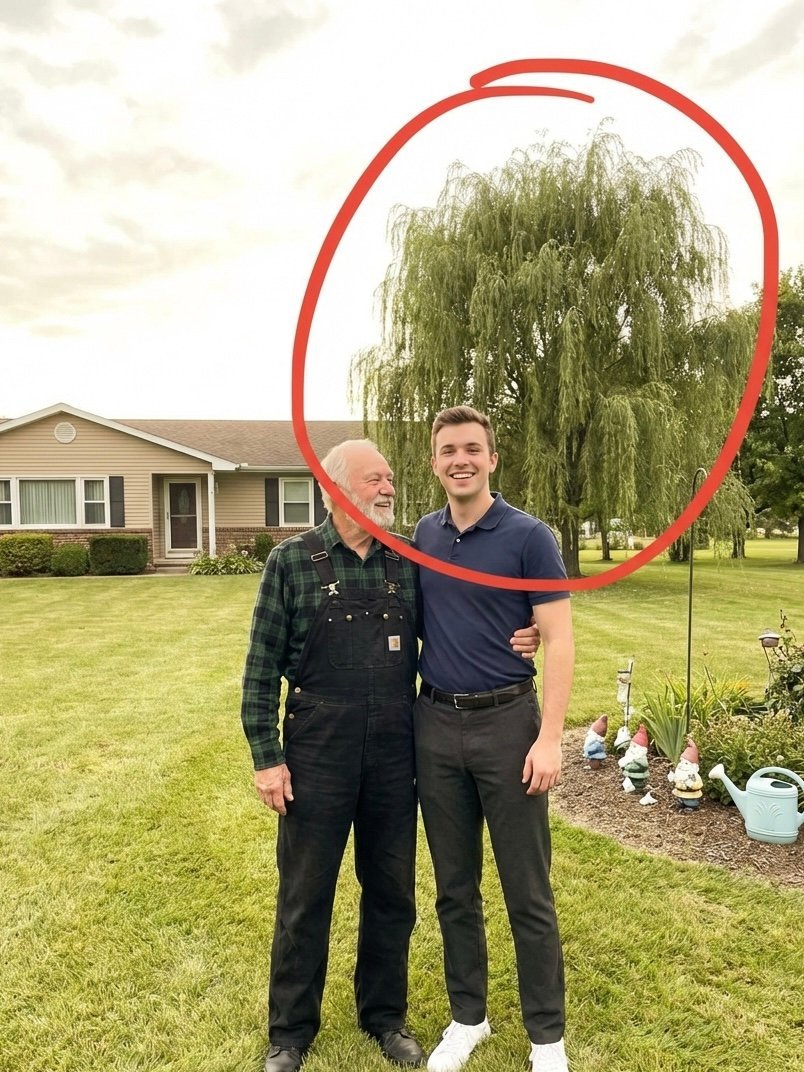
“My dear Nolan, dig beneath the weeping willow in the backyard. There’s a private matter I’ve been hiding from you for 22 years.
It’s time you learned the truth.”
The weeping willow stood at the far edge of the yard, gnarled and ancient.
I grabbed Grandpa’s old shovel from the shed. The weight of it felt familiar in my hands, like holding a piece of him. The night air was cold, biting at my ears.
I started digging beneath the tree, dirt flying in clumps.
Five minutes in, the shovel hit something solid. CLANG.
I dropped to my knees, clearing the dirt with my hands.
A small, heavy, rusted metal safe was buried under the roots.
The metal scraped against the roots as I pulled it free. Then a car door slammed behind me.
I turned around.
Marla stood there, her coat unbuttoned, eyes locked on the safe. “What did he leave, Nolan? I forgot my purse… came back for it.
Then I heard you digging back here.”
She walked closer, her heels sinking into the soft earth.
I didn’t answer. My fingers fumbled with the latch.
It wasn’t locked. Inside, I found a modest stack of cash, a folded letter, and a second sealed envelope labeled: “Only open if you choose to stay.
If you choose the money in the box, then leave this unopened.”
It wasn’t what I expected.
Not even close. I unfolded the first letter. Grandpa’s voice filled my head as I read:
“Nolan, if you’re reading this, Marla’s already shown up.
I know her.
She’ll push. She’ll tell you to sell the house, to move on, to take the easy road.
This safe isn’t about what’s inside. It’s about what you do when someone tries to take something from you.
Will you fold?
Or will you stand your ground?”
I looked up slowly. Marla was watching me like a hawk. “What does it say?” she asked.
I folded the letter back up.
“It’s private.”
The softness left her face in an instant. “So, what have you decided?”
“About selling the farmhouse?”
“Of course!
I knew you’d be smart about this. You can’t run this place, Nolan.
It needs repairs you can’t afford.
Sell it now, split the money, and start fresh somewhere else. You’ll thank me later.”
“I need time to think.”
“Time?” Marla laughed. “Time doesn’t fix a sinking ship.”
I didn’t respond.
I just walked back to the house, the safe tucked under my arm.
Marla followed me, her voice relentless. She sat at the kitchen table, tapping her nails against the wood.
“You’ve always struggled, Nolan. You know that.
This is your chance to settle.
To finally have something stable.”
I set the safe down and turned to face her. Memories surfaced, unbidden: Marla after her parents split when she was 17, how she moved in with her mom, Grandpa’s daughter, and how everything became a competition after her mother passed. Marla had always wanted what wasn’t hers.
Even as a teenager, you could see it in the way she looked at things, as if she were already calculating how to take them.
She would visit during the holidays, trying to win Grandpa over with gifts and compliments. But Grandpa saw through it.
He’d just smile and ask her how she was really doing, and she’d deflect. He never played favorites.
He just chose honesty.
I remember one Thanksgiving when Marla brought Grandpa a fancy watch. He thanked her, set it on the shelf, and never wore it once. “Why don’t you wear the watch, Grandpa?” I asked him.
Grandpa looked at me.
“Because things don’t mean much if the person giving them doesn’t understand why you’d want them in the first place.”
I was too young to understand what he meant then. But sitting here now, watching Marla calculate her next move, it made perfect sense.
She wasn’t here because she cared. She was here because she thought there was something to gain.
“Grandpa loved you too,” I said softly.
Marla scoffed. “He loved you more. Everyone could see it.
You were his golden boy.”
“Isn’t it?
I tried, Nolan. I tried so hard.
But it was always YOU.”
For a moment, I almost felt sorry for her. Marla glanced at the clock.
“It’s late,” she said.
“I’m exhausted. I’ll take your room. You can sleep on the couch.”
The rest of the night, I walked through the house.
I touched the doorframe Grandpa had fixed when I was 11.
The cabinet he taught me to sand and restain. The porch railing we replaced together last summer.
Every corner held a memory. By morning, I knew what I had to do.
Marla was in the kitchen pouring coffee.
I stood in the doorway, my voice calm. “I’m not selling this place.”
She froze. “Excuse me?”
“I’m keeping the farmhouse, Marla.”
Her face flushed.
“You’re making a terrible mistake.”
She slammed the mug down.
“You’re a fool, Nolan. This place is worthless.
It’ll drain you dry. You’ve struggled your whole life, and now you finally have a chance to settle with real money.
A good-for-nothing farmhouse isn’t worth your future.”
I didn’t flinch.
Marla grabbed the safe from the counter, her hands shaking with rage. “This should’ve been mine. I should’ve been Grandpa’s favorite, not you.”
She fumbled, and the safe slipped from her grip, hitting the floor with a crash.
The second envelope fell out.