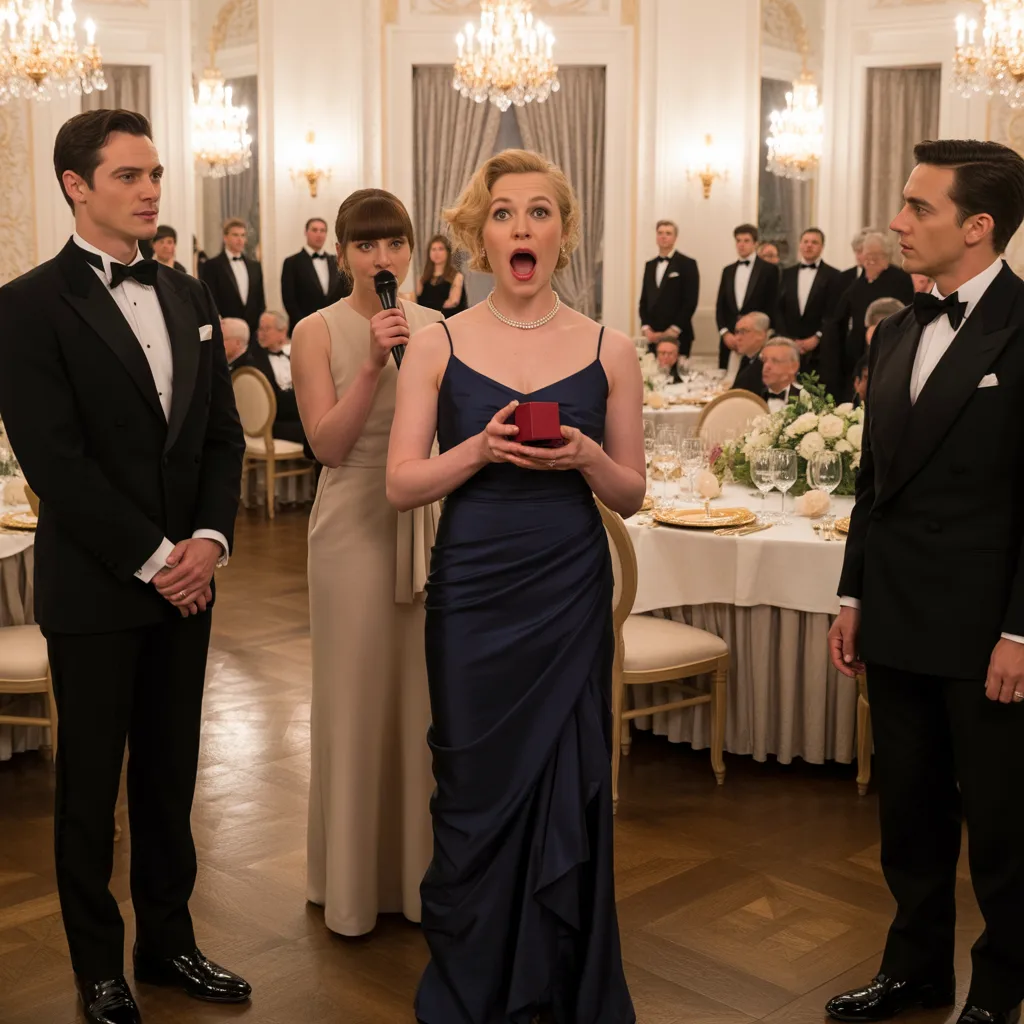
“Security. Remove this useless woman.”
My stepmother said that into a microphone in front of 200 guests at my father’s retirement party. And my father, standing three steps away in his custom tuxedo, looked at the floor and said nothing.
I walked out. I didn’t run. I didn’t cry.
Within 47 minutes, I moved $17 million into a trust she didn’t know existed and turned off my phone. When I turned it back on, there were 56 missed calls. My entire family was standing at my front door.
But they weren’t there to apologize. They were there because a legal document they’d never seen had just collapsed 20 years of careful planning. My name is Laura Paxton.
I’m 34. This is the night I stopped being invisible. My father is Richard Paxton.
If you’ve driven through the suburbs north of New York City and noticed those glass-and-steel office parks that seem to multiply every few years, there’s a decent chance his name is on the permits. Commercial real estate. Thirty-five years of buying land, building things, and shaking hands with men who wore watches that cost more than most people’s cars.
When he announced his retirement that spring, the whole town acted like a senator was stepping down. But that kingdom had a foundation most people never saw. My mother, Catherine Hail, died when I was eleven.
Ovarian cancer. Eight months from diagnosis to funeral, and then she was gone — just like that, like someone had blown out a candle in the middle of dinner. What I remember most isn’t the hospital or the silence afterward.
It’s the kitchen table. My mother sitting across from me with a roll of craft paper and a set of drafting pencils, teaching me how to draw a floor plan. She’d sketch the bones of a building — the load-bearing walls, the joists, the hidden geometry that held everything up — and she’d say, “See, Laura, everything beautiful starts with structure.”
I didn’t know then that she was a licensed architect.
Nobody told me that detail. It got buried along with everything else about her. Eight months after the funeral, my father married Diane Hartwell.
I remember the exact morning he told me, because I was sitting at that same kitchen table drawing a floor plan of our house from memory, and he sat down across from me and said, “You’re going to have a new mother, sweetheart.” I was eleven. I didn’t know how to say I don’t want a new one. So I said nothing.
That was the first time I chose silence. It would not be the last. Diane was the kind of woman who could walk into a room and rearrange it without moving a single piece of furniture.
She did it with tone, with timing, with the particular talent of making every suggestion sound like a kindness and every command sound like a question. She wore Chanel tweed the way other women wore denim. Her hair was always blown out, always honey blonde, always exactly the same.
I never once saw Diane Paxton look unprepared. That should have been my first warning. Within a year of the wedding, the Thanksgiving seating chart changed.
I moved from sitting next to my father to a smaller table in the sunroom. “Because you’re so much more comfortable away from the crowd, aren’t you, Laura?”
By year three, the family Christmas card featured Diane, my father, and Meredith — Diane’s daughter from her first marriage, born two years after me. I was told the photographer ran out of time before my solo shots.
By year five, my bedroom had become Diane’s yoga studio. My things were boxed and moved to the guest room. “You’ll be leaving for college soon anyway,” she said.
“No point wasting space.”
Diane introduced Meredith to people as our daughter. She introduced me as Richard’s daughter from before. Before — as though I were a rough draft my father had since revised.
I became a restoration architect. I restore old buildings. Not the glamorous kind.
Not Manhattan penthouses or Hamptons beach houses. I work on the ones everyone else has forgotten. A crumbling Carnegie library in the Hudson Valley.
A 19th-century firehouse in the Catskills. A schoolhouse in Beacon with a collapsed roof and a hundred years of stories in its walls. I strip back the decay, find the original bones, and bring them back to life.
Some days I’m covered in plaster dust and crawling through attic spaces with a flashlight between my teeth. I earn $110,000 a year, which is a perfectly good living. But in the Paxton world, where Meredith’s latest Instagram sponsorship deal was worth $200,000 for posting photos of handbags, my career was a punchline.
Last Christmas, at the family dinner I was grudgingly invited to, Meredith announced her latest brand deal while Diane beamed. When the conversation turned to me, Diane tilted her head and said, “And Laura, have you found anything more stable yet?” As if restoration architecture were a phase. As if I’d been job hunting for a decade.
My father looked at his plate. He always looked at his plate. I drove home that night in my seven-year-old Subaru Outback, paid off, 200,000 miles on it.
Meredith’s Mercedes GLC was parked next to it in the driveway when I left. She patted my hood on the way in and said, “Cute car. Very you.”
I didn’t answer.
I just drove. That’s what I’d always done. Drove and swallowed and drove.
What none of them knew was that six weeks earlier, the Historic Preservation Society had awarded me their highest honor for the Carnegie Library project. I didn’t tell them. I’d stopped offering good news to people who only knew how to diminish it.
That project would change everything. I just didn’t know it yet. Eleven months before the retirement party, I was on the floor of my Brooklyn Heights apartment sorting through a box I hadn’t opened in years.
My mother’s box — a battered cardboard thing I’d carried from the Westchester house to my college dorm to my first apartment and finally here. Inside: her leather-bound notebook, a few drafting pencils, a photograph of her standing in front of a half-built house with sawdust in her hair and the biggest grin I’d ever seen. At the very bottom, beneath a stack of old birthday cards, was a sealed envelope I’d never noticed before.
Cream-colored, heavy stock. My mother’s handwriting on the front — that slanted, confident script I’d recognize anywhere. For Laura, when she’s ready.
My hands were shaking when I opened it. Inside was a single sheet of her personal letterhead. Catherine Hail, AIA.
Hail Architecture and Preservation. My mother had been a licensed architect. She’d had her own firm.
Nobody had ever told me. Not my father. Not Diane.
Not a single person in 23 years. Below the letterhead, in that same slanted hand:
My darling girl, there are things about our family’s money I need you to understand when you’re old enough. I’ve made arrangements to protect what’s yours.
Mr. Aldridge has everything. Find him.
Tucked behind the letter was a business card. Thomas Aldridge, Esquire. Trusts and Estates.
I sat on my apartment floor for a long time. Then I opened my laptop and searched his name. Thomas Aldridge was 67, still practicing.
His office was in Midtown Manhattan, twelve stops on the subway from my front door. I sent him an email with my full name and the words: My mother was Catherine Hail Paxton. She left me a letter.
She told me to find you. He responded in two hours. The subject line read: I’ve been waiting for this email for 23 years, Miss Paxton.
I went the next morning. But before I tell you what was in that office, I need you to understand something about my father. Richard Paxton was not a villain.
That’s what made it so much worse. A villain you can hate cleanly. My father was something more complicated — a man who loved me but lacked the courage to show it when it cost him anything.
I have one memory I returned to more than any other. I was fourteen. My father picked me up from school on a Tuesday for no reason, just showed up and drove me to the west side of town where a beautiful old stone building was being demolished.
We sat in the car and watched the wrecking ball swing. He was quiet for a long time. Then he said, “Your mother would have fought to save that building.”
It was the last time he mentioned her name.
After that, Catherine Hail Paxton became a ghost in her own house. Her photographs disappeared from the hallways. Her books were boxed.