Unseen Connections: A Story of Love, Trust, and Unexpected Protection(2/2)
She watched the door, and in between the steaming cups and the soft conversations that floated by, she tried to place the man’s face in her mind. Memory is a tricky thing; an odd wrinkle in a jaw, the set of someone’s shoulders, a curl of hair behind an ear can either make a person you have seen into a friend or a fear. The man’s face had been plain enough that now, in the softer light, she couldn’t recall how his mouth had set when he watched.
But then a hand on the small table caused her to look up. Mark stood there with his coat still smelling faintly of laundry detergent and rain. For a moment she saw him as if for the first time in a long while: not the person who knew how to fix a clogged sink or make a mean omelet, but the one who carried a kind of quiet vigilance in the way he moved.
He sat opposite her and reached across the small table as if to close the space between worry and safety. They did not need an explanation. Sometimes there are things in the world too complicated for words; sometimes a look will do.
Mark’s presence unknotted something inside Claire, not by erasing what had happened but by standing as a solid fact against the small, spreading fear. He sipped his tea and listened to the soft hum of the café, and the ordinary clatter of spoons felt like an anchor. She told him about the man, about the stare that had made the carriage feel too small.
He listened in the simple way he always did, leaning forward slightly, hand curled around the cup like a small anchor. Not once did he tell her she had overreacted. Not once did he shrink her fear into something ridiculous.
He named only the facts he had found: the man had been seen nearby on the days before; he had been near Claire’s workplace some evenings; he had risen to watch the carriage as it left the platform tonight. Mark’s voice did not carry triumph or dramatic flourish—just the plain facts that, in their quietness, made the point clear. After they spoke, Claire felt tired in a different way.
It was not only the physical weariness of a hard day but the mental fatigue of feeling watched and then seen, of recognition and relief braided together. She rested her chin on the knuckles of her hand and watched the steam curl up from her cup. Mark’s hand reached out again, covering her small grip like a protective lid.
Love, she thought, is not always loud or heroic. It is often small and stubborn: it appears as a late-night text, a bowl warmed in the microwave, hands that know the exact place to press on a back to ease a knot. It acts without fanfare.
It is a presence that can cross miles on a screen and arrive without a pat on the head, unannounced and steady. They left the café together. Outside, the city had slid into night: neon signs blinking slowly, a few taxis parked by the curb, the distant thrum of highways.
Mark walked close at her side, and his shoulder brushed hers like a promise. The world that had felt sharp and heavy when she first left the train was now a place she could hold again because someone else had folded it back into something manageable. On the walk home, Claire felt the surface of her life smooth out a little.
The man on the train was no longer a small, hovering terror; he was a fact that could be put into a story with an ending that did not have to be gruesome. The police would be called, the station monitored, and the simple, ordinary work of small institutions would unfold as it tends to do: calls, notes taken, eyes shifted. But beyond that, there was the human thing—the way Mark had watched, the way he had taken a thread of something and knotted it into action.
He had given weight to her unease and then, in a calm practical way, worked to make that weight lighter. The photograph tucked in her bag felt like a promise kept. She thought again of the small summer afternoon in the river and of everything that had built between them out of patience and choice.
It was a strange kind of comfort to feel visible and protected in the same breath. She had, in one evening, remembered how fear can arrive without warning and how love can appear just as quickly, without ceremony, simply present and ready. They reached their front door as the streetlights blinked the hour.
Their hallway smelled faintly of home—old coffee, a hint of lemon cleaner, the familiar softness of a place shaped by two lives. Inside, the kettle was set to boil by habit. They moved around each other with the easy choreography of people who share a life: a lid taken off, a mug reached, a jacket hung on the peg.
There was no grand recounting of the night, only small exchanges that sealed the day back into normal. Claire placed her bag on the table and took out the photograph, smoothing the corner until the edges were neat again. Mark sat on the sofa and watched her with a look that had practiced patience written in it.
He had not said much about the hours he had spent watching cameras and tracing paths; he had given her the outcome, not the blow-by-blow. Sometimes, she thought, care does not need to be explained. It simply is.
They stood at the window and watched the street for a long, small time. A few people passed under the halo of lamp light, dogs on leashes tugging at the ends of their leads. In the quiet place where they stood, Claire felt the day’s sharpness turn to something quieter.
The man who had watched her on the train existed now only as a piece of a story they could tell in short, practical sentences if needed. For the rest, he would be noted, reported, and monitored. Later, when the kettle had cooled and the apartment settled into its deeper nighttime hush, Claire lay down beside Mark and felt the steady, real weight of his presence.
It was the sort of weight that held rather than pushed. She closed her eyes and let the small noises of the apartment—Mark’s soft breathing, the hum of the fridge—remind her that the world includes gentle things as well as sharp ones. Outside, the streetlights kept their slow watch.
Inside, two people who cared for one another had done the simplest, clearest thing: they had seen each other, and then acted. The rest was the slow acceptance that some nights will bring a scare and that, when they do, there is a person to reach for who will listen, who will search, and who will show up. It was not an heroic ending, and it did not need to be.
It was enough that she was home and that someone had been watching—carefully, patiently, and from a distance—so that she could come back safe. Always there, unseen but steady.
More in uncategorized
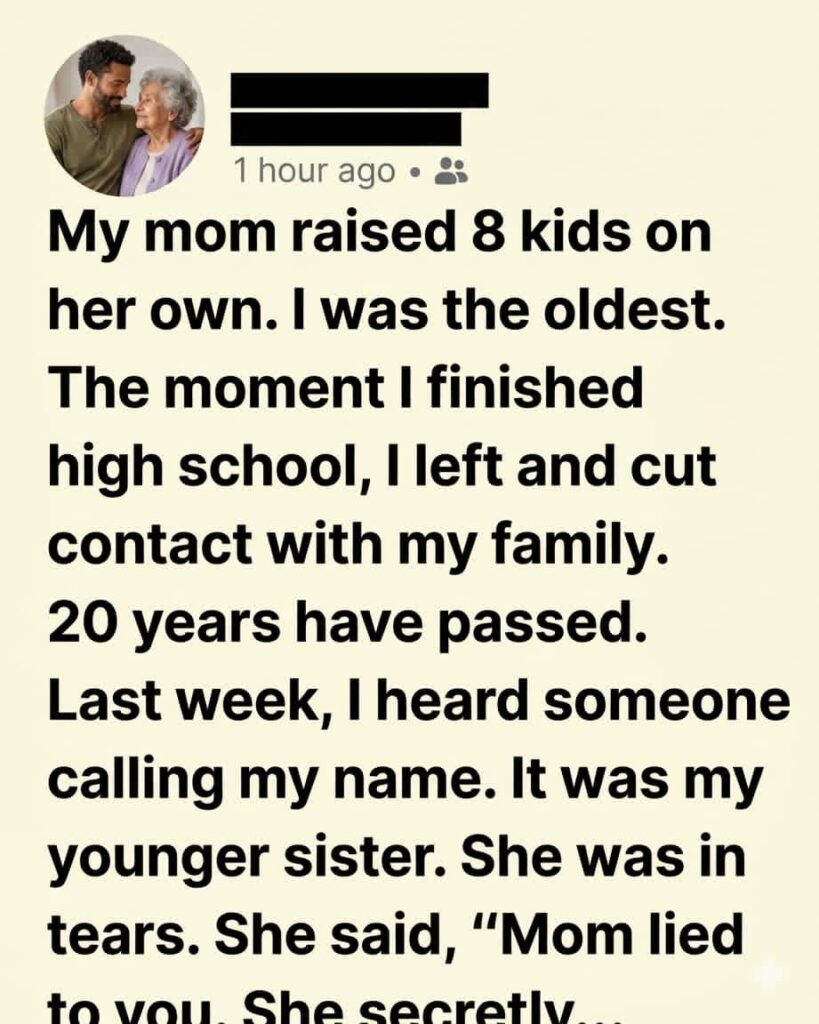
I Thought My Mother Ruined My Life Until My Sister Told Me the Truth

‘I’m Divorcing You’: The Shocking Kinder Surprise I Got After Telling My Husband I Was Pregnant