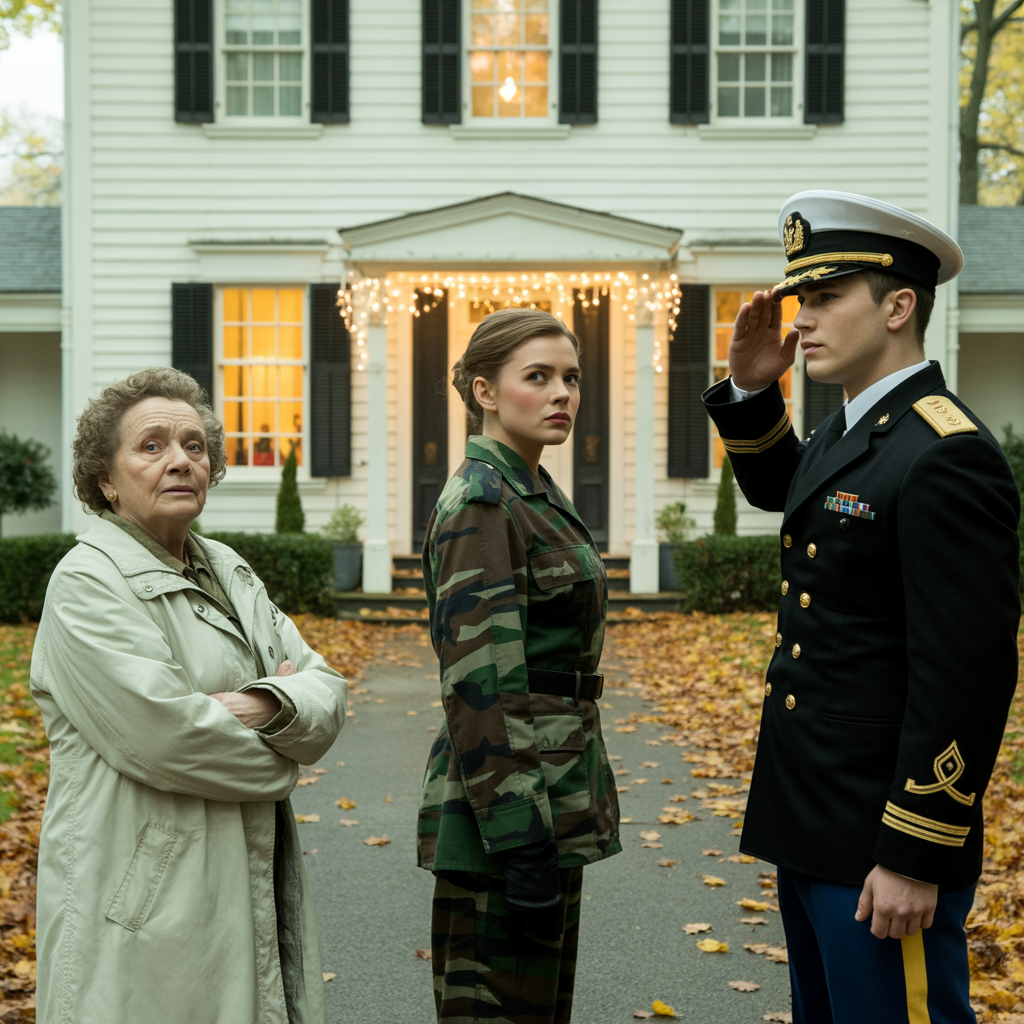
The single word cut through her hysterics like a blade. I took a step closer to her. She shrank back into her chair, pressing herself against the expensive upholstery.
“You didn’t want what was best for me, Marjorie,” I said, my voice steady and cold. “You wanted what was best for your ego. You needed a failure.
You needed someone to point at and say, ‘Look at her. Look how sad and small she is,’ so that Nathan would look even bigger by comparison.”
I gestured to Nathan, who was still standing, looking like his entire world had just tilted on its axis. “Nathan is the star,” I continued.
“He’s the hero. He’s the golden boy. But a star doesn’t shine as bright without a dark background.
That’s what I was to you, wasn’t I? I was the dark background. I was the prop you used to make your son shine brighter.”
Marjorie opened her mouth to argue, but no words came out.
The truth was too blatant, too naked. “I—I never,” she whispered weakly. “You did,” Nathan said.
His voice was hoarse. He was looking at his mother, but the admiration that usually filled his eyes was gone. In its place was something colder, something like disgust.
“She’s right, Mom,” Nathan said, shaking his head slowly. “God, she’s right. You always told me she was lazy.
You told me she washed out of real training. You told me she was just a clerk.”
He looked down at his hands. Hands that had held weapons.
Hands that had saved lives. And then he looked back at his mother. “You made me arrogant.
You made me believe I was better than her just because I wear a uniform everyone recognizes. But I’m not better. I’m just louder.”
“Nathan,” Marjorie gasped.
Tears were welling up in her eyes—tears of self-pity, not remorse. “How can you say that? I’m your mother.
I did everything for you.”
“You lied to me,” Nathan said simply. “You looked at a woman who serves at the highest level of national security and you called her a POG because it made you feel important.”
He turned away from her, unable to look at her face anymore. The idol had fallen.
The pedestal had shattered. I watched the realization wash over Marjorie. She had lost.
She had lost the game she’d been playing for eighteen years. She had lost the narrative. And worst of all, she was losing the adoration of her son.
For a narcissist, that is a fate worse than death. She turned her gaze back to me. The fear in her eyes was replaced by a sudden, vicious hatred.
If she couldn’t control me, she would try to destroy me one last time. “So, you think you’re better than us now?” she spat, her voice trembling with rage. “Just because you have some secret clearance?
Just because you have a fancy code name? You’re still just Collins. You’re still the girl with no husband, no children, no life.
You’re cold. You’re empty.”
“I am disciplined,” I corrected her. I looked at her with a clarity that felt liberating.
“Eighteen years, Marjorie. For eighteen years, I sat at this table and ate your dry turkey and swallowed your insults. I didn’t do it because I was weak.
I didn’t do it because I was afraid of you.”
I leaned in, my voice dropping to a whisper that forced her to lean in to hear. “I did it because I was trained. I was trained to keep secrets that would make your hair turn white.
I was trained to put the mission above my personal feelings. My oath to the Constitution is more important than my pride. That is the difference between us.
You need applause to feel valuable. I don’t.”
I straightened up, smoothing my blazer. “But tonight?
Tonight you crossed the red line. You didn’t just insult me. You insulted my father.
And you tried to use his memory to shame me.”
I shook my head. “You don’t get to speak his name. Not anymore.”
Marjorie was shaking.
Her face was a mask of ugly, twisted fury. She couldn’t handle the truth. She couldn’t handle the mirror I was holding up to her soul.
“Get out,” she screamed. It was a shrill, piercing sound that cracked the tension in the room. “Get out of my house, you ungrateful, miserable girl.
Get out.”
She was pointing at the door, her hand trembling violently. She was trying to reclaim her territory. She was trying to have the last word.
I didn’t flinch. I didn’t yell back. I simply nodded.
“Gladly,” I said. I looked at my mother one last time. She was still sitting there, silent, tears streaming down her face.
But she gave me a tiny, imperceptible nod. It wasn’t enough to make up for years of silence, but it was a start. “Goodbye, Mom,” I said softly.
I turned on my heel and walked toward the foyer. “I didn’t rush.”
I walked with the measured pace of a woman who knows exactly where she is going. “Don’t come back,” Marjorie shrieked behind me.
“Don’t you dare come back here expecting Christmas dinner. You’re dead to me.”
Her words bounced harmlessly off my back. They were just noise.
Static. I reached the heavy oak door and pulled it open. The air outside hit me like a physical blow—cold, crisp, and clean.
It smelled of winter and dead leaves, but to me, it smelled like freedom. It smelled like the end of a very long, very dark chapter. I stepped out onto the porch and let the door close behind me.
Thud. The sound was final. It was the sound of a bridge burning, and the warmth of the flames felt incredible.
I walked down the driveway toward my car. The wind bit at my cheeks, but I didn’t button my coat. I wanted to feel it.
I wanted to feel everything. For the first time in my life, I wasn’t the niece who wasn’t good enough. I wasn’t the cousin who lived in the shadow.
I was Collins Flynn. I was Oracle 9. And I was free.
If you have ever had to walk away from a family member to save your own sanity, hit that like button. It’s the hardest thing to do, but sometimes it’s the only way to survive. Leave a comment saying, “I chose peace,” if you agree that boundaries are necessary.
I reached my car and put my hand on the door handle. My phone vibrated in my pocket. A secure line.
I pulled it out. The screen glowed in the darkness. “This is Oracle,” I answered.
“Ma’am.” The voice on the other end was clipped. Urgent. “We have a situation developing in sector four.
Task Force Alpha is requesting authorization for immediate extraction.”
I looked back at the house one last time. Through the window, I could see Marjorie still gesturing wildly, shouting at an empty room. I saw Nathan sitting with his head in his hands.
I turned my back on them. “I’m on my way,” I said into the phone. “ETA twenty minutes.”
I got into the car, started the engine, and drove away.
The rearview mirror was dark, but the road ahead was illuminated by my headlights, bright and clear. The Pentagon at 2 a.m. is a different world.
The tourists are gone. The massive parking lots are empty except for the scattered cars of the watch officers and crisis response teams. The corridors, usually buzzing with the noise of thousands of bureaucrats, are silent, stretching out like endless linoleum arteries.
But deep inside the E-ring, inside the NMCC—the National Military Command Center—the pulse never stops. I walked through the double doors, flashing my badge. The Marine guard didn’t just check it; he recognized me.
He straightened up, giving a sharp nod. “Ma’am.”
“Status?” I asked, not breaking stride. “Situation Room B.
They’re waiting for you, Oracle.”
I entered the room. It was a hive of controlled chaos. A dozen analysts were hunched over computer terminals, their faces illuminated by the blue glow of screens.
On the main wall, a massive digital map of Kabul, Afghanistan, was displayed in high definition. “Officer on deck,” someone barked. The room didn’t snap to attention.
We don’t do that in crisis mode. But the energy shifted. Heads turned.
Eyes focused. The uncertainty that had been filling the room evaporated the moment I walked in. I wasn’t Collins the poor relation anymore.