Mission: to establish my value and sever the toxic ties on my own terms—not in a screaming match, but with undeniable public truth.
Enemy: my father, the primary aggressor. My mother and sister, the willing collaborators. Their tactics: guilt, gaslighting, and the weaponization of my sense of duty.
Terrain: the wedding reception at Carry Blast Furnaces, a neutral site but filled with their allies, a high‑pressure, emotionally charged environment.
Troops: I was a force of one. My only potential asset was an unknown variable, the groom’s father.
This led me to the intelligence‑gathering phase of my operation.
I opened my laptop and searched for General Mark Peterson, the groom’s father. My sister was marrying into a military family, a detail my father had conveniently ignored.
The search results were extensive. General Peterson was a decorated two‑star Army general, a West Point graduate, a man with a sterling reputation. I spent hours reading articles about him, watching his speeches on YouTube. He spoke about integrity, about leading from the front, about how respect is the bedrock of the military.
I read a quote from a speech he gave at a Memorial Day service: “We wear this uniform not to command fear, but to earn respect. And that respect is owed to every single person who takes the oath, regardless of rank or job.”
I felt a spark of recognition. He wasn’t a blustering tyrant like my father tried to be. He was a man who believed in the same system of merit and honor that had saved me. He believed in the world where I belonged.
He was no longer an unknown variable. He was now a key strategic asset.
The next evening was the rehearsal dinner, held at a steakhouse downtown. This was my opportunity to conduct reconnaissance and prepare the battlefield.
I saw General Peterson across the room talking with his wife. He was exactly as he appeared in his photos: tall, distinguished, with an air of quiet authority. I waited for a lull in the conversation, took a steadying breath, and approached.
I did not approach him as a victim seeking aid. I approached him as a fellow officer.
“General Peterson, sir,” I said, my voice clear and steady.
He turned, his eyes sharp and intelligent.
“Ma’am,” he replied, giving me a respectful nod.
“Major Kira Moore, Marine Corps,” I said, introducing myself. “I’m Lacy’s sister. It’s an honor to meet you, sir.”
“The honor is mine, Major. Your sister is a lovely young woman. My son is a lucky man.”
“Thank you, sir,” I replied. “Sir, if I may have a moment, I wanted to provide you with some context about my family so that you’re not caught by surprise tomorrow.”
His expression shifted slightly, a flicker of professional curiosity. He gave a slight nod.
“Go on.”
“My father is a man who values a certain kind of work,” I explained, keeping my tone neutral and factual. “My career in military logistics is difficult for him to comprehend. He has a nickname for me. He calls me ‘the glorified janitor.’”
I let the ugly words hang in the air for a moment.
“In our world, sir, respect is absolute. It’s ingrained in everything we do. In my family, it’s a more relative concept. I just thought you should be aware of the terrain.”
He studied my face for a long moment, his eyes seeing more than I was saying. He saw the discipline, the control. He recognized a fellow professional.
“Understood, Major,” he said finally. “Thank you for the briefing.”
With a nod, I excused myself.
The seed had been planted. I hadn’t asked him for anything. I had simply provided intelligence to a senior officer. What he did with it was his command decision.
Back in my hotel room that night, I faced my final tactical choice: my uniform.
My full dress blues were hanging in a garment bag, the crimson bloodstripe on the trousers crisp, the brass buttons polished to a mirror shine. To wear it would be a statement of power, an act of defiance.
But Gunny’s words came back to me: smart, not loud.
Wearing my uniform would be loud. It would be an escalation. It would make me the aggressor in their eyes. My father would use it as proof of my arrogance.
No, my power didn’t come from the uniform. It came from the truth.
I turned to my suitcase and pulled out a simple dark navy‑blue dress. It was modest, elegant, and completely unremarkable. I would walk into that wedding not as a major, but as Kira Moore, a daughter and a sister. I would be the civilian. I would let them be the ones in uniform—the uniforms of their own prejudice, their own cruelty, their own lies.
My weapon wouldn’t be the eagle, globe, and anchor on my collar. My weapon would be their own actions brought into the light for everyone to see.
I arrived at the wedding reception alone. Dressed in my simple navy dress, I was intentionally unremarkable, a ghost slipping into the festivities unnoticed.
I found my assigned table at the back of the reception tent, a strategic outpost from which I could observe the entire battlefield.
My family was exactly where I knew they would be—at the center of everything, a loud, laughing vortex of attention. They moved with an unnerving ease. My father clapping men on the back. My mother fussing over Lacy’s dress.
Watching them, you would never know that just days before they had committed an act of profound betrayal. They performed their roles with a cheerful, practiced denial that was colder and harder than the steel furnaces looming outside.
I didn’t have to wait long. The operation commenced exactly as I had predicted.
Frank couldn’t resist an audience. He saw me sitting alone, saw his relatives gathered at the table next to mine, and saw his opportunity.
He approached with that familiar swaggering gait, the walk of a man who owned the world and everyone in it. He leaned over, a casual, menacing presence, and delivered his prepared remarks.
“That one’s just a glorified janitor,” he announced to the table loud enough for everyone nearby to hear. “Who even invited her?”
This time, I didn’t just hear the attack. I watched it detonate.
I saw the cruel, satisfied smirk on my father’s face as his words landed. I saw my mother’s gaze flicker away, her silence a perfect act of complicity. I saw my sister Lacy, the beautiful bride, give a small uncomfortable smile and turn to her new husband, a silent dismissal. And I heard the familiar chorus of laughter from my aunts and cousins, the sound that had haunted my childhood.
It was all happening again, just as it always had.
But this time, there was a new element on the battlefield. This time, they had a witness.
And then it happened.
From the head table, General Mark Peterson stood up. It was not a dramatic leap to his feet. It was a slow, deliberate, and powerful movement that seemed to pull all the sound and energy in the room towards him.
The laughter died in people’s throats. Conversation sputtered and stopped. Forks and knives froze halfway to their mouths. The entire chaotic reception hall fell into a sudden, shocked silence. The only sound was the faint clinking of ice cubes in a glass.
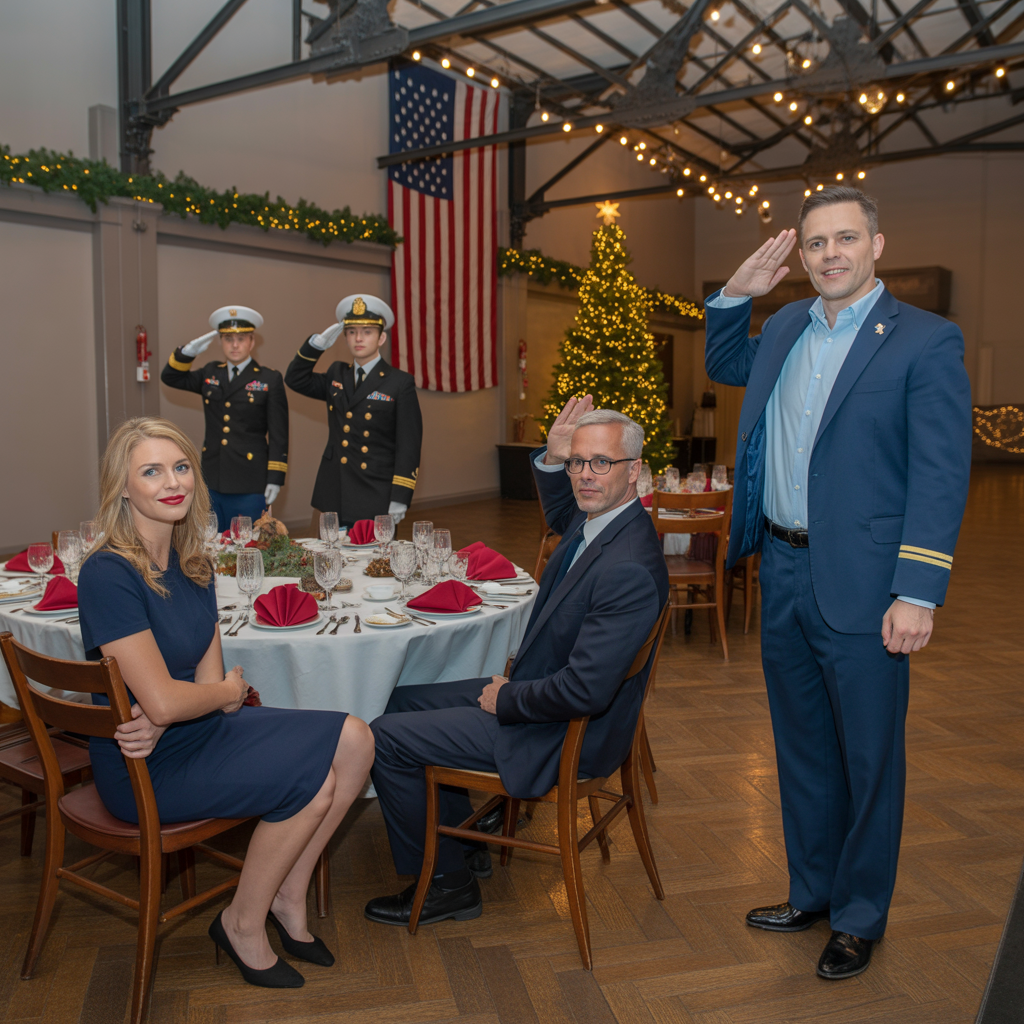
General Peterson was in his dress uniform, a constellation of ribbons and medals on his chest. He turned his body to face me across the expanse of the room, and then he did something that shattered my father’s world.
He raised his right hand to the brim of his cap and executed a perfect textbook military salute. His arm was ramrod straight, his fingers aligned, his gaze locked directly on me.
In the civilian world, it might look like a simple greeting. But in our world, a salute is a profound act. It is not a gesture between people. It is a gesture of respect for the rank, the responsibility, and the sacrifice that a person represents. Junior personnel salute senior officers.
And here, a two‑star general was saluting a major.
It was a public, unequivocal declaration of respect that defied every rule my father had ever lived by.
The silence in the room stretched, becoming thick and heavy.
Then the general’s voice, a calm and commanding baritone honed by decades of leadership, cut through the quiet. He was not speaking to me. He was speaking to my father, but he never took his eyes off me.