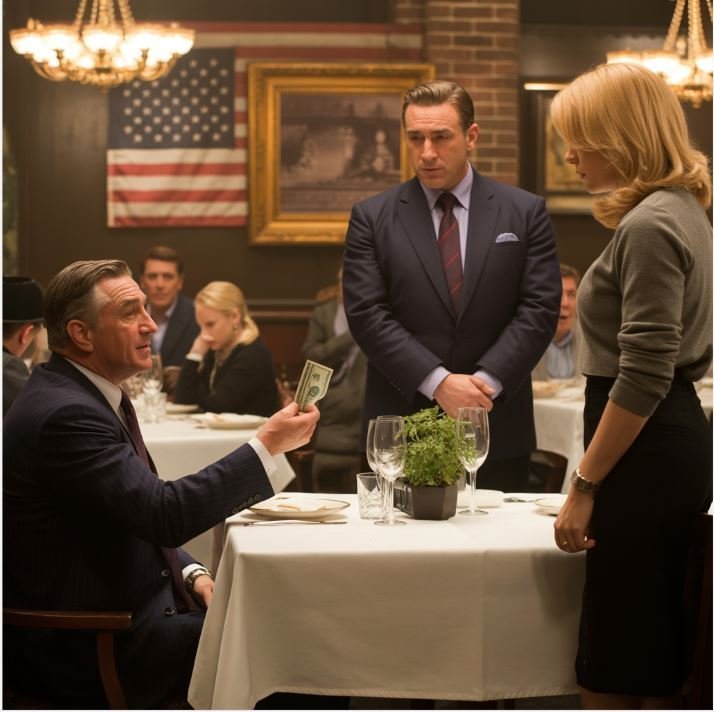
“Mr. Caldwell,” Graham said again. This time the volume was different. It wasn’t the whisper of a servant. It wasn’t the polite murmur of a host. It was a voice projected from the diaphragm, a baritone that cut through the ambient jazz and the clatter of silverware like a foghorn. The restaurant went silent. The couple at the next table froze mid-bite. Marcus Thorne stopped chewing.
Grant spun in his chair, his face contorting in confusion. “Excuse me, why are you shouting?”
Graham took a step back, creating a stage of his own. He held the hundred-dollar bill up between two fingers, displaying it to the room as if it were evidence in a murder trial. “I cannot accept this gratuity, sir,” Graham said, his voice ringing off the brick walls. “And I certainly cannot fulfill your request to remove the lady in the corner.”
“Lower your voice,” Grant hissed, panic flaring in his eyes. “What are you doing?”
“I am clarifying the house rules,” Graham said, and he smiled. It was a sharp, dangerous smile. “You see, sir, you asked me to remove her because you said she didn’t belong here.” Graham pivoted, turning his body so that he was presenting me to the room. “But that is impossible, Mr. Caldwell.”
Grant stood up, his chair scraping loudly. “I am going to have you fired. I am calling the owner right now.”
Graham shook his head. “That won’t be necessary, sir. You don’t need to call anyone.” He paused for three seconds—a lifetime in a silent room. “Because the owner is sitting right there.”
“Ms. Davis,” Graham said. He spoke the name with a formal reverence that acted as a physical barrier between my brother and myself. It was a title, a designation of rank, and it hung in the air like smoke.
Grant froze. His mouth was slightly open, prepared to launch another insult, or perhaps another laugh, but the sound died in his throat. He looked at Graham. Then he looked at me, and then he looked back at Graham. His brain was misfiring. To him, I was Leah Caldwell, the girl who wore hand-me-downs and drove a sedan with a dented bumper. Ms. Davis was a stranger. Ms. Davis was the faceless entity that had beaten him to the Holston deal.
“Who?” Grant asked. The word came out as a squeak.
“Ms. Davis?” Graham repeated, gesturing to me with an open palm. “The owner of this establishment, the owner of the Holston Building, and—unless I am mistaken regarding the family resemblance—your sister.”
Grant stared at me. The silence in the restaurant was absolute. The background jazz seemed to have faded away, leaving only the sound of Grant’s heavy breathing. Then he laughed. It was a terrible, forced sound, wet with panic. He turned to Marcus Thorne and the other guests, spreading his hands wide.
“Okay, okay,” Grant said, shaking his head. “You got me. That is very funny, Leah. Did you pay him? Did you slip him twenty dollars to say that? That is adorable.” He looked at Graham, his eyes hard and threatening. “All right, joke is over. You had your fun. Now bring us the dessert menu before I actually get angry.”
He was fighting for his life. He was trying to wrestle the reality back into a shape he could understand, a shape where he was big and I was small. Graham did not move. He did not blink.
“It is not a joke, Mr. Caldwell,” Graham said. “If you would like, I can recite the deed number for the building. Or perhaps you would recognize the transfer of funds for the renovation work done in 2019. I believe your firm bid on the contract for the electrical overhaul. You were rejected because your bid was forty percent over market rate and lacked the necessary compliance bonds.”
Grant flinched. That was a specific detail, a detail only the person who rejected the bid would know. “That is internal data,” Grant stammered. “How would you know that?”
“Because Ms. Davis rejected the bid,” Graham said calmly. “She sat in the meeting. You just didn’t see her because she was listed as the Managing Director on the conference call. And you were too busy pitching to the junior associates to notice the woman at the end of the table.”
I watched the color drain from Grant’s face. He was remembering. He was replaying three years of his life, scanning the background of every meeting, every email, every rejection, trying to find me.
I stood up. I did not rush. I smoothed the front of my wool sweater and walked toward the center table. My boots clicked softly on the hardwood floors I had personally selected for their acoustic properties. I stopped two feet from Grant. I did not look at him. I looked at Graham.
“The tablet, please, Graham,” I said.
Graham handed me the black device. It was the master control for the Point of Sale system. It showed everything: the live revenue, the labor costs, the inventory levels, and the banking routing numbers. I turned the screen toward Grant.
“Look at the top left corner,” I said softly.
Grant looked. He didn’t want to, but he couldn’t help himself. There, in crisp white letters against the dark background, was the corporate registration name: Davis Hospitality Partners LLC.
“You know that name?” I said. “You have complained about it for years. You told Dad that Davis Hospitality was a vulture fund that stole the Holston Building from under you. You told your partners that Davis Hospitality was a faceless conglomerate from New York.” I tapped the screen. “It is not from New York, Grant. It is from my savings account.”
Grant looked up at me. His eyes were wide, wet, and terrified. “You… You are Davis?”
“My middle name,” I said. “I thought you knew, but then again, you never really paid attention to the details, did you?” I swiped the screen, bringing up the live feed of the daily deposits. “This is the revenue from tonight,” I said, pointing to the number that was steadily ticking upward. “It goes directly into a fiduciary account controlled by me. Every bottle of wine you ordered, every steak, the chair you are sitting in, the heat keeping you warm… it all belongs to me.”
I turned my gaze to Marcus Thorne. Thorne was sitting perfectly still. He was a predator, and he recognized when another predator had entered the clearing. He looked at the tablet, then he looked at me. There was no mockery in his eyes, only a cold, sharp assessment.
“You own the building?” Thorne asked. His voice was low. “Serious.”
“I own the block,” I corrected. “Lark and Ledger is the anchor tenant. I also own the boutique next door and the residential units on the upper floors. I hold the paper on the entire Holston asset, free and clear. No leverage.”
Thorne raised his eyebrows. “No leverage.”
“I prefer to mitigate risk,” I said.
Thorne slowly placed his napkin on the table. He looked at Grant. The look was not one of anger. It was one of dismissal. It was the look one gives to a counterfeit watch.
“Grant,” Thorne said. “You told me you had a controlling interest in this property. You said, and I quote, ‘I have the owner in my pocket.’”
Grant spluttered. “I meant I had a relationship, a family relationship. It is the same thing. Marcus, she is my sister. What is hers is… you know, it is all in the family.”
“It is not in the family,” I said. My voice cut through his rambling like a knife. “There is no ‘we,’ Grant. There is no ‘us.’ There is my company. And there is your client tab.”
I tapped the tablet again. I pulled up the reservation profile for Grant Caldwell. “Chef Marcus,” I called out toward the open kitchen. The executive chef, a burly man with forearms scarred from years of oven burns, stepped up to the pass. He wiped his hands on a towel and looked out into the dining room. He didn’t like Grant. Grant had once sent back a risotto because it was “too ricey.”
“Yes, Ms. Davis?” Chef Marcus asked.
“How many times has this guest attempted to bypass the reservation queue?” I asked.
“Six times in the last month,” the chef replied, his voice booming. “He yells at the hostesses. He tells them he is going to have them fired if he doesn’t get a table. He says he is the brother of the owner and that he basically runs the place.”