The room went quiet, just the hum of the dryer spinning the next load. I froze. My hands were still holding the warm cotton of the towel. I hadn’t told Mia the full extent of the resort situation yet. I had only told her they were being difficult. I hadn’t told her they weren’t coming at all. I was ashamed, even though I knew it wasn’t my fault. The shame of being unprioritized feels sticky, like you are the one who failed to be worth showing up for.
I looked at Darnell. He was looking at me with simple, open curiosity. There was no judgment in his face. He just wanted to help my father park his car.
“They aren’t driving down,” I said. My voice was small, barely audible over the dryer.
“Oh, flying then?” Tracy asked. “Even worse. The airport shuttle is a nightmare.”
“No,” I said. “I…” I took a breath. I put the towel down on the washing machine. “They aren’t coming.”
“What?” Mia straightened up, her eyes narrowing.
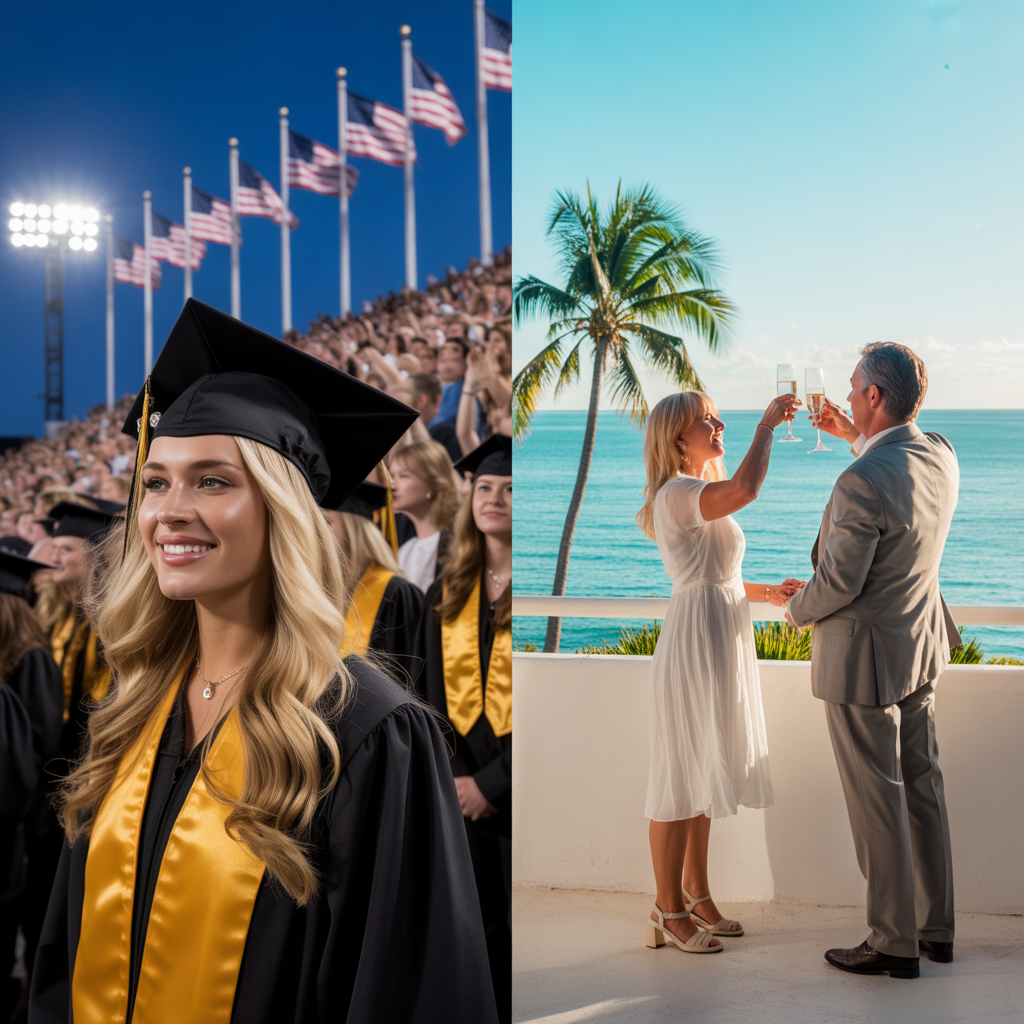
“They went to the Sapphire Coast,” I said, the words tumbling out now, stripping away the protection I had tried to build around them. “Sloan needed a mental health break. They left this morning. They are going to watch the live stream.”
The silence that followed was different from the silence in my parents’ house. In my house, silence was a weapon used to freeze you out. Here, the silence was heavy with shock. It was the silence of people who could not process the data because it violated the fundamental laws of how they understood love. Tracy stopped folding. She put the sheet down slowly. She turned to look at me, her expression shifting from confusion to a profound, heartbreaking clarity.
“They are skipping your college graduation,” Darnell said slowly, “to go to the beach?”
“It is a wellness retreat,” I said, automatically reciting the script my mother had given me before realizing how stupid it sounded. “But yes, basically.”
I looked down at the floor, waiting for the pity. I braced myself for the Oh, you poor thing or the I am so sorry, Aurora. I hated pity. Pity made me feel small. Pity made me feel like a victim. But Tracy didn’t offer pity. She walked around the ironing board. She stood in front of me and she put her hands on my shoulders. Her grip was firm.
“Well,” Tracy said. Her voice was brisk. Matter-of-fact. “That solves the ticket problem, then.”
I looked up, blinking. “The ticket problem?”
“The university only gives four tickets per student,” Tracy said. “Mia used one for her boyfriend, one for her aunt, and we took the other two, but we were worried about where we were going to sit relative to the stage. We wanted to be close.” She looked at Darnell.
Darnell nodded, a slow, solemn nod that felt like a contract being signed. “If you have extra tickets,” Darnell said, “we would be honored to use them. We can sit in the family section. We can make some noise.”
“You don’t have to,” I said quickly. “I know you are here for Mia. You don’t have to adopt me for the day.”
“We aren’t adopting you for the day, Aurora,” Mia said, stepping forward. “You have been eating our food for three years. You fixed my dad’s resume. You helped Mom set up her Etsy shop. You are already in the ecosystem.”
“We would like to sit in your row,” Tracy corrected me gently. “Not because we feel bad for you, but because we want to see you get that diploma. We know how hard you worked for it. We remember the nights you slept on this couch with your textbooks because your dorm was too loud.”
I looked at them, the Simmons family. They were messy. They were loud. They argued about football and burnt lasagna. And they were offering me the one thing I had been starving for my entire life: presence. Not presence with conditions. Not presence that cost $2,450. Just presence.
My throat felt tight. But I didn’t cry. I nodded. “Okay,” I whispered. “I have the tickets. They are digital.”
“Send them to my phone,” Darnell said, tapping his pocket. “I will handle the parking. You just worry about not tripping on that gown.”
Later that afternoon, I sat on Mia’s back porch. The air was crisp. I had my laptop open. I had three tickets left in my allocation. The Simmons family would take two. I had one left. I thought about who else had actually been there. Not in the abstract sense, but in the trenches.
I navigated to the faculty directory and found the email address for Dr. Evan Hart. Dr. Hart was the head of the communications department. He was a terrifyingly intelligent man who wore tweed jackets and didn’t believe in grade inflation. In my junior year, I had sent him a draft of my thesis at two in the morning, panicked that the entire premise was flawed. He had replied at 2:15. He hadn’t just corrected the grammar. He had written three paragraphs of analysis, challenging my arguments, pushing me to be sharper, better. He treated my mind with a respect my parents never showed my person.
I typed the email. Dear Dr. Hart, I know this is last minute and I know you usually sit with the faculty on the stage, but it would mean a lot to me if you would accept a guest ticket to sit with my support section. My parents are unable to attend. I want to look out and see the people who actually taught me how to stand.
I hit send. I expected a polite decline. Faculty had their own protocols. Five minutes later, my phone pinged.
Aurora, I would be honored. I will trade my faculty gown for a seat in the stands. See you Saturday.
I stared at the screen. I opened the university portal again. The guest list form was locked, but the special accommodations and seating request was still open for another hour. This was where you listed the names of the ticket holders for security clearance. I typed them in. Seat 1: Tracy Simmons. Seat 2: Darnell Simmons. Seat 3: Dr. Evan Hart. Seat 4: Sarah Jenkins. Sarah was a girl I worked with at the coffee shop who had covered my shifts for two weeks during finals so I could study. She had asked for a ticket weeks ago, joking that she wanted to see me “escape.”
I looked at the list. It was eclectic. It was unconventional. It was perfect. I could have called my parents then. I could have told them, “Hey, since you aren’t coming, I gave your tickets away.” But I didn’t. I knew exactly what would happen if I did. If I told Linda Hill that the Simmons family was going to be sitting in the front row, holding the reserved spots, her vanity would override her selfishness. She would panic. She would realize how bad it would look to the neighbors, to the town. If she was absent while those people were present, she would book a flight. She would drag a complaining Sloan onto a plane. They would arrive late, stressed, and demanding credit for the “sacrifice” of coming. They would hijack the day. They would make it about their heroic arrival.
I wasn’t going to give them the chance to perform. This wasn’t about punishing them anymore. It was about protecting the peace I had just found in the Simmons’ laundry room. I wanted the people who were there because they wanted to be, not the people who were there because they were afraid of looking bad.