He stormed into my living room, still ranting, his voice bouncing off the walls. “Do you know how hard it was to get reservations at Marelli’s? Do you know how expensive that dinner was? And you just didn’t show up! You embarrassed our entire family!”
Emma appeared at the top of the stairs in her school clothes, her small face pale with fear, her eyes wide and uncertain. Jake was right behind her, his body language protective, ready to intervene if necessary. Seeing Emma’s frightened expression triggered something in me—a mother’s fierce, protective rage that burned away every remaining trace of the accommodating little sister I’d been for forty-two years.
“Don’t you dare yell in front of my kids,” I said, my voice low but cutting, sharp enough to make Mark actually pause mid-rant.
“Your kids? Everything is always about your kids! Emma this, Jake that! Do you ever think about anyone else in this family?” He threw his hands up in exasperation, as if my children’s existence was a personal inconvenience he’d been tolerating out of charitable obligation.
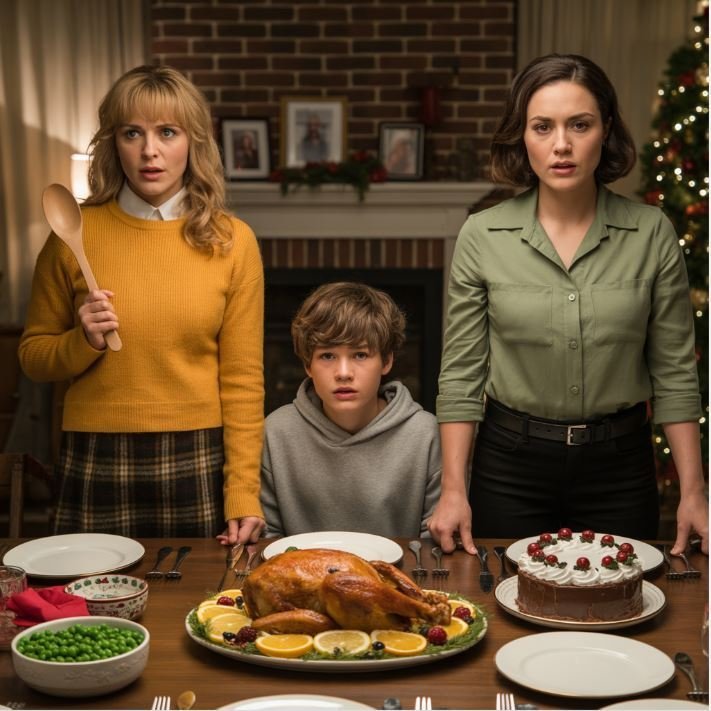
That’s when I completely lost whatever tenuous grip I’d been maintaining on my temper. “Are you kidding me right now? Emma spent three days cooking for this family. Three days, Mark. She used her own money—money she earned babysitting, money she’d been saving for months. She took time off school. She worked harder than most adults work at their actual jobs. And she did it all because she loves Grammy and wanted to make her birthday special. And you’re standing here in my living room yelling at me because your ‘adults only’ restaurant reservation—where my children weren’t even invited—was somehow more important than her effort?”
“It’s not about the cooking, Sarah!” Mark’s voice was reaching a pitch that suggested he knew he was losing this argument but refused to admit it.
“Then what is it about, Mark? What is this really about?”
“It’s about you always making everything about yourself and your kids! It’s about you playing the victim whenever things don’t go exactly your way! It’s about you turning Mom and everyone else against Ashley and me!” His accusations flew like poorly aimed arrows, none of them hitting their target but filling the air with hostility regardless.
Emma started crying upstairs—not loud, dramatic sobs, but quiet tears that somehow hurt worse because she was trying so hard to be brave. Jake immediately put his arm around her, murmuring something comforting I couldn’t quite hear. That sight—my daughter crying because of Mark’s cruelty, my son comforting her because their uncle was too self-absorbed to see the damage he was causing—made something in me snap completely.
“Get out of my house right now.” My voice was cold, hard, absolutely final.
“Excuse me?” Mark looked genuinely shocked, as if I’d spoken in a foreign language.
“Get. Out. Of. My. House. You don’t get to come here at eight in the morning, wake up my neighbors, make my daughter cry, and then blame her for loving her grandmother too much. You don’t get to stand in my living room and tell me that my children don’t matter. Get out right now.”
“Sarah, you’re being completely unreasonable—” he started, trying to regain his usual authoritative tone.
“I said get out! Now!”
Mark stared at me, genuine shock replacing his anger. I don’t think he’d ever heard me yell before, never seen me refuse to back down, never encountered this version of his sister who was done being accommodating. For forty-two years, I’d been the peacemaker, the understanding one, the sister who apologized even when she’d done nothing wrong. That version of Sarah was gone, burned away by the sight of my daughter’s tears.
“Fine,” Mark finally said, his voice tight. “But this isn’t over. Mom wants to talk to you, and you better make this right.”
He stormed out, slamming the door so hard it rattled the picture frames on the wall, his departure as dramatic as his arrival.
I immediately went upstairs to comfort Emma, who was genuinely upset, asking if she’d done something wrong, if Grammy was mad at her, if the family hated her now. It broke my heart that she was blaming herself for Mark’s tantrum, internalizing his anger as somehow deserved.
“Listen to me,” I said firmly, holding her face in my hands so she had to meet my eyes. “You did nothing wrong. Emma, what you did for Grammy was beautiful and thoughtful and perfect. Don’t let anyone—not Mark, not anyone—make you feel bad about being a loving granddaughter. Do you understand me?”
She nodded, though tears were still streaming down her face.
After I got the kids to school, I sat in my car in the parking lot, trying to process what had just happened. My phone was ringing constantly—my parents, Mark again, various relatives—but I turned it off, desperate for silence, for space to think.
When I finally got to work, Lisa immediately asked if I was okay. “Mark showed up at my house this morning and basically attacked me for ruining his perfect ‘adults only’ dinner,” I told her, my voice still shaking slightly with residual anger and adrenaline.
“He did what? Sarah, that’s harassment. You can’t let them treat you and Emma like this.”
“I know. I’m just exhausted by all of it.” The weariness was profound, settling into my bones like a weight I’d been carrying for decades and only now fully feeling.
“What are you going to do?”
That’s when I realized I was done—completely, irrevocably done. Done with being the family scapegoat, the disappointing daughter, the sister whose children mattered less. Done with accepting whatever scraps of consideration my family threw our way and being expected to be grateful for them. Done with watching my children hurt and pretending it was acceptable.
I turned my phone back on and called my mother. This conversation was going to happen on my terms, not theirs.
“Sarah, oh thank goodness—” she started, but I cut her off.
“Mom, before you say anything else, you need to understand something. Mark came to my house this morning and screamed at me in front of my children because I didn’t abandon Emma’s birthday dinner to attend his restaurant reservation. He made Emma cry. He woke up my entire neighborhood. He blamed Emma for working too hard to make your birthday special.”
Silence on the other end, heavy with implication.
“I’m forty-two years old, Mom. I’m not going to be yelled at by my younger brother for prioritizing my daughter’s feelings. And I’m not going to watch my kids be treated as second-class family members anymore.”
“Sarah, nobody thinks of them as second-class—” she started, but her voice was weak, unconvincing even to herself.
“Really? When was the last time you suggested an ‘adults only’ event that excluded Mark’s kids? When was the last time you canceled plans with Mark’s family to accommodate mine? When was the last time you praised Emma and Jake with the same enthusiasm you reserve for the twins?” I paused, letting the questions hang in the air. She couldn’t answer because we both knew the truth.
“Mom, Emma loves you. She spent three days making you a birthday dinner because she wanted to show you how much she loves you. And your response was to cancel it ninety minutes before it was supposed to start, for Mark’s restaurant plan, with no consideration for her feelings. How do you think that made her feel?”
“I… I didn’t think,” she whispered, the words barely audible.
“No, you didn’t. You never think about how your choices affect Emma and Jake. You just assume they’ll understand, they’ll adapt, they’ll be fine with whatever’s decided for them.” My voice was firm but not angry—this wasn’t about winning an argument, it was about finally speaking truth that had been ignored for too long.
“That’s not true, Sarah,” she protested weakly.
“It is true, and I’m done pretending it isn’t. Emma deserves to have grandparents who appreciate her effort, who consider her feelings, who love her enough to make her a priority sometimes. If you can’t be those grandparents, then we’ll find our chosen family elsewhere. We already started Sunday night with people who actually see my children’s worth.”
“What do you mean?” Fear crept into her voice, the realization that this conversation was about more than one canceled dinner.