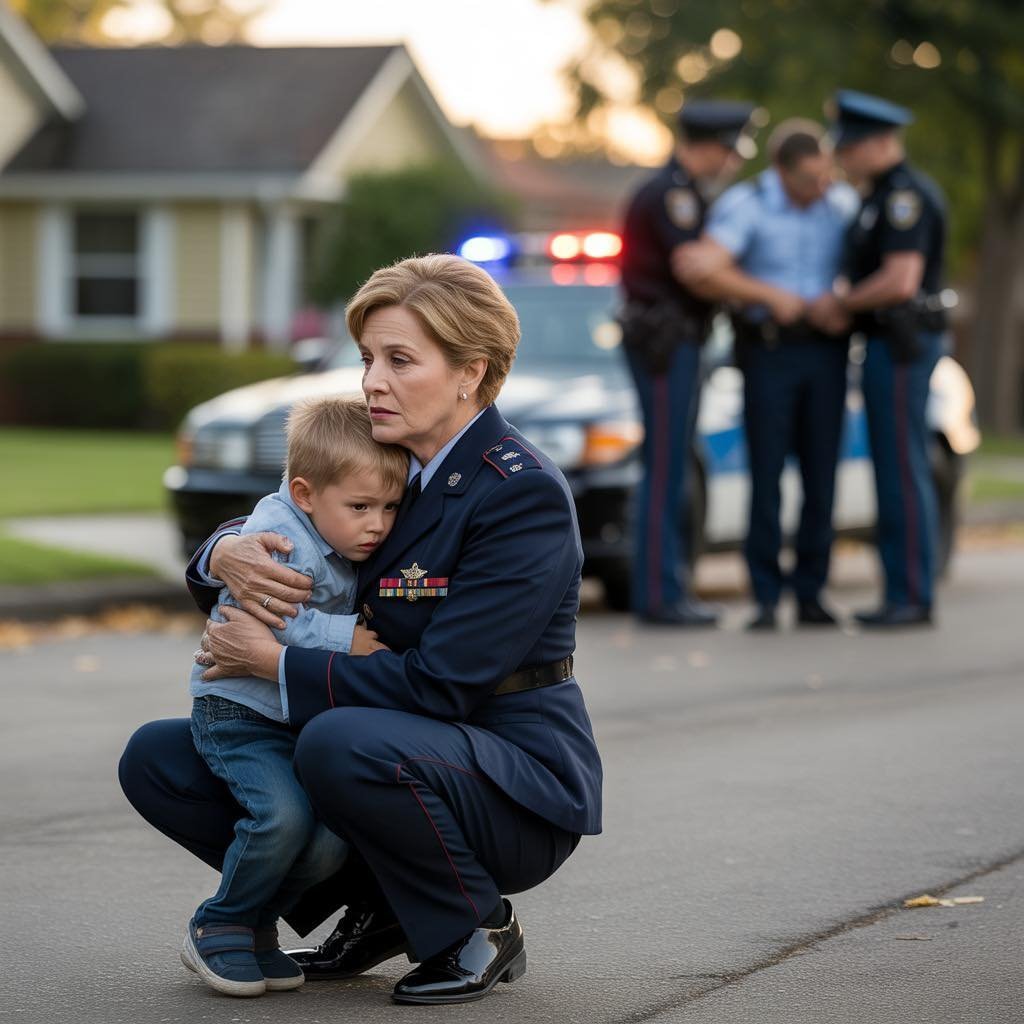
Agnes had been escorted to a hotel by a social worker pending the investigation—she’d flipped on Brad so quickly and thoroughly that the DA was considering her as a witness rather than a co-defendant. Sarah sat at the kitchen table, holding a cup of tea I’d made her while Sam slept in her lap, his small body finally relaxed after I’d helped her give him a warm bath to wash away the trauma of the evening. “The police said you… you took him down,” Sarah said quietly, staring into her tea.
“The officer told me it was the most professional civilian restraint he’d ever witnessed. He said it looked like military training.”
I sat down across from her, feeling every one of my sixty years now that the adrenaline had faded. My knees ached.
My wrist was sore where I’d blocked Brad’s knife strike. “I took some self-defense classes at the Y years ago,” I offered. Sarah looked up at me, and I saw my daughter—truly saw her—looking at me with adult eyes for perhaps the first time in her life.
“Mom. Don’t lie to me. Not tonight.
Who were you? Before you were Grandma, who were you really?”
I looked at my hands, resting on the table. The hands that had cooked dinner and changed diapers and later tonight had disabled a man twice my size.
“I was a specialist, Sarah,” I said quietly. “I worked for the government in intelligence operations. My job was to protect people and extract information from dangerous individuals who threatened national security.
It’s why I was gone so much when you were young. Why your father raised you largely on his own. Why I couldn’t talk about my work.”
“Is that why you know how to… to do what you did tonight?” she asked.
“Yes.”
Tears spilled down her cheeks. “You saved him. If you hadn’t been here, if you’d just been a normal grandmother who didn’t know how to fight back—”
“But I was here,” I interrupted gently.
“And I’m not going anywhere. You and Sam are safe now.”
She nodded, wiping her eyes, then looked at me with something like awe. “He called you weak.
They both did. They had no idea.”
“People often mistake quietness for weakness,” I said. “Kindness for passivity.
I let them think what they wanted while I gathered information and waited.”
“Waited for what?”
“For them to cross a line I couldn’t allow,” I said simply. “They crossed it tonight.”
Later, after Sarah had carried Sam upstairs to bed, I walked through the house doing a security check out of habit. The front door was damaged where the police had initially forced entry, but I wedged a chair under the handle.
I checked all the windows. I walked past the closet under the stairs—its door hanging broken on twisted hinges, the darkness inside no longer threatening now that it had been exposed and defeated. I returned to the living room and sat in the armchair by the window, watching the street.
A police cruiser was parked down the block, a silent guardian that would remain until morning. I wasn’t worried about Brad coming back. He wouldn’t make bail, not with the assault on an elderly person charge added to the child abuse charges.
The recording I’d provided the police had been damning. My statement had been detailed and precise. Sarah’s testimony had been heartbreaking and absolute.
I thought about the years I’d spent in windowless rooms in undisclosed locations, facing men who thought they were monsters, who thought they were unbreakable. I’d learned that everyone has a breaking point. Everyone has a weakness that can be identified and exploited if you’re patient enough, observant enough, skilled enough.
Brad’s weakness had been his ego, his absolute certainty that size and aggression equaled power. He’d thought strength was about dominating others, about inflicting pain to create fear. He’d never understood that true strength is about enduring pain—and then ending the source of it with precision and finality.
I closed my eyes, listening to the silence of the house. It was a good silence now. A safe silence.
Upstairs, I could hear the faint sound of Sarah reading to Sam, her voice soft and soothing, rebuilding the sense of security that had been shattered tonight. They’d called me a servant. They’d called me weak.
They’d thought I was nothing more than free childcare, a convenient resource to be exploited and dismissed. Let them think what they wanted. I had been many things in my life—intelligence specialist, interrogator, guardian.
But tonight, I had been exactly what was needed: the wall between a child and the wolves. And tonight, the wolves had learned what happened when they mistook quietness for weakness. The next morning, Sarah found me in the kitchen making pancakes shaped like dinosaurs because that’s what Sam liked.
She hugged me from behind, her arms tight around my shoulders. “I’m sorry, Mom,” she whispered. “I’m sorry I didn’t see what was happening.
I’m sorry I believed Brad when he said you were happy here.”
“You were working hard, trying to build a life,” I said, flipping a triceratops. “You weren’t supposed to see it. They were careful to hide it from you.”
“What happens now?” she asked.
“Now?” I smiled at her. “Now you file for divorce. Now you take your son and build a life where kindness isn’t seen as weakness and crying isn’t seen as failure.
Now you teach Sam that real strength is about protecting others, not dominating them.”
“And you?” she asked. “Will you stay?”
I looked at her, my daughter, finally seeing me clearly. “For as long as you need me,” I said.
“But this time, not as free help. As family.”
She laughed through her tears. “Deal.”
Sam came downstairs then, moving carefully like he wasn’t quite sure the world was safe yet.
But when he saw the dinosaur pancakes, his face lit up with that four-year-old joy that can resurface even after trauma, given safety and love. “Gamma! You made dinos!”
“I did,” I said, scooping him up for a hug.
“And today, we’re going to have a special day. Just you, me, and Mommy. We’re going to the park and the ice cream shop, and you can cry if you want to, laugh if you want to, and be exactly who you are.”
He hugged me tight, and I felt his small body relax completely for the first time since I’d opened that closet door.
They’d thought I was just a grandmother. Just free childcare. Just a servant who could be dismissed to the kitchen.
They’d been wrong about all of it. And that, ultimately, was the lesson Brad and Agnes had learned at considerable cost: never underestimate the person serving your dinner. You have no idea what skills they brought home from work.
These were old hands, veined and age-spotted, but they didn’t shake. They hadn’t shaken in thirty years, not since my second tour in Kandahar when steadiness under pressure meant the difference between extracting intelligence and watching an operation collapse. I pushed through the swinging door with my hip, the hinges giving their familiar squeak.
“Here you are,” I said softly, placing the gravy boat beside Brad’s plate with the same precision I’d once used to set recording equipment in hostile interrogation rooms. I made a move to pull out the empty chair next to Brad—the one usually reserved for family or honored guests, the one that had sat empty all evening while I stood in the kitchen eating cold scraps off a paper plate like a dog being fed table scraps. Mrs.
Why don’t you finish your dinner in the kitchen? I’m sure there’s plenty of good meat left on the carcass.”
I looked at Brad, this man who had married my daughter seven years ago, who had seemed charming and ambitious at their wedding, who had slowly revealed himself to be something else entirely. My daughter Sarah was working a double shift at the hospital—her third this week—believing I was living here as a beloved matriarch, a cherished grandmother helping out while recovering from what I’d told her was a “mild stroke.” She didn’t know the stroke story was a cover for a minor tactical injury I’d sustained during my final classified assignment. She didn’t know her husband treated me like an indentured servant.
And close the door behind you—the draft is annoying.”