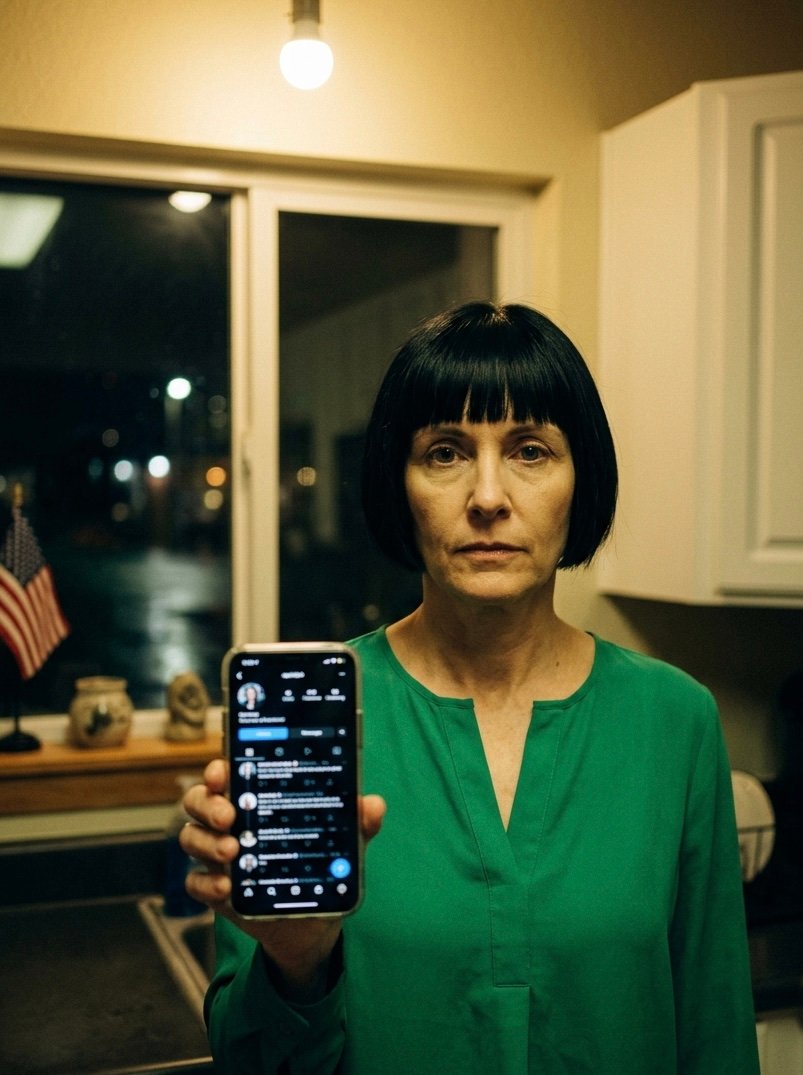
My name is Isabella. I’m thirty‑four years old. I live alone now in a small, clean apartment in a city a few hours from the New Jersey cul‑de‑sac where I grew up.
My building sits over a coffee shop and a dry cleaner, on a tree‑lined street where people walk golden retrievers and carry reusable grocery bags from Trader Joe’s. My walls are painted a soft cream. My sheets are crisp and white from too much time in the Target bedding aisle.
Everything in my life is organized. Everything is quiet. It took me a long time to get used to a silence that wasn’t filled with tension.
The night everything started again, my phone was vibrating against the nightstand, a harsh, angry sound in the soft dark of my bedroom. I rolled over and squinted at the red digits on my alarm clock. 2:14 a.m.
The phone kept buzzing. Relentless. I reached out and picked it up.
The screen lit up so bright it hurt my eyes. Mom. I hadn’t seen that name on my screen in ten years.
Below her name, in small white letters, was the notification. 35 missed calls. Thirty‑five.
My heart started pounding against my ribs like I was back in high school, waiting to see my report card. My hands were shaking so hard I nearly dropped the phone. Panic is a funny thing.
Even after a decade of freedom, after ten years of building my own life, one word on a glowing screen flipped me back into being a scared little girl standing in my parents’ hallway. I felt small. I felt guilty.
I sat up in bed and turned on the lamp. The light was yellow and warm, but I felt cold. I wrapped my arms around myself and just stared at the screen.
Why was she calling? Why now? Why thirty‑five times in the middle of the night?
In a normal family, thirty‑five calls from your mother at two in the morning means an emergency. A car crash. A stroke.
A heart attack. Somebody dying. But I don’t come from a normal family.
In my family, an “emergency” isn’t always real. Sometimes an emergency is just a weapon. I didn’t answer.
I couldn’t. I put the phone face down on the mattress and sucked in a breath, then another, trying to steady myself. In, out, in, out—just like my therapist in Philadelphia had taught me in that stuffy office with the humming air conditioner.
I looked around my room instead of at the phone. At the stack of books lined up neatly on my dresser. At the framed print of a gray‑blue Atlantic Ocean I’d bought last year with my own money from a weekend trip to the Jersey shore.
At the heavy blackout curtains I’d installed myself, the ones that kept the world outside where it belonged. This was my space. They weren’t allowed here.
The phone, still facedown on the bed, resumed its angry buzz. It was like a drill pressing into my brain. I thought about blocking the number.
I should have done it ten years ago. But a small part of me—the part that had been trained from childhood to be obedient, to be “the strong one”—hesitated. What if someone really was dying?
What if it was my father? My father was the only one I’d ever truly missed. He was weak, yes.
He never stood up for me. But he wasn’t cruel like my mother or my sister. He was just… defeated.
The buzzing stopped. For a second, there was blessed silence. Then a text popped up on the lock screen.
Isabella, pick up. It’s an emergency. It’s your sister.
My sister, Elina. Of course it was about Elina. It was always about Elina.
I put the phone down again, my thumb hovering but not typing any reply. I swung my legs over the side of the bed and padded to the kitchen. My bare feet were cold against the hardwood floor.
I poured myself a glass of water from the filtered pitcher and stood by the small kitchen window, looking down at the empty city street below. A streetlight washed the parked cars in pale orange. Somewhere in the distance, a siren wailed.
Ten years ago, I had walked out of a dining room and never looked back. I changed my number. I moved to a different city.
I got a new job. I never told them where I went. For the first year, I was terrified they would find me.
Every time I saw a silver sedan like my mother’s, my heart stopped. Every time my phone rang from an unknown number, I hit decline and watched it vibrate across the table. But they didn’t chase me.
That was the part that hurt most in the beginning. They didn’t try to find me to apologize. They didn’t call to see if I was safe.
They just… let me go. I was useful to them. I was the bank.
The fixer. The cleanup crew. When I stopped being useful, I stopped existing.
It took me a long time to understand the difference between being loved and being useful. When you are loved, people care about your feelings. They care if you are hurt.
They want you around because your presence matters. When you are useful, people care about what you can give them. They care if your wallet is open.
They want you around because your existence makes their lives easier. For twenty‑five years, I thought I was loved. I thought if I just gave enough, worked hard enough, sacrificed enough, they would finally look at me the way they looked at Elina.
I was wrong. I took a sip of water. It was cool and clean, tasting faintly of the city pipes.
In the bedroom, my phone started buzzing again. Call number thirty‑six. I didn’t move toward it.
I stayed by the window and let my mind drift back—not just to the slap, not just to the last dinner, but further. Back to when I was just a daughter trying to be good. Back to the slow, quiet descent into becoming a victim in my own home.
I needed to remember why I left. So I wouldn’t be tempted to answer. Elina is two years younger than me.
From the day she was born, she was the princess. She was delicate. She was pretty.
She had big blue eyes that filled with tears whenever she didn’t get her way. I was different. I was sturdy.
Quiet. Brown‑eyed with plain brown hair that frizzed in the New Jersey humidity. I did my homework without being asked.
I cleaned my room. I brought home A’s. “Isabella, you’re the strong one,” my mother used to say as she stood at the stove in our narrow suburban kitchen, flipping grilled cheese in a cast‑iron pan.
“Elina needs help. You don’t.”
I took that as a compliment. I thought it meant I was special.
I didn’t realize it was a trap. Being “the strong one” just meant I was the one expected to carry the load. It began with small things, the kind of things no one else would have noticed.
“Isabella, let Elina have the last cookie. You don’t need it.”
“Isabella, do Elina’s chores. She has a headache.”
“Isabella, give Elina your allowance.
She wants that doll and we’re a little short this week.”
I always said yes. I wanted to be good. I wanted Mom to smile at me the way she smiled at Elina.
I wanted Dad to pat my head, call me “Izzy,” and say, “Good job, kiddo.”
As we got older, the stakes got higher. The favors stopped being about cookies and dolls and started being about my life. When I was sixteen, I got my first job bagging groceries at the ShopRite off Route 22.
I worked evenings and weekends. I saved every penny in a battered blue savings account booklet I kept hidden under my socks. I wanted a car.
Not a fancy car. A used Honda Civic I’d seen on Craigslist. Freedom on four wheels.
Two weeks before I had enough saved, Elina crashed her scooter into a neighbor’s fence. She wasn’t hurt, but the scooter was totaled and the fence was splintered. That night, Mom came into my room.
She sat on the edge of my bed and sighed like the weight of the world was on her shoulders. “Isabella,” she said softly. “We have a problem.”
She told me about the fence.
The scooter. The repair bill. How they “didn’t have the cash right now.”
“We need to use your car fund.”
It wasn’t a question.