Do not suddenly move in a way that would alert them before I had proper protections in place. She said she knew an attorney in Columbus who specialized in estate planning and elder law.
She asked if she could make an introduction.
I said yes.
I spent the rest of that morning as if nothing had happened. I came back to the house, made myself half a turkey sandwich, put away a load of laundry, and asked Emma about her science quiz when she got home.
If I seemed quiet, nobody mentioned it.
That afternoon I told Carol I wanted to go browse at the public library.
“Take your time,” she said.
“Do you want me to pick you up later?”
I almost laughed at the tenderness of that.
“I have the car,” I said.
The library sat in a low brick building with rows of maples already shedding themselves into the parking lot. I used one of the public computers and researched senior living communities, independent living apartments, and active adult housing within a reasonable distance of Columbus, because June was there and because I wanted some part of my next life to sit near somebody who had known me before I became a mother.
That was how I found Hearthstone Gardens in Worthington.
Not a nursing home. Not assisted living.
An independent community with one- and two-bedroom apartments, full kitchens, a gardening club, a woodworking room, scheduled day trips, a library of its own, and a courtyard with rose beds that, even in late autumn, looked as though somebody still cared what would happen to them in spring.
There was a waiting list, but when I called the next day from the Kroger parking lot on the far side of town, the director told me a one-bedroom might open in a few weeks.
I said I would like more information.
By Friday evening, Linda had connected me with Patricia Harlan, the attorney.
Patricia was direct in the way truly competent women often are. No wasted sweetness.
No false urgency. Just clean, ordered thinking.
She explained exactly what a durable power of attorney for finances would allow and what it would not.
She explained that used honorably, it could be a sensible planning tool.
Used dishonorably—or obtained from a person under pressure, confusion, or false pretenses—it could become a way to reroute control long before a person had actually surrendered capacity.
“What matters,” she said, “is not the form itself. It’s the surrounding circumstances, the pressure, the intent, and whether the person signing understands fully and freely what she’s doing.”
I sat in my parked car behind a drugstore while she spoke, watching two teenagers argue over whose turn it was to return a shopping cart.
“And right now,” she continued, “the most important fact is that you haven’t signed anything.”
“No,” I said.
“Good. Then let’s keep it that way.”
Over the next eleven days, I lived my life as normally as I could while quietly rearranging its foundation.
I had three phone calls with Patricia, always from outside the house and never at the same time twice.
I did not want patterns.
Careful people understand that patterns are how other people begin to predict them.
Under Patricia’s guidance and Linda’s help, I opened new accounts at a different bank—one Scott did not know, one with no connection to his business circles or their neighborhood. I moved the proceeds from the house sale.
We set verbal passwords on the accounts. Instructions were placed on file that no changes, transfers, or discussions would take place with any third party without my direct written authorization and live confirmation.
Patricia also helped me establish a revocable living trust in my own name.
My son Daniel, who lived in Portland, was named as successor trustee, but only upon a physician’s determination of incapacity.
Not a family hunch. Not a son-in-law’s administrative efficiency. A physician.
I updated my health care documents too.
Daniel was named as my health care proxy.
Not because Carol was my daughter and therefore less loved, but because Daniel, from three time zones away, had somehow remained the least interested in managing me. Distance sometimes protects people from developing the illusion that proximity equals entitlement.
I rented a small post office box for mail related to the new accounts and documents.
I copied records. I organized papers.
I confirmed with Hearthstone that the one-bedroom apartment would indeed be available in three weeks and paid a deposit over the phone while sitting in the parking lot of a grocery store with a bag of clementines on the seat beside me.
The whole time, I behaved as if nothing had changed.
I helped Emma with a history project on Ohio canal towns.
I made a pot of chicken soup on Sunday afternoon with extra thyme and fresh parsley, and Scott came into the kitchen, lifted the lid, inhaled, and said, “This is the best-smelling thing in the house.”
At dinner he told me, “This is the best soup I’ve ever had.”
I smiled and said, “Thank you.”
I meant neither the smile nor the thank you, but forty years of nursing had taught me how to perform calm in situations where calm was the only useful tool available.
Once, during those eleven days, Scott brought the subject up again.
We were alone in the kitchen. He was making coffee with the machine that ground beans noisily enough to wake the dead.
“Did you get a chance to look at those planning materials?” he asked.
I was wiping down the counter.
“I did,” I said.
“And?”
“And I won’t be signing anything until I speak with Linda.”
For half a second, something changed in his face. It vanished quickly, but I saw it.
Surprise first.
Then recalculation.
He said it lightly. Friendly.
But from that day forward, he was more careful around me. Not less interested.
Just more careful.
That, more than anything, confirmed what I already knew.
I also spent those days sorting through my belongings.
Not packing. Not yet. Simply deciding.
What goes with a woman when she leaves one life for another?
More importantly, what doesn’t?
I knew I would take the framed photographs of Tom and the children when they were small.
I would take the quilt my mother pieced together during the Carter administration while listening to baseball on the radio. I would take the blue stoneware mixing bowl I used every Thanksgiving.
I would take the folder containing my nursing licenses, retirement papers, and certificates—not because anyone else cared, but because I did. A life’s work deserves not to be misplaced in somebody else’s linen closet.
Late one evening, after the house had gone quiet, I wrote two letters at the guest room desk.
The first was to Carol.
The second was to Scott.
I wrote them by hand on cream stationery I had bought years ago and never used because I had once believed good stationery required occasions.
Widowhood cures a person of that idea.
If the words matter, that is occasion enough.
Carol’s letter was the harder one.
I told her I loved her. I told her leaving without a confrontation was not meant to punish her but to protect myself. I told her I had heard enough to understand that staying in her house was no longer safe for me emotionally or financially.
I told her I did not know how much she had understood and how much she had chosen not to understand, and that those were not the same thing, but neither one allowed me to remain.
I told her something else too, and it took me a while to write it cleanly:
A daughter does not have to intend harm to participate in it.
Sometimes harm enters a room wearing concern and is allowed to stay because nobody wants an unpleasant conversation.
Scott’s letter was shorter.
I informed him that my financial affairs were private, fully managed, and no longer open to discussion. I instructed him not to contact my bank, adviser, or attorney under any circumstance.
I wrote that care is not the same as control, and that he had mistaken my grief for softness.
Then I folded both letters and tucked them into envelopes.
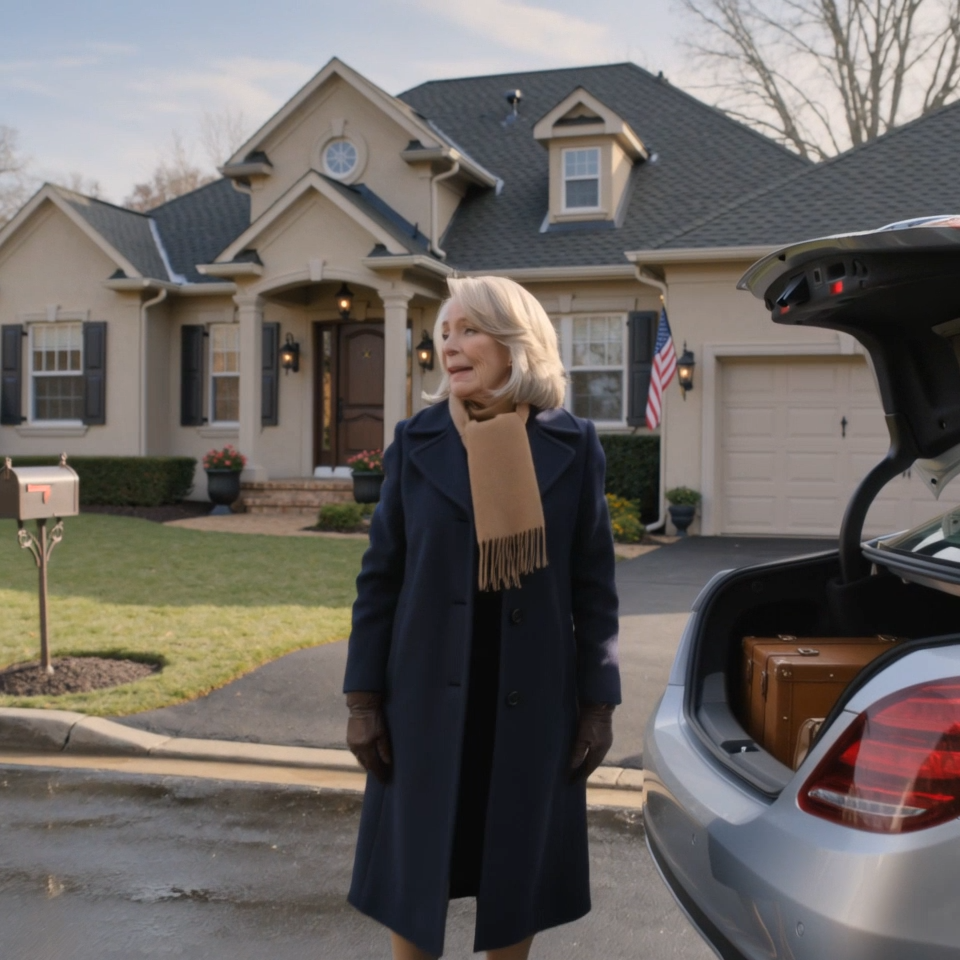
The morning I left, the air had that hard blue quality Ohio mornings get in late November when the ground is cold before the sun has any real say in the matter. Carol and Scott were taking Emma to a morning assembly at school.
The night before, I had told them I wasn’t feeling quite up to it.
Carol had pressed the back of her hand to my forehead, the way I used to do for her when she was eight.
“You don’t feel warm,” she said.
“I’m probably just tired.”
She studied my face for a second longer than usual.