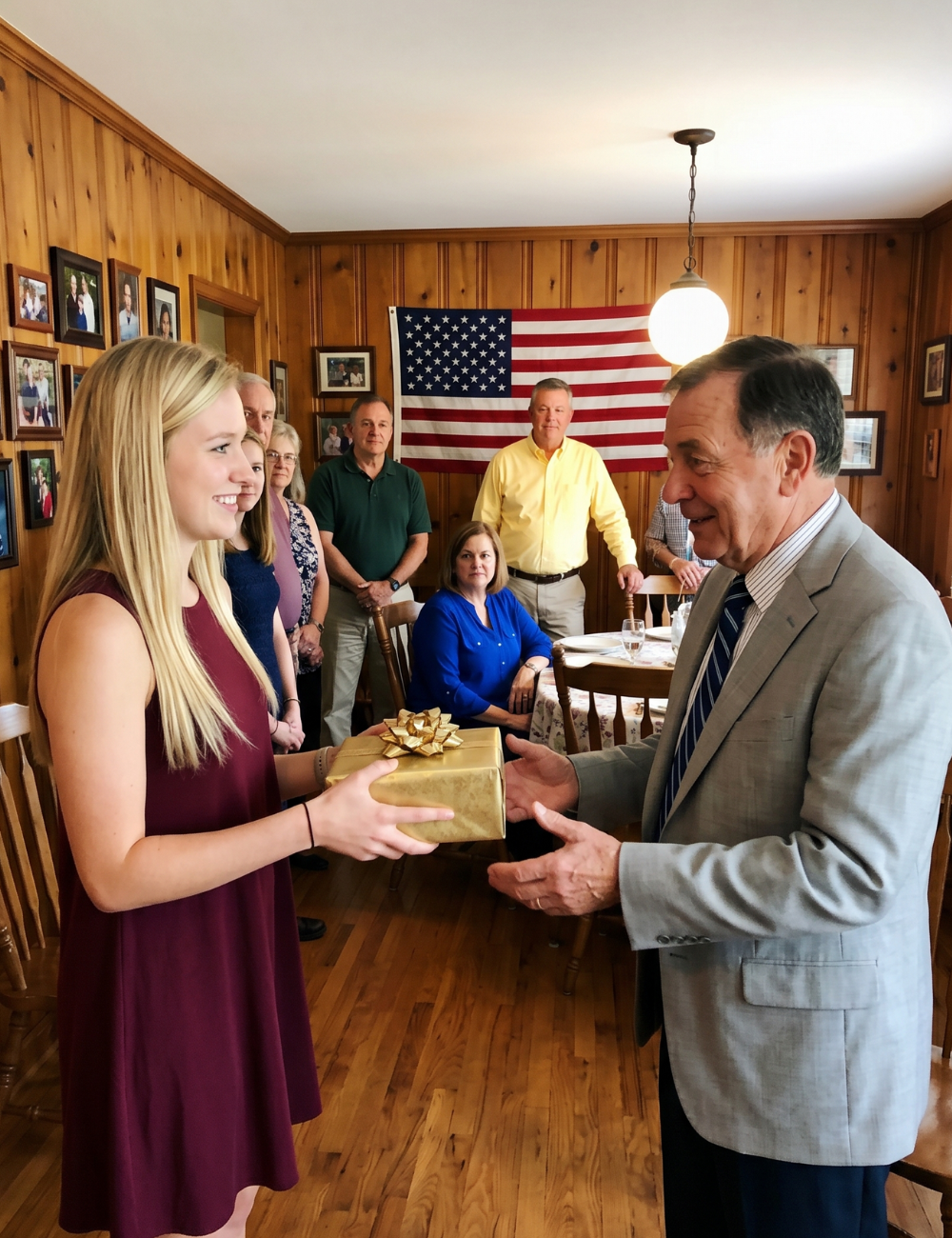
In a town of four thousand, silence is its own verdict. While my parents drove through the night, I was thirty thousand feet in the air, too. I boarded the plane in Columbus before dawn, the carry‑on bag at my feet and a hollow ache in my chest where the gold box had been.
I stared at the empty space on the floor like I could still see it there. Tommy was waiting at Denver International when I walked out of the terminal, hands shoved into his jacket pockets, worry etched into the lines around his eyes. He didn’t ask what happened.
He could read it on my face. He just took my bag, slid his arm around my shoulders, and walked me to the truck. We drove home in silence.
Not the kind that’s full of unsaid arguments. The kind that says, I’m here, and that’s all that matters right now. When we got inside, I sat on the couch and didn’t bother turning on the lights.
I stayed in my jacket. The familiar shapes of our living room—thrift‑store coffee table, crooked bookshelf Tommy kept meaning to fix—blurred in the dark. My phone buzzed three times on the coffee table.
“Ohio,” I said without looking. “I’m not ready.”
Tommy nodded, picked up the phone, set it face down, and went to put the kettle on. The crying hit like a wall—not the cinematic kind with a single tear rolling down a cheek, but the ugly, gasping kind you usually only let out alone in your car.
I pressed my face into a throw pillow and sobbed until my throat hurt. Tommy sat beside me and put his hand between my shoulder blades. He didn’t say any of the easy lines people like to throw at grief.
He just stayed. Eventually, the sobs ran out. I sat up, wiped my face on my sleeve, and turned my phone off.
I didn’t want to hear anything from Harden. Not that night. The next morning, muscle memory got me out of bed at five.
I made coffee and stepped out onto the porch in my bathrobe, mug warm between my hands, Denver air crisp in my lungs. Was I wrong to go? I wondered.
Was I wrong to keep quiet for five years? Should I have shouted the truth from the beginning or kept it buried forever? I was still turning those questions over when I heard an engine I didn’t recognize.
A dusty white pickup truck rolled slowly up the street and stopped crookedly at the curb in front of my duplex. Ohio plates. For a second, my brain refused to make the connection.
Then the driver’s door opened. My father climbed out. He wore the same flannel shirt he’d had on at the party.
It was wrinkled now. His hair was flattened on one side from sleeping in the truck. His eyes were rimmed red, like he hadn’t blinked in fourteen hours.
On the passenger side, my mother got out, careful with her knees. She held the gold box against her chest. The torn corner had been patched with fresh tape.
They stopped at the end of my short walkway, twenty feet of concrete between us. We just looked at each other. Somewhere down the block, a dog barked.
A sprinkler hissed to life in a neighbor’s yard. The world kept doing world things while my parents stood in front of my house for the first time ever. Dad’s mouth opened, closed, opened again like he was trying to chew his way through words that didn’t want to come out.
When he finally spoke, his voice was stripped down to something I’d never heard from him. “I’m sorry, Flora,” he said. Three words.
I’d spent my entire life wanting to hear them and never once believing I actually would. He swallowed. “I pushed away the only person who was holding us up,” he said.
“I pushed you away. I was wrong.”
I didn’t run down the steps. I didn’t collapse dramatically into his arms.
I stood there in my bathrobe with my coffee cooling in my hands and let the words settle where they needed to settle. Mom broke first. She walked up the path slowly, the box still clutched to her chest, tears already spilling over.
She stopped at the bottom step. “I knew, deep down,” she said hoarsely. “I knew something was off.
The numbers didn’t make sense. The way Vivien talked about money, the way the bank statements looked when I peeked. But I told myself it wasn’t my place to question.
I told myself your father would handle it. I was scared of what it would mean if I pushed.”
She squeezed the box tighter. “I let him push your gift off the table,” she whispered.
“In front of everyone. And I just sat there. I didn’t stand up for you once.”
Her gaze met mine.
“I don’t know how to forgive myself for that,” she said. I looked at her for a long moment. At the gray in her hair she’d stopped dyeing.
At the lines around her mouth that looked deeper than they had on Facebook. Then I stepped to the side and opened the front door. “Come in,” I said.
“Both of you.”
It wasn’t warm. Not yet. It was a beginning.
Inside, I moved on autopilot. Mugs out of the cabinet. Kettle on.
Tea bags in chipped cups. Tommy emerged from the hallway, hair sticking up, T‑shirt wrinkled. “Mr.
and Mrs. Mitchell,” he said quietly. Dad shook his hand like he’d been waiting to do that for years.
We sat at my little $4 estate‑sale kitchen table, the three of us. The same table where I’d written the letter that had blown up our family’s story. “I’m glad you came,” I said.
“But I need you to understand something before we talk about anything else.”
They both looked at me. “I love you,” I said. “That’s why I did what I did.
But I will not go back to being invisible in my own family.”
Mom nodded so fast her earrings trembled. Dad cleared his throat. “It’s not going to be like that anymore,” he said.
“Not if I have anything to say about it.”
“You do,” I said. “And so do I.”
They told me about the night after I’d left. About Martha opening the box.
About the letter. About Mr. Holloway’s comment at the door.
About how the phone in their house had been oddly quiet the next day—not because people were ignoring them, but because no one quite knew what to say. Dad told me about going to the bank on Monday. About sitting across from Dave Keller and asking him to remove Vivien’s name from every joint account.
Dave had done it without a single “I told you so.”
“She had access to things she shouldn’t have,” Dad said quietly. “That’s on me.”
They’d made an appointment with a local attorney to go over everything Vivien had had her hands in—the accounts, the insurance, the bills. “It’s precaution,” Dad said.
“But I need to know if there are any other surprises.”
Vivien, for her part, had sent a long group text three days after the party, after my parents had already left for Denver. According to Martha, it was full of winding explanations, of how she was the real victim, how Martha had turned everyone against her, how people just didn’t understand how much she’d done. Nobody responded.
Martha forwarded it to me with a single line: “The whole town’s talking. Not about the money. About who you are.”
I’d read it twice and then put my phone down and gone back to charting vitals.
Now, at my kitchen table, with my parents’ hands wrapped around mugs of tea, I said the part I’d been holding onto since I heard their truck outside. “If we’re going to rebuild anything,” I said, “I need a few things.”
Dad straightened in his chair. Mom folded her hands.
“I need you to call me,” I said. “Not just when something’s wrong. Regularly.
I need to hear from you because you want to, not because you feel guilty.”
Dad nodded. “Every Sunday,” he said. “Seven o’clock.
I can do that.”
“I need you to stop letting one person decide who’s in this family and who isn’t,” I continued. “That goes for Vivien or anyone else. No one person gets to be the gatekeeper anymore.”
Mom nodded, tears welling up again.