I opened my jewelry box and took out my mother’s Mikimoto pearl earrings — the only thing of hers Diane hadn’t managed to claim. Then I picked up my phone and called Thomas Aldridge. “If I need you tomorrow,” I said, “can you execute within the hour?”
His voice was calm, unhurried.
“Everything has been ready for 23 years, Miss Paxton.”
I set my alarm for seven, hung the dress on the back of my door, and slept deeply — the way you sleep when you finally stop hoping and start deciding. The Whitmore Hotel on a Saturday evening in October is the kind of place that makes you feel underdressed even in your best. Crystal chandeliers the size of small cars.
Italian marble floors polished to a mirror sheen. A live jazz quartet playing Cole Porter with the effortless precision money buys. Two hundred guests.
Business partners, golf friends, Westchester socialites. A banner that read: Cheers to Richard Paxton. 35 Years of Building Legacy.
I gave my name at the reception table. The young woman checked her list, scrolled, checked again. “You were added yesterday.”
Yesterday.
Two hundred guests confirmed months in advance, and I was squeezed into the margin like a typo someone caught at the last minute. “Thank you,” I said, and walked in. The whispers hit me in waves.
Not shouts — whispers. The kind that travel across a cocktail hour like a draft under a door. A cluster of women near the bar: “That’s the frigid daughter.”
A man in a pinstriped suit, leaning toward his wife: “I heard she’s been out of work for months.”
Another voice, half-hidden behind hydrangeas: “She can’t do anything right.
Diane says she just causes scenes.”
Diane’s seeds were blooming exactly on schedule. I kept my back straight. I kept walking.
I found my father near the small stage — standing between Diane and Meredith, smiling for a photographer arranging them into a family portrait. Richard. Diane.
Meredith. Three people, perfectly composed. No one called my name.
From the corner of my eye, I noticed two men in dark suits near the ballroom entrance. Security earpieces. One of them glanced at Diane, then at me, and shifted his weight.
They’d been told to watch me. I made my way across the ballroom. I passed a table of my father’s former business partners — men I’d known since childhood — and not one of them said hello.
Diane’s narrative had done its work. I wasn’t Richard Paxton’s eldest daughter anymore. I was the cautionary tale they’d been briefed on.
I reached the small circle around my father. Richard saw me first. A flicker of warmth, quickly followed by something that looked like panic.
He opened his mouth, but before the words came, Diane’s hand was on his shoulder. “Laura,” he managed. “Glad you could make it.”
Five words.
The same five words you’d say to a colleague you barely recognized. Diane turned to face me, radiant in cream silk, diamonds at her throat, that particular smile she wore when she was about to draw blood. Her voice was pitched just loud enough for the circle around us to hear every syllable.
“Laura, what a surprise. I wasn’t sure you’d come, given everything.” She let the pause land, eyes sweeping the group. Then, softer, almost tender: “Just don’t make it about yourself, okay?
Tonight is about family.”
Family. The word landed like a slap. Meredith appeared at Diane’s elbow, a new Tiffany necklace catching the chandelier light.
She looked at my dress with the specific smile that is actually an inventory. “Laura, love the dress. Is that from last season?”
I looked at my father.
“Dad, can I talk to you for a moment? Alone?”
I saw the instinct — the flicker of yes. His body leaned half an inch toward me.
Then Diane’s hand tightened on his arm. “Richard, the Hendersons are waiting. You can talk to Laura later.”
My father looked at Diane.
Looked at me. And then he turned and walked away. I stood alone in the middle of 200 people.
The speeches began at 8:30. Diane took the microphone first. She delivered a flawless performance — thanked the guests, praised Richard’s 35 years, called Meredith up for an embrace that drew a collective sound from 200 throats.
She spoke about family, loyalty, the people who truly make a house a home. She did not say my name. Catherine’s name was not mentioned once.
When the applause faded, I stood. I wasn’t going to make a speech. I only wanted to walk to the front, give my father his gift — a small velvet box containing a brass compass I’d restored, the one my mother had given him when they were young and in love, engraved with her initials, C.H.
— and say something quiet. Something that was ours. I was ten steps from the stage when Diane saw me coming.
Her expression didn’t change. That’s the thing I remember most. How controlled she was.
She leaned into the microphone and, in a voice as clear and calm as a dinner bell, said:
“Security.”
The ballroom murmured. Heads turned. “Please remove this woman.
She wasn’t invited, and she’s causing a disruption.”
Two hundred people went silent. The jazz quartet stopped. Even the bartender paused mid-pour.
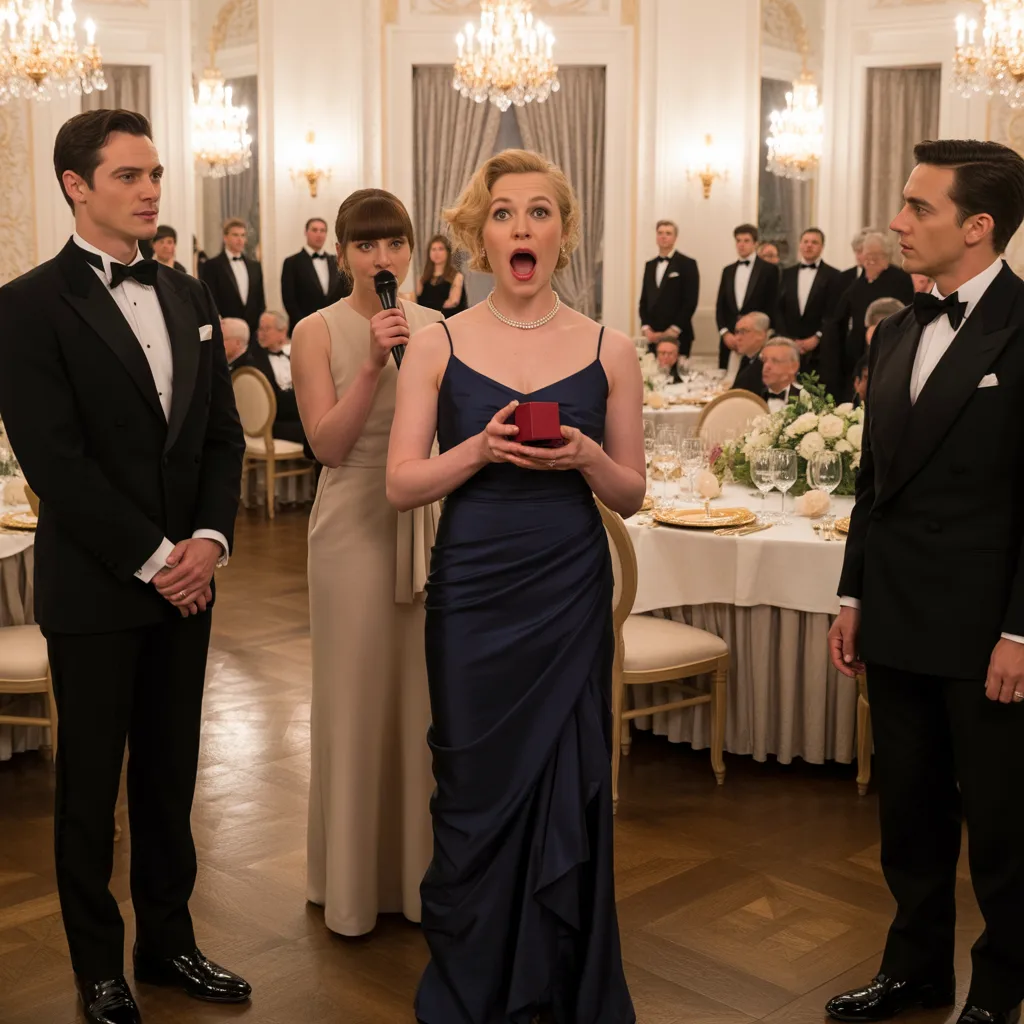
Every pair of eyes in that room turned to me — standing alone in the center aisle, holding a small velvet box, wearing my mother’s pearls. I looked at my father. Richard Paxton was three steps from the microphone.
He looked at Diane. He looked at me. And then he looked at the floor.
He said nothing. The two security guards materialized beside me. One of them spoke quietly.
“Ma’am, we’ve been asked to escort you out.”
Meredith, near the stage, had her phone up. Filming. I set the velvet box on the nearest table.
I did not throw it. I did not slam it. I placed it gently, the way you’d set down something you loved and were leaving behind.
Then I looked at my father and said, not with anger, just clearly enough for the people nearby to hear: “I came for you, Dad. Not for her. But I see your choice.”
I turned.
I walked toward the exit, back straight, eyes dry, my mother’s Mikimoto pearls catching the last of the chandelier light as I passed through the double doors. Behind me, I heard Diane’s voice return to the microphone. “I’m so sorry about that, everyone.
Now, where were we?”
The jazz quartet started up again before the doors closed. The October air hit me like cold water. I stood on the marble steps of the Whitmore Hotel and listened to the muffled music bleeding through the walls.
Cole Porter. Laughter. The clink of champagne glasses.
A world continuing without interruption, as if a woman hadn’t just been marched out of her father’s celebration by two men in earpieces. I gave myself sixty seconds. Sixty seconds to feel all of it.
The humiliation. The silence where my father’s voice should have been. The knowledge that 200 people had watched me be erased and gone back to their champagne.
Sixty seconds for every swallowed word, every Christmas at the small table, every drive home when I told myself it didn’t matter. Then I stood up. Because my mother didn’t raise me to sit on other people’s steps.
I pulled out my phone and called Rebecca Stone, the fiduciary manager. She picked up on the first ring. “Rebecca, this is Laura Paxton.
I’m ready to proceed with the segregated fund transfer tonight.”
“I’ll need your digital signature and the authorization code from Mr. Aldridge. I can execute within 45 minutes of receiving both.”
“You’ll have them in ten.”
I walked to my car, opened my laptop on the passenger seat, and dialed a conference call.
Aldridge joined first, then Rebecca. “Authorization code,” Aldridge said. He read it off — twelve alphanumeric characters, calm and precise, as if reading a weather report.
“This authorizes the transfer of segregated funds from the Paxton family trust to the Laura Paxton Irrevocable Trust per the trust agreement of 2004 and amendment of 2006.”
Rebecca confirmed receipt. My phone buzzed with a DocuSign document. I read every line — because my mother taught me that everything beautiful starts with structure — and signed.
“Processing,” Rebecca said. “Estimated completion: 45 minutes.”
I wasn’t canceling accounts out of spite. I was watching arithmetic do what arithmetic does.
When the trust balance dropped below the collateral covenant threshold, the bank’s automated system would freeze every linked account. Every card. Every membership.
Every insurance rider. At 9:47 PM, Rebecca called back. “Transfer complete.
$17,042,316.78. The funds are in your trust, Miss Paxton.”
I closed the laptop. I sat in the dark and listened to my own breathing.