
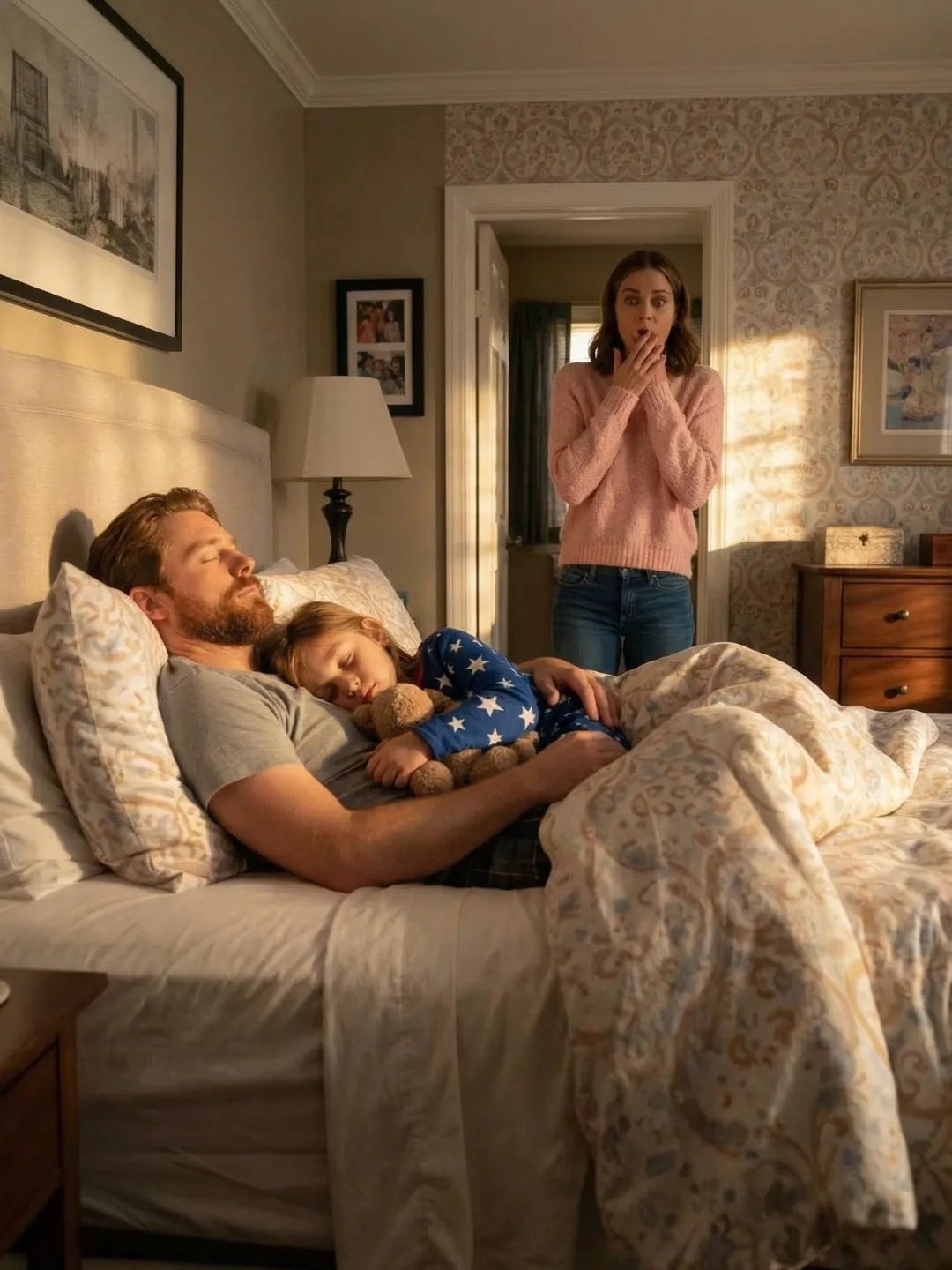
Our home in suburban San Jose was usually a picture of routine and soft evening quiet. My husband, Daniel, and I had raised our daughter, Emily, with a focus on structure and independence; she was a confident child who loved her storybooks and her sturdy, orthopedic twin bed. For years, bedtime was the easiest part of our day.
That changed on a Tuesday.
Emily came down to breakfast, her hair tousled and her eyes heavy, and told me, “Mom, my bed is getting too small. I felt like I was being crowded out all night.”
I laughed it off, assuming it was just a vivid dream. But when she said it again on Wednesday, and then again on Thursday, the levity faded. I started checking her room, looking for signs of bugs or structural issues, but everything seemed perfectly fine. By Friday, when Emily whispered, “Mom, did you come in to visit me last night? I felt someone there,” a cold, quiet worry settled in my stomach.
Daniel tried to be the voice of reason. “She’s seven, honey. Seven-year-olds have active imaginations. It’s probably just a growth spurt making her restless.”
But a mother’s instinct is a persistent thing. It doesn’t care about logic; it cares about safety. To quiet my own mind, I placed a high-definition security camera on her bookshelf, tucked discreetly behind a row of worn-out paperbacks. I told myself I just needed one night of footage to prove that she was sleeping alone and soundly.
The first night, the feed was static. A dark, quiet room. No movement.
The second night, the camera caught a shadow.
I woke up at 3:15 AM, the blue light of my phone screen illuminating my side of the bed. I tapped the app and watched the feed. My breath caught in my throat. The door to Emily’s room was creaking open, letting in a thin sliver of light from the hallway. A figure appeared—slow, tentative, moving with the fragility of a winter leaf.
It was Daniel’s mother, Margaret.
She walked with a slight limp, her posture hunched, until she reached the bedside. She stood there for a long time, looking down at our daughter. Then, she slowly sat on the edge of the mattress and carefully lay down beside Emily.
Emily shifted in her sleep, her small body instinctively moving to make space, and Margaret curled up behind her, her hand resting protectively over Emily’s shoulder.
I didn’t wake Daniel. I didn’t run into the room. I just watched, tears blurring the screen.
Margaret had been a widow for thirty years, a woman of steel who had raised Daniel single-handedly on a waitress’s salary. She was the woman who had mended every torn pair of jeans and worked every holiday so Daniel could have a better life. But lately, she had begun to lose her grip on the present. We had seen the signs—the keys left in the fridge, the stories repeated three times in one afternoon—but we hadn’t realized that the past was becoming more vivid than the present for her.
In that dark, quiet room, Margaret wasn’t a confused elderly woman struggling with dementia. In her mind, she was likely back in the eighties, curling up next to a young Daniel in a house that no longer existed. She was seeking the only thing that made sense to her heart: the feeling of being a mother, of keeping a child safe in the dark.
The next morning, the breakfast table was somber. We didn’t show Margaret the video; there was no need to shame her for a memory she couldn’t control. Instead, we sat her down and told her we were rearranging the house.
“Mom,” Daniel said, his voice thick with emotion, “we’re moving your room to the guest suite downstairs. It’s closer to the kitchen, and it’s much quieter.”
Margaret looked at him, her eyes momentarily clear, reflecting a flash of the strong woman she had been. “I don’t want to be a bother,” she whispered.
“You’re not a bother,” I said, taking her hand. “You’re the heart of this home.”
The transition wasn’t easy, but it was filled with grace. We moved Emily’s bed into our room for a few weeks to give her a sense of security, and we spent the evenings in Margaret’s new room, listening to her talk about the “little boy” she was raising, even when she addressed Daniel by his father’s name. We leaned into her reality rather than fighting it. We helped her fold clothes that weren’t there and shared tea with ghosts of our family’s past.
Emily, for her part, showed a wisdom far beyond her seven years. When she finally moved back into her own room, she started leaving the door cracked open, and she kept a spare blanket draped over the foot of her bed. “In case Grandma gets cold,” she told me.
Emily’s bed wasn’t too small; it was just trying to hold two lifetimes of love at once. We hadn’t been dealing with a ghost or an intruder, but a heart that was simply trying to find its way home. In the end, we learned that the seasons of life don’t just change for the young—they change for the old, too. And sometimes, the most important thing we can do is slow down, open the door, and make enough space for everyone to rest.