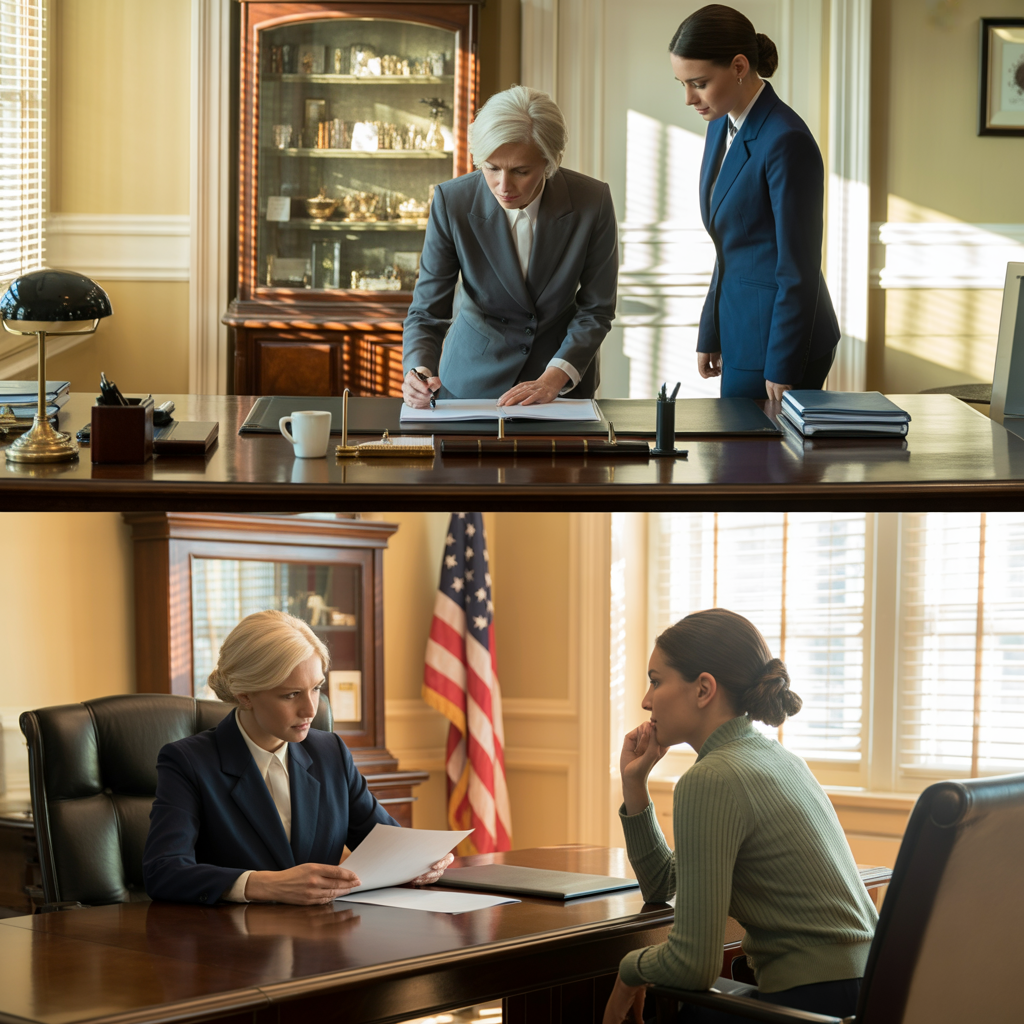
Pastor Helen sat in the front row. Emma slipped in quietly and took the seat beside her. I caught her eye and nodded once. She didn’t smile. She looked serious.
Ready.
“Thank you all for coming,” I began, standing behind the small podium. No microphone, no amplification—just me.
“My name is Edith Groves. I’ve lived in this town since I was twenty-one. I ran a hardware store with my husband, raised one son, paid my taxes, kept a clean kitchen, and buried more friends than I care to count.”
I paused.
“I am not sick. I am not senile. I am not fragile. But I am tired of silence—of manipulation, of the way people treat older women like faded photographs. Easy to overlook unless you need something sentimental.”
A few nods. Someone sniffled in the second row.
“I came here tonight to tell you a story. My story. The one that’s being twisted and whispered around this town in coffee shops and choir rows. I came to correct the record.”
I opened my notebook, but I didn’t read from it. I spoke from memory, from the marrow.
I told them about the forged document. About Thomas walking into a bank and trying to declare me incompetent. About the letter with Ray’s dead name at the bottom. About the calls. About the slick suggestions that I’d lost touch with reality.
I didn’t cry. I didn’t shout.
I just told the truth line by line, like nails into wood.
I told them about the trust—how I created it for Emma because she was the only one who came without asking, who stayed without strings.
And then I looked directly at Evelyn.
“She told me I was tearing the family apart,” I said. “But what do you call a family that only holds together through fear and obligation? Is that even something worth saving?”
Evelyn didn’t blink, but her fingers tightened on her purse.
“I’m not asking for pity,” I said. “I’m not asking for applause. I just want the truth to live somewhere outside my body before it’s too late.”
I took a breath and looked around.
“I know many of you have children, grandchildren. I know some of you have secrets—shame, maybe regret. Maybe you’re sitting there thinking, I’ve kept quiet for too long. I know the feeling.”
I looked at the woman from the corner store who once lent me sugar. At the man who ran the funeral parlor. At Emma watching me like a lighthouse.
“Well,” I said, “this is me saying it’s never too late.”
I stepped back.
No bow. No flourish.
Just the hush of a room learning how to listen again.
Afterward, there was no clapping—just something better. Stillness, the kind that doesn’t need noise to prove it heard you.
Then, one by one, people rose. Some shook my hand. Others hugged me. A few just nodded—eyes glassy, lips tight. I didn’t need words. I had enough of those for one night.
Emma came last. She didn’t say anything; she just wrapped her arms around me like she was trying to hold everything together that the world had tried to tear apart. Then she whispered, “You looked taller tonight.”
I laughed, soft and surprised. “That’s what happens when you stop carrying shame.”
Behind her, Evelyn had already gone—slipped out the side door like smoke, like guilt trying to avoid daylight.
I didn’t care.
Let her run. Let her report back. Let them fume in their rooms filled with resentment and failed control.
I had done what I came to do.
And that night, for the first time in a long time, I slept without dreaming of explanations.
I woke to roses—three pale yellow stems in a mason jar left on my porch without a note. No card, no signature, just the flowers placed gently beside the door like gratitude that didn’t need to be traced.
I knew they were from someone who had been there, someone who heard.
Inside, the kettle hissed. I poured my tea, sat by the window, and watched the street breathe. A dog walker passed. A boy with a backpack too large for his frame.
Life, unaware that anything had changed.
But it had.
Not in headlines, not in legal documents—inside.
Later that morning, Emma called.
“They’re quiet,” she said. “Too quiet.”
She meant Thomas and Evelyn. I understood the worry. That stillness wasn’t surrender. It was strategy—the quiet of people who play long games, who don’t mind waiting if they believe you’ll wear down.
But I wasn’t tired anymore.
“They know now,” I said. “All of them. The town, the church, your boss, the bank. That story they were trying to spin has a counterweight now.”
Emma sighed. “I’m still getting calls from a number that won’t leave voicemails.”
“Block it,” I said.
“I did, but it feels like they’re circling. Waiting for something.”
“They’re waiting for you to break,” I said. “So don’t.”
“They’re not used to hearing no,” I added. “They’re about to get fluent in it.”
I hung up and got dressed slowly. I was heading into town—not for errands, but for presence. It matters sometimes just to be seen.
At the coffee shop, the owner, Miranda, gave me my tea on the house. She didn’t say why, and I didn’t ask. A silent solidarity passed between us.
I sat by the window and read the paper, letting normalcy settle into my bones.
Then Evelyn walked in.
No clipboard this time, no coat armor—just jeans, a sweater, and a face that looked carved out of cold marble. She saw me, paused, then walked straight to the counter, ordered her drink, waited, said nothing.
But she kept glancing over. Flickers. Tells.
When she turned to leave, she paused at my table.
“Quite the speech,” she said.
I didn’t look up from my paper. “Truth doesn’t need embellishment.”
“You’ve turned this town into your jury.”
I folded the paper carefully. “No. I just stopped letting you write the testimony.”
She shifted. “You think any of this will matter when the lawyers get involved?”
“It already matters,” I said. “People believe me—and more importantly, I do.”
She tilted her head, studying me like a puzzle that used to be easy. “You always were theatrical.”
“No,” I said. “I was quiet. You just mistook that for agreement.”
She scoffed and stepped back, but before she left, I added, “You can keep circling, keep calling, keep spinning stories—but I promise you, Evelyn, when the dust settles, all you’ll have is the echo of your own entitlement.”
She didn’t reply. She left.
And this time, the room didn’t watch me.
It watched her.
Later at home, I sat in the kitchen with the roses in front of me. I touched one of the petals—soft, stubborn in its brightness.
Then I opened the locked drawer where I kept my will. I added a note—not legal, just personal.
To Emma: In case you ever doubt your worth, know this. You didn’t inherit money. You inherited proof that standing your ground is not the same as being unkind. Love, Grandma.
I folded the note, placed it beneath the documents, and closed the drawer.
Let them prepare lawsuits, whispers, strategies.
I had legacy, and not even they could steal that.
It came quietly, the way most endings do.
A letter—certified mail, return receipt requested. My name typed neatly, the envelope thick but weightless in meaning. The sender: Thomas Groves, Co. Lang, and Associates.
Deborah called before I even opened it.
“It’s not a lawsuit,” she said. “It’s a settlement offer.”
Of course it was.
They’d tested the town, tested me, tested Emma, found no cracks. So now they did what entitled people do when power slips through their fingers—offer a compromise designed to look like mercy.
I opened the letter with a butter knife and unfolded it on the kitchen table like a relic.
To Edith Groves,
In the interest of preserving what remains of our family’s dignity and avoiding further public embarrassment, we propose the following.
You agree to dissolve the trust in Emma’s name and reinstate the previous financial distribution outlined in your 2019 estate plan. In exchange, we agree to cease all legal and reputational challenges and refrain from further action or contact. This is a one-time offer. Please consider the impact on your granddaughter and the long-term unity of our family.
With respect,
Thomas and Evelyn Groves
No lawyer signature.
Just theirs.
Not strategy. Desperation in a suit.
I read it twice, then once more, slower. Every sentence trying to fold itself into reason, into decency.