For my entire adult life, I have operated under a silent, exhausting contract: if I am needed, I must be there. I was the family’s emotional shock absorber, the one who stepped into every crisis, swallowed every disappointment, and silenced my own needs to ensure the peace of everyone else. I became an expert at the reflexive “Yes,” a response so deeply ingrained that it felt like an instinct rather than a choice.
Then came the morning that broke the cycle.
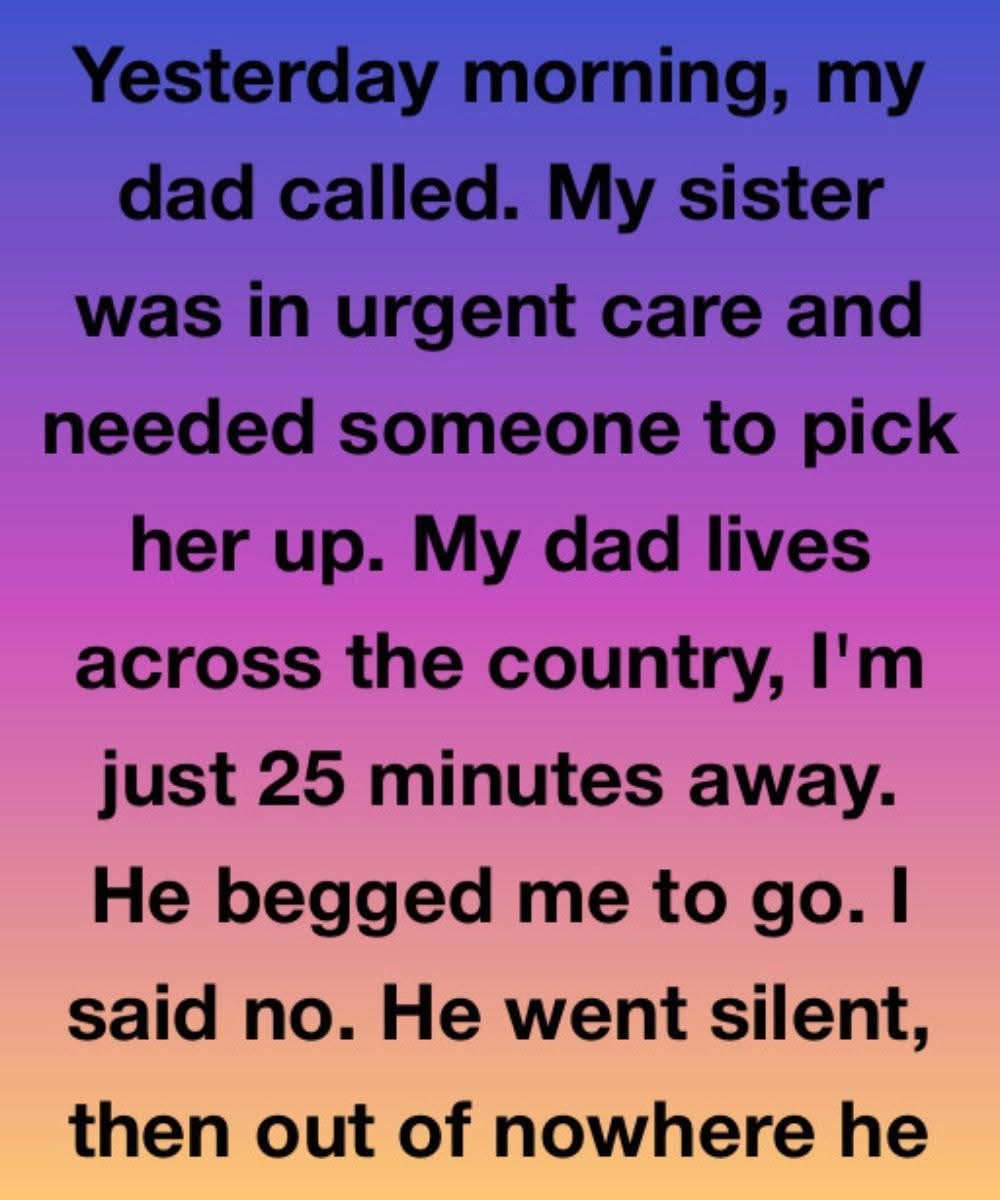
I was sitting in the fragile, quiet peace of my own home when my father’s voice shattered it. My sister was in urgent care. He was miles away, across the country, and the familiar, frantic baton of family crisis was being thrust into my hands. “Please,” he said, his voice tight with the expectation of my compliance. “She needs you.”
In the past, my response would have been instantaneous—the keys in my hand, the engine running, my own plans for the day discarded like trash. But this time, the “Yes” stayed locked in my throat. I felt the familiar, toxic wave of guilt rising, trying to override my logic, but I anchored myself to the truth of the last three years.
There had been no contact with my sister for a reason. The distance hadn’t been a sudden cliff; it was a slow erosion caused by years of broken promises and a betrayal of trust that had left my bank account empty and my spirit bruised. Everyone around me had spent years preaching the gospel of being the “bigger person,” as if my capacity to be hurt was infinite. But being the bigger person had left me small. It had hollowed me out until I was nothing but a support structure for people who never bothered to ask if I was standing on solid ground.
I took a breath that felt like it took a lifetime. “No,” I said.
The silence that followed wasn’t just quiet; it was heavy with the weight of shattered expectations. My father’s whisper of confusion—“I don’t understand how you can do this”—was a blade, but for the first time, I didn’t try to dull it with an apology. I didn’t justify, defend, or explain. I let the silence exist, realizing that my peace was worth more than his understanding.
Hours passed. The guilt I expected—the crushing, familiar weight of it—never quite materialized. Instead, there was a strange, vibrating stillness.
When the phone buzzed, I braced for the assault. But the message from my dad was something else entirely. “She’s home. She’s upset. I am too. But we realized we never asked how all this has affected you.”
I stared at the screen, and the air left my lungs in a long, shuddering exhale. He hadn’t called to berate me. He had called to acknowledge the cost of my availability. For the first time in my life, the “reliable one” was being seen, not just for what I could provide, but for the exhaustion I had been carrying.
The next morning, the bridge I thought I had burned flickered back to life. A text from my sister. No demands, no pleas for help, no expectation that I would come running. Just a simple, quiet admission: “I know I’ve hurt you. I’m working on it. I don’t expect you to come running, but I hope someday we can heal.”
I didn’t rush to respond. I sat with the moment, letting it sit in the palm of my hand like a fragile bird.
I realized then that healing isn’t a grand, cinematic reconciliation. It is the slow, painstaking work of boundaries. By saying “No” to a cycle that was destroying me, I hadn’t destroyed my family; I had forced them to see me as a human being with limits, rather than a resource to be tapped.
Choosing myself was the most terrifying thing I have ever done, but it was also the most honest. Peace is no longer a luxury I have to earn by being useful to others; it is a space I have created for myself. I am no longer just the person who shows up when everyone else falls apart. I am finally the person who can stand on her own, and in that newfound strength, there is finally room for real, honest love to grow.