I learned the unit price of chocolate cereal, how fast a teenage boy can make a gallon of milk vanish, and that some mornings the right response to sorrow is pancakes.
We made schedules and broke them. Our grocery store had a cashier who called Jaime “honey” and me “doctor” with the same affection.
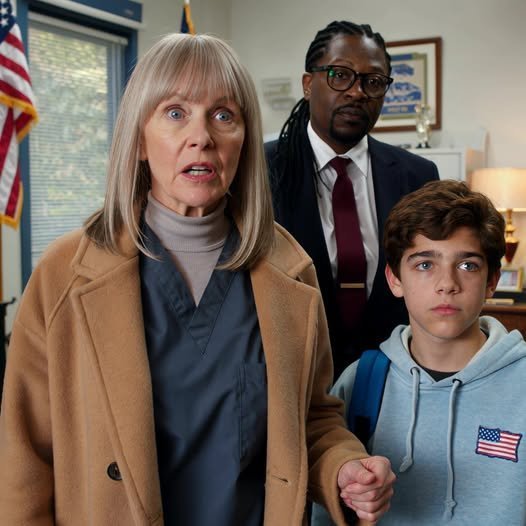
We showed up—at check‑ins with Principal Norwood, at counseling with Ms. Matthews, at therapy sessions where Rachel taught her body to spell its name again.
The reinstatement hearing at Westridge came two weeks later in a boardroom that smelled like furniture polish and pressure.
The Discipline Council sat in a tidy row: a math teacher with sharp glasses, a trustee who liked the word precedent too much, Ms. Matthews, and Norwood at the head, steady as a metronome. Jaime sat between us in a too‑big blazer, knuckles white around the watch in his pocket.
“Violence is a bright line,” the trustee said, tapping a pen like a gavel.
“Zero tolerance exists for a reason.”
“Context exists for a reason,” I said, my voice the one I use in an OR when a room is about to lose its nerve. “He accepts responsibility.
He also just found his mother beaten nearly to death and was taunted about her abandonment. He made a terrible choice in a moment that would break many adults.”
Ms.
Matthews folded her hands.
“Jaime, what would you do differently?”
“Walk away,” he said, the words rough but honest. “Tell a teacher. Call the counselor.
Not use my hands.” He swallowed.
“I’ll apologize. I’ll pay for Derek’s medical bill if he has one.
I’ll do community service. I’ll go to counseling.
I just… I want to stay.”
The math teacher spoke for the first time.
“He tutors two of my freshmen in algebra during lunch. He never asked for credit.”
Norwood glanced down at her notes, then back up. “Westridge is not only here to produce transcripts,” she said, voice even.
“We are here to produce citizens.
Reinstatement with conditions: weekly counseling, restorative conference with Derek, apology in writing, and community service hours logged to the dean. One infraction and we revisit this.” She looked at Jaime.
“Earn it.”
Jaime nodded so hard the cap on his pen popped. “Yes, ma’am.”
Later, on our way out, the trustee stopped me.
“You argued like a surgeon,” he said, half compliment, half complaint.
“I argued like a grandmother,” I said. “It’s a different anatomy, same stakes.”
When discharge from rehab loomed, Rachel called. “We need to talk about living arrangements,” she said, no preamble—the family style.
“My condo has another bedroom,” I said.
“Elevator. Security.
Closer to therapy. Jaime’s already settled.
It’s not forever.
It’s a landing.”
Silence stretched long and honest. “I won’t be a charity case,” she said at last. “This isn’t charity,” I said, the heat surprising me.
“It’s family.” The word felt like a muscle waking up.
“We’ll need boundaries,” she said, practical even in pride. “Expectations.
Rent. Groceries.
Household rules.”
“Yes,” I said, and meant it.
“We’ll write them down.”
We did—on a yellow legal pad at my dining table with coffee rings soaking into the margin: rent when she was working; chores split by reality, not arithmetic; groceries on a rotating list where chocolate cereal mysteriously kept appearing. Rachel took the smaller room even when I argued. “You’ve given us enough,” she said, and wouldn’t move.
She finished her master’s and became the therapist she’d needed—occupational therapy with a trauma focus.
Jaime found the guitar for real. He practiced at night until calluses formed and the songs sounded like understanding.
I stepped down as chief a year later. Not surrender—recalibration.
I taught.
I operated. I mentored. I came home for dinner.
I learned the names of Jaime’s friends and which ones needed the soft touch and which ones got the look over my glasses that makes residents forget their own names.
The case against Drew moved like cases move: slow, relentless. He took a plea—aggravated assault, attempted murder—when his lawyer finally believed the evidence board: neighbor testimony, surveillance footage of him dragging a limp woman to his car, Rachel’s testimony about a pattern of escalating violence.
Prison took him. It didn’t fix the past.
It protected our future.
Years accreted. The sharp edges dulled, not from forgetting, but from being held so often they went smooth. We kept William alive in stories that honored him without turning him into a shrine that suffocated the living.
On the anniversary of his death, we drove to Cedar Lake and let the water be exactly what it was.
Five years after the call that cut my life into Before and After, I flipped pancakes in my kitchen for a boy‑turned‑man on his graduation day. My condo—the museum I once lived in—had learned to be alive.
Sneakers waited by the door with domestic audacity. A guitar pick hid under the couch.
A stubborn plant refused to die out of love or spite.
Mugs collected in pairs by the sink because someone always forgot the first. “Has anyone seen my cap?” Jaime yelled from upstairs, voice deeper now and still breaking when excited. “Hall closet,” Rachel called, arranging flowers on the table, moving with the slight asymmetry that has become part of her grace.
At thirty‑eight, she worked with survivors who trusted her instantly, the way people do when they recognize their own story in someone else’s scars.
“Smells amazing, Grandma,” Jaime said, appearing in a blue gown and the ridiculous square cap that makes everyone look five and brilliant. “Language of respect,” I said, sliding a pancake onto his plate.
He ate it with his hands. I passed a fork to the air.
Amelia blew in—colleague turned friend turned fixture—carrying an absurdly large gift bag and the look of someone about to commit an act of generosity and get away with it.
“This is from all of us at the hospital,” she said. “Open before the ceremony or I will combust.”
Inside: a restored vintage doctor’s bag. Inside that: a top‑tier stethoscope, a pocket diagnostic kit, a leather‑bound journal with his initials.
In the inner pocket: an envelope.
Jaime opened it, and his face did a quiet, holy thing. “Medical school tuition?” he whispered.
“But I haven’t even—”
“The department endowed a scholarship in your grandmother’s name when she retired,” Amelia said. “The board voted the first recipient should be William’s son—if he wants it.”
He looked at me.
Legacy and love balanced on a blade.
I put a hand on his shoulder. “Whatever path is yours—medicine, music, both—we’ll follow your lead,” I said. “There’s no right answer but the true one.”
He let out a breath I think he’d been holding for years.
“Okay,” he said.
“Okay.”
Before we left, I brought out a small velvet box I’d been keeping. We stood by the door: a young man in a cap and gown, his mother in a blue dress the exact color of our shared eyes, me holding the hinge between past and future.
He opened the box. The chain pooled in his palm like quicksilver.
He set the watch against his wrist first, as if his skin needed to learn its weight before his heart did.
The click of the case sounded like a door closing on an empty house and opening somewhere else. “My father wore it to his graduation,” I said. “His father before him.
It should be yours today.”
He traced the engraving with his thumb, the metal catching light.
“Time reveals truth,” he read. He looked at Rachel.
She lifted her hand—there is a tiny ridge across her first knuckle from an old scar—and touched the chain where it bit his skin just enough to leave a mark. Her breath left her like relief finally allowed a body to exhale.
“It really does,” Jaime said, and the words didn’t feel like an inscription anymore.
They felt like a map. The ceremony was gloriously human—names mispronounced with conviction, speeches that will live only in the hearts of their speakers, a crowd crying for children and for selves. Principal Norwood—hair now completely white and somehow more elegant—shook Jaime’s hand.
“From almost expelled to valedictorian,” she said, winking where only I could see.
“We always did love a twist, Mr. Parker.”
Rachel squeezed my hand.
“Remember when he broke that boy’s nose?” she whispered, laughing through tears. “I do,” I said.
“Best suspension of my career.”