Her hands were folded calmly on the table in front of her. Her back was straight.
Her eyes were steady, fixed on a point just past Colonel Hail’s head. Commander Bray, her direct superior in the Navy detachment, sat beside her, his face a mask of professional neutrality.
Colonel Hail opened the session with a clipped, no-nonsense tone.
“Gunnery Sergeant Maddox. You requested this formal hearing. The floor is yours.”
Maddox cleared his throat, a theatrical sound meant to draw focus.
He was playing to the room, not to the truth.
“Yes, sir. Thank you, sir,” he began, his voice filled with practiced sincerity.
“We’re here, sir, because Chief Donovan attacked myself and my men in a maintenance corridor late last night. It was completely unprovoked.
We were on our way to check a supply manifest, and she… well, sir, she just snapped.
She came at us. We tried to de-escalate the situation, but she was… she was out of control.”
He paused, letting the words hang in the silent room. Reyes nodded weakly, still cradling the arm she had expertly disabled the night before, a perfect piece of stagecraft.
Dunn, looking down at his hands, echoed the gesture as if reliving some profound trauma.
Colonel Hail didn’t react. His expression didn’t flicker.
He just turned his steady, assessing gaze to Clare. “Chief Donovan.
Your response?”
Clare didn’t launch into a passionate defense.
She didn’t offer a counter-narrative, or explain, or justify, or argue. She simply lifted one hand and gestured toward the thin folder sitting on the table in front of her. “My report is complete, sir,” she said.
That was all.
Commander Bray spoke next, his voice calm and professional. “Colonel, with your permission.
The Chief’s report includes her formal statement, a log of prior incidents, and two pieces of digital evidence. The JAG officer is prepared to present them.”
Hail nodded once, a sharp, decisive motion.
“Proceed.”
The JAG officer, a lean captain with wire-rimmed glasses and an air of quiet competence, rose from his chair and approached the large monitor on the far wall.
He clicked a remote, and the screen flickered to life. “First exhibit,” he announced, his voice neutral. “Security footage from the dining facility, dated three days ago.”
The video played in stark, silent clarity.
The entire room watched as the image of Maddox loomed over Clare’s table.
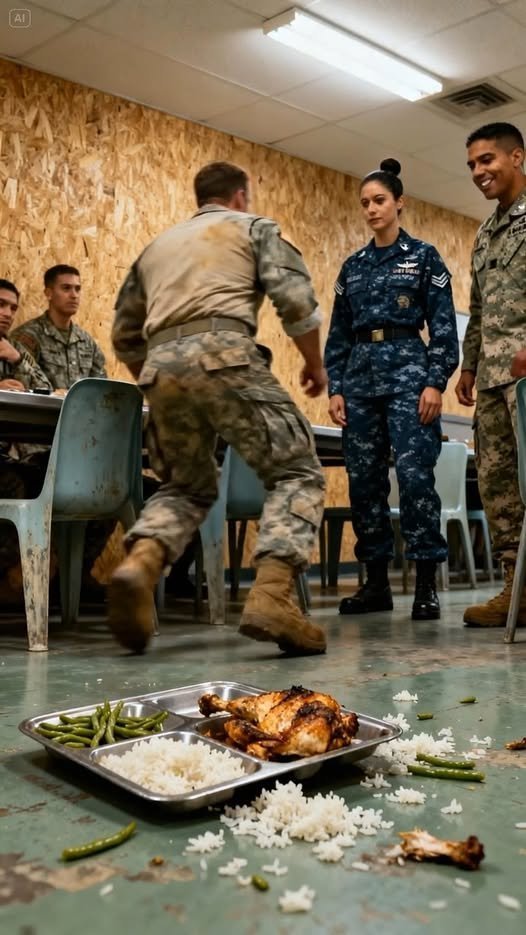
They saw his mouth moving, his posture aggressive. They saw his hand lash out and knock her tray to the floor.
And then they saw Clare, in the face of it all, stand up in complete silence and walk away, not even the scrape of her chair betraying a single shred of emotion. The room held its breath.
Reyes and Dunn shifted uncomfortably in their seats, their carefully constructed image of victimhood beginning to crumble under the weight of visual proof.
Maddox tried to mask the tension in his jaw, but a dark red flush was creeping up his neck, a telltale sign of his fraying composure. Hail’s fingers tapped once, a single, sharp sound, against the polished table. It wasn’t a reaction.
It was an acknowledgment of a fact entered into evidence.
The JAG officer clicked the remote again. “Second exhibit.
Body-worn camera footage, recorded by Chief Donovan during the incident last night.”
Maddox inhaled sharply, a tiny, choked sound. He looked at Clare, his eyes wide with dawning horror.
She didn’t move a muscle.
The screen lit up, showing a first-person view of the narrow, dimly lit metal corridor. The room watched as the three men closed in. They heard Maddox’s taunts.
They saw the shove, a clear, unambiguous act of physical aggression.
And then they watched the next nine seconds unfold in brutal, efficient detail. The pivot.
The wrist lock. Reyes’s failed lunge and the precise, disabling nerve jab.
Dunn crashing into Maddox as their own momentum was turned against them.
It wasn’t a brawl. It was a demonstration. It was controlled, efficient, and utterly one-sided.
It wasn’t violence.
It was mastery. When the video ended, the monitor went black, and the silence that filled the conference room was total and absolute.
Colonel Hail leaned back slowly in his chair. He wasn’t looking at Maddox anymore.
He was studying Clare, his eyes holding a new kind of recognition, the kind that comes only from deep and hard-won experience.
He was a man who had seen operators move like that before, in places far from Falcon Ridge, in situations where that kind of fluid precision meant the difference between life and death. He let the silence stretch, letting the undeniable truth of the video settle into the room like dust after a detonation. Finally, he spoke, his voice quiet but resonant.
“Chief Donovan,” he said, his eyes still locked on hers.
“Where did you learn control like that?”
For the first time, Clare lifted her gaze and met his directly. Her eyes were steady, unshaken.
“Sir,” she said softly, her voice carrying a profound weight. “I learned to do what was necessary to keep people alive.
Nothing more, nothing less.”
And somehow, that simple, humble statement was louder, more powerful, and more damning than anything Maddox had tried to claim.
The hearing was over. The only thing left was the sentence. The sun had barely lifted its head over the jagged peaks of the eastern mountain range when the loudspeakers across Falcon Ridge crackled to life with a sound that made everyone stop what they were doing.
A base-wide formation had been ordered.
Mandatory. It was an event so rare that it almost never happened unless the news was grave, historic, or both.
From barracks, workshops, and administrative buildings, soldiers and Marines poured onto the vast, dusty parade ground, their boots kicking up clouds of fine brown powder. They fell into their ranks with the practiced, rigid geometry of a drawn bowstring.
Murmurs and hushed questions traveled through the formations like ripples in water.
Nobody knew the specific details, but everyone could feel the oppressive weight of the moment. Something significant was about to happen. Chief Petty Officer Clare Donovan stood near the rear ranks of the small Navy detachment, her hands clasped behind her back, her eyes fixed straight ahead on the empty platform at the front.
Her uniform was crisp, her posture as always, a column of quiet calm.
If she felt anything—tension, dread, anticipation—none of it was permitted to touch her face. At precisely 0800 hours, Colonel Nathan Hail marched onto the platform, his presence immediately commanding the attention of the entire field.
The command was given, and the field snapped to a single, unified state of attention, a thousand bodies moving as one. “At ease,” he commanded, his voice carrying clearly across the cool morning air.
He stood with his hands clasped behind his back, his shoulders square, his gaze sweeping slowly, deliberately, over the entire formation.
When he spoke next, his tone was as hard and unyielding as rock. “In this uniform,” he began, “we uphold a sacred trust. A trust built on honor, discipline, and respect.
And when those standards fail—when those who wear these ranks betray that trust—we correct it.
Immediately. Publicly.
And completely.”
A subtle, collective ripple went through the crowd. Eyes began to shift, almost involuntarily, toward the front row of the Force Recon platoon’s formation.
There stood Maddox, Reyes, and Dunn, rigid as statues.
All three were pale, their faces grim. Maddox kept his jaw clenched so tightly that the muscle twitched visibly beneath his skin. Hail continued, his voice like the crack of a rifle.
“Last night, evidence was presented to this command.
Incontrovertible evidence of misconduct, of persistent harassment, of the abuse of authority, and of a deliberate, calculated attempt to conceal the truth by three Marines assigned to this base.”
You could feel the collective intake of breath across the parade ground. “Effective immediately,” Hail declared, his voice ringing with the finality of a judge’s gavel, “Gunnery Sergeant Cole Maddox is hereby reduced in rank to Staff Sergeant.
Corporal Reyes and Corporal Dunn are hereby reduced in rank to Lance Corporal. All three will forfeit one month’s pay and are reassigned from all leadership roles, pending further administrative review for separation.”
Gasps, sharp and stunned, whispered through the formation.
This wasn’t a slap on the wrist.
This was a professional freefall. A career-ending judgment, delivered in front of everyone they knew. None of the three demoted Marines moved a muscle.
They just stood there, absorbing the public weight of their disgrace.
“And now,” Hail said, his tone shifting, becoming quieter, deeper, “we address the final piece of this. The reason we are all standing here.” He turned his head slightly, his gaze finding her in the ranks.
“Chief Petty Officer Clare Donovan. Front and center.”
A path opened in the ranks as Clare stepped forward.