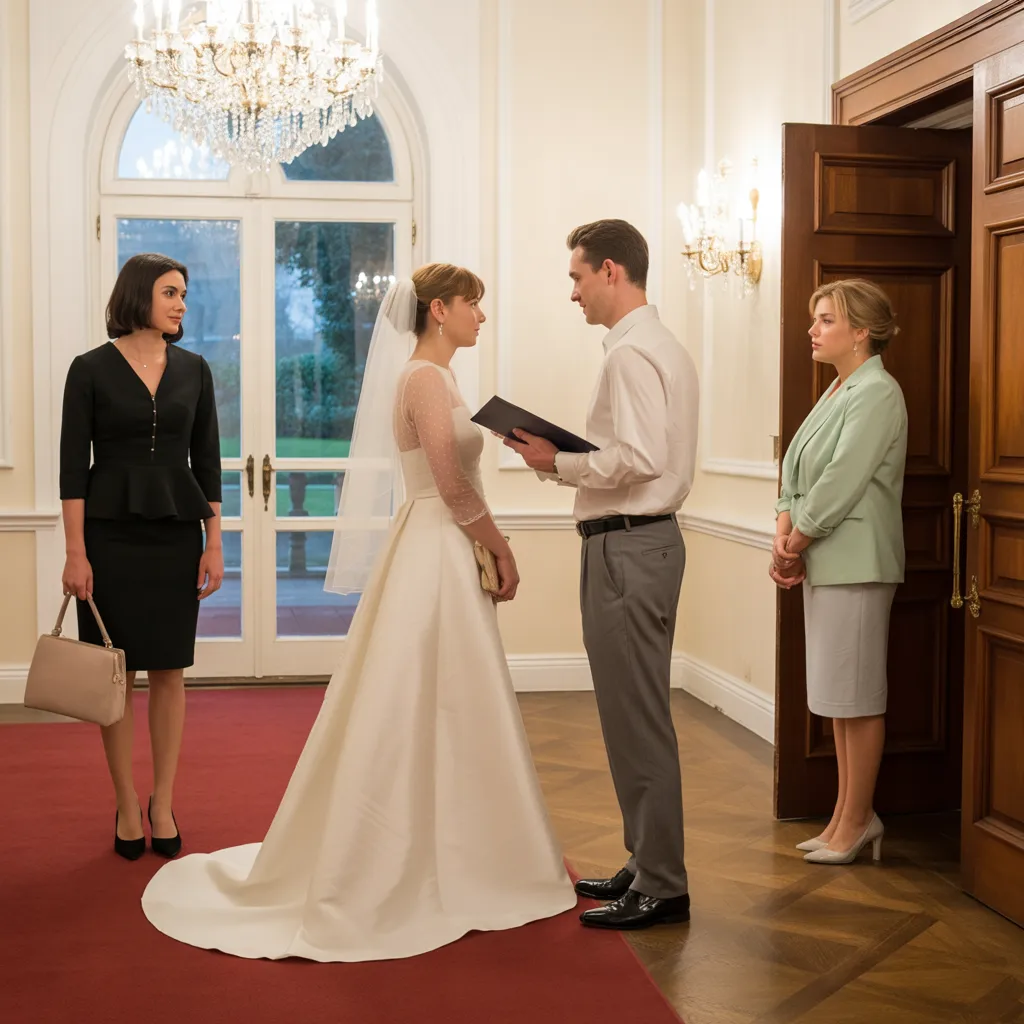
he staff member at the door smiled the way people do when they have been told to be polite about something ugly. He looked at his clipboard, then back at me, then at his clipboard again, as though my name might appear between one glance and the next. “I’m sorry, ma’am.
Your name isn’t on the list.”
Behind him, through the open French doors, two hundred white chairs faced an altar covered in hydrangeas. Blue-violet ones, the kind that only grow right in coastal Georgia if you plant them in acidic soil and tend them like they matter. I knew this because my sister Whitney had texted me about those hydrangeas eleven times in March.
She had not texted me about the guest list. I was standing there holding a garment bag. Inside it was a backup bustle pin, a spool of ivory thread, and a miniature sewing kit I had packed at five that morning in case the train snagged on a chair leg or the zipper caught on the beading near the hip, which it would, because I had warned Whitney about that seam three times.
She’d said, “It’ll be fine, Tess. Stop worrying.” So I had driven forty minutes to stop worrying in person. I watched his pen hover over the R section of the list.
My name should have been right there, between Robinson and Sawyer. But there was a line drawn through that space. Not a gap.
A line. Someone had crossed me off deliberately, neatly, like a correction. My ribs did something strange.
They tightened, then went still, like a breath that forgot to release. Through the open doors I could see the first rows filling up, the Hargroves on the left, our side on the right, Aunt Patty adjusting her hat, Cousin Devon on his phone. And somewhere inside, past the foyer and the string quartet warming up, my sister was standing in front of a full-length mirror wearing the dress I had spent ninety-two days making by hand.
Ninety-two days. Three months of fourteen-hour shifts in a studio that smells like sizing solution and cold coffee. Three months of hand-beading a bodice at two in the morning because the light is different at two in the morning and you catch mistakes you would miss at noon.
Three months of cutting French lace so fine it dissolved if you breathed on it wrong. I once sneezed during a fitting and lost an entire panel. The dress was worth eighteen thousand dollars.
Whitney had told the Hargroves it cost forty, from a designer named Elise Laurent who did not exist, at a studio on Spring Street in SoHo that was also a fiction. I learned this from the family group chat three months earlier, when Whitney posted a screenshot of the receipt. I had stood in my studio holding my phone and read it twice.
Elise Laurent Studio, the header said. Amount: $40,000. Diane, my mother, had replied with three heart emojis and the words worth every penny.
I was still holding that fact somewhere in the back of my chest when I turned from the door and found my mother already there, six feet away in a seafoam suit with pearl buttons, standing beside a column like she had been waiting. Not surprised. Not embarrassed.
She was holding a ceremony program, the kind with a ribbon tied through the fold, and she looked at me the way you look at a stain on a tablecloth. Something you would rather not deal with in front of company. “We discussed this, Tessa,” she said.
“You sent a text at eleven at night saying the venue was at capacity.”
“And it is.”
“There are forty empty chairs. I counted from the parking lot.”
She exhaled through her nose. That exhale was a Diane Ror specialty.
It meant you had embarrassed her by being correct. “We can’t let a poor designer shame the family.”
She did not whisper it. She did not even try to keep her voice down.
The staff member with the clipboard suddenly found his shoes very interesting. I looked at the ribbon on the program in her hands. Blush pink.
Whitney had wanted blush pink everything. I had dyed that ribbon myself, at midnight, in my kitchen sink, matching it to the sash on the dress. My name was not on the program credits.
Something behind my sternum went flat. Not broken. I want to be precise about that.
Flat, like a note that stops resonating. Like the air had been let out of something I had been inflating for twenty-nine years. I looked past her through the doors.
The dress moved. Whitney was spinning for someone, a camera flash going off, and the skirt caught the light and threw it back in that way silk charmeuse does when the bias cut is right. Mine was right.
I had recut it twice to be sure. I held the garment bag a little tighter. The emergency kit inside it was for her.
I had driven forty minutes to protect a dress worn by a woman who had told her in-laws it was made by someone who did not exist. So I smiled. “Enjoy your day.”
I turned around, walked back to my car, and put the garment bag on the passenger seat like it was a person.
I sat there for a moment with both hands on the wheel, engine off, listening to the parking lot sounds. Hargrove sedans, rental SUVs, a catering van from a company Whitney had also underpaid, though that was a different story. It took my mother six words to reach inside me and take something out.
The strange part was how clean it felt. Like a seam pulled free. I drove the forty minutes back to Savannah with both windows down because the air conditioning in my Civic had died in July and I had been too busy sewing a wedding dress to fix it.
The October humidity hung on my forearms like damp cotton. Spanish moss blurred past on both sides of the highway, and somewhere around mile marker fourteen, the garment bag shifted on the passenger seat and the zipper jingled, and the sound was so small and so stupid that my throat closed. I did not cry.
I want that on the record. I pressed my tongue to the roof of my mouth, a trick I learned at fifteen, the Thanksgiving that Diane told the table Whitney had gotten into Florida State and that I was still figuring things out, which was her way of saying I had chosen a sewing scholarship over a real degree. I held it there until the feeling flattened into something I could drive with.
The smell of the garment bag was what nearly undid me. Cedar and lavender from the drawer sachets I used to store muslin. Whitney used to steal those sachets for her school locker because she said they smelled expensive.
She was fourteen, I was ten, and I had made them from fabric scraps and dried flowers from the backyard. When Diane found out, she said, “Let your sister have them. You can always make more.”
I could always make more.
That was the whole arrangement, when I looked at it plainly. Whitney needed a Halloween costume, so Tessa made one. Whitney tore her homecoming dress, so Tessa fixed it.
Whitney wanted custom tote bags for her sorority rush, so Tessa made twelve, one for each pledge sister, and Whitney never mentioned who made them. Diane had a phrase for the whole system. She used it the way other mothers say I love you, casually, without checking whether it landed.
“Whitney is the face. You’re the hands.”
Like I was a body part someone had misplaced at a family reunion. Like Whitney was the store window and I was the back room where things got assembled.
The metaphor worked for Diane because it meant she never had to credit me and never had to explain Whitney. It was efficient. I’ll give her that.
I had graduated from SCAD with a BFA in fibers and a concentration in textile construction. I paid for it myself, through scholarships, work-study, and a weekend job hemming curtains for a retirement home in Thunderbolt. Diane did not attend the graduation.
She sent a card that said “Proud of you!” with an exclamation point that somehow felt sarcastic. Whitney sent a text: Congrats. Can you make me a dress for my anniversary dinner btw.
No question mark. Not a question. The studio came later.
A twelve-by-fourteen room above Lorraine Mabry’s fabric shop on Broughton Street. Lorraine was sixty-seven and had been selling fabric in Savannah since before I was born. She gave me the space at reduced rent because she said I reminded her of herself at twenty-three: stubborn, talented, and catastrophically bad at charging people.