He stood, straightened his tie, and walked toward her with a practiced, almost pleasant smile. “So, Mrs. Nala,” he began, voice silky, “if I understand you correctly, your husband, who was out working, providing for your family, somehow found the time to secretly take photos of the home, secretly misuse a credit card, and secretly spend money—all just to make you look bad.
Is that your story?”
“I—I didn’t say it like that,” Nala stammered. “I just told you what happened.”
“It sounds very convenient,” Cromwell replied. “The dishes in the sink, the messy living room, the overflowing laundry—none of that is your responsibility?
You bear no fault in that at all?”
“I was sick,” Nala said. “I could barely walk.”
“Do you have any medical documentation from that time?” he asked quickly. “A doctor’s note?
A hospital record?”
“I didn’t go to the hospital,” Nala murmured. “I took medicine at home. I thought I’d recover.”
“So you have no proof of this supposed illness,” Cromwell said.
“Just your word against clear photographs.”
He moved on. “You say your husband used the credit card,” he continued, “but the card is in your name. Did you ever notify the bank that someone else was using it?”
“No,” Nala answered.
“Did you ever confront him? Cancel the card? Do anything to stop this?”
“No,” she said again, her voice small.
“So you said nothing. You signed nothing. You reported nothing.
Yet now you want this court to believe you played no part in those charges at all?”
“I trusted him,” Nala replied, her voice rising. “He was my husband.”
“Blind trust that just happened to empty an account,” Cromwell said. “Interesting.”
He walked back to his table and picked up a large, glossy photograph.
“Your honor, I ask permission to present Exhibit P-12,” he said. He held the photo up high enough for everyone to see. It was Nala.
In their bedroom. Her hair was messy, her face red and streaked with tears, her mouth open mid-cry. She looked unrecognizable even to herself.
“Mrs. Nala, can you explain this photo?” Cromwell asked, a hint of triumph in his voice. Nala began to shake.
“That night…” she whispered. “That night he came home and called me a useless wife. He told me I was a burden.
He said I didn’t deserve to be Zariah’s mother. He kept pushing and pushing until I broke. I was crying.
I didn’t know he was taking a picture.”
“So you admit,” Cromwell said sharply, “that you were screaming, crying, and out of control. Isn’t that exactly what our expert, Dr. Valencia, described?
Intense emotional reactions? Unstable behavior?”
“No!” Nala burst out. “You’re twisting everything.
He did this on purpose. He wanted to break me. He—”
She couldn’t control it anymore.
The hurt, the fear, the humiliation—it all came crashing out. She stood up. “He set me up!” she shouted.
“He baited me, he recorded me in secret, he is not the victim here—”
“Enough,” the judge said sharply, striking the gavel. “Sit down, Mrs. Nala.
Regain your composure.”
Nala collapsed back into her chair, sobbing openly. In that moment, she knew she’d done exactly what they wanted. She had looked unstable.
She had looked emotional. She had matched the picture Cromwell and Valencia had painted. Across the room, Tmaine hung his head as if deeply pained by his wife’s “outburst.”
Cromwell sat down with a satisfied expression.
The judge watched Nala with an expression that, for the first time, looked like it had already settled into a decision. When that day’s hearing ended, Abernathy tried to reassure her. She barely heard him.
“It’s over,” she whispered. “Tomorrow they’ll take her from me.”
That night, time moved painfully slow. The sentencing hearing—the day the judge would announce his decision—was scheduled for the next morning.
Nala knew what was coming. She was going to lose Zariah. She went into her daughter’s room.
Zariah was already asleep, her small chest rising and falling in the glow of the nightlight. Tmaine wasn’t home. He was probably celebrating an early victory somewhere.
Nala sat at the foot of the bed, running her fingers through her daughter’s hair. Tears slid down her cheeks and dripped onto the pillow. Zariah stirred.
“Mommy?” she whispered, eyes fluttering open. “Shh, go back to sleep, princess,” Nala murmured. She hugged her daughter tightly, memorizing how her little body felt in her arms.
“Whatever happens tomorrow,” she whispered into her hair, “I love you. I will always love you.”
Zariah wrapped her arms around her mother’s neck. “I love you too, Mommy,” she said sleepily.
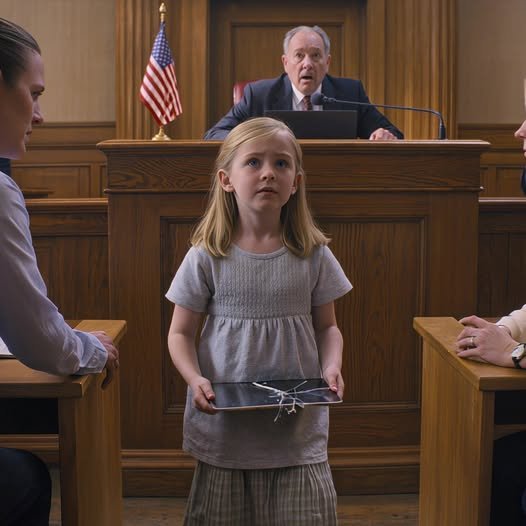
As Nala slowly let go, she noticed it again. The corner of that old, cracked tablet sticking out from under Zariah’s pillow. Zariah was still clutching it, even in sleep.
Nala frowned. Why was that broken thing so important to her daughter? She was too exhausted to think any more about it.
She kissed Zariah’s forehead and left the room. She thought she was walking away from the last night she would ever tuck her daughter in. She had no idea that hidden under that pillow was the one piece of evidence that would turn their world upside down.
PART THREE
The courtroom felt even colder the next morning. Nala sat at the defendant’s table, shoulders tight, eyes swollen from a night without sleep. Abernathy sat beside her, his jaw set, his gaze fixed on the judge’s bench.
On the other side of the room, Tmaine looked freshly pressed and confident, wearing a new suit. He exchanged a light joke with Cromwell, both of them looking like men who already knew they’d won. In the gallery, Nala spotted Valencia sitting elegantly in a cream-colored dress.
She gave Nala the slightest, almost invisible smile. The bailiff called the court to order. The judge walked in, took his seat, and opened the thick file in front of him.
“In the matter of the divorce petition filed by Mr. Tmaine…” he began. “Today we are here for closing arguments and the court’s ruling.”
Cromwell spoke first.
He summarized his case with polished ease. “Your honor, the evidence here is clear,” he said. “We have photographs showing the defendant’s neglect of the household, financial records indicating irresponsible spending on a card in her name, and, most importantly, expert testimony from a licensed child psychologist confirming her emotional instability.”
He gestured toward Nala.
“We even witnessed, in this courtroom, behavior consistent with that expert’s findings when Mrs. Nala lost control and became visibly distressed during testimony.”
He turned to Tmaine. “On the other hand, we have a father who has provided financial stability, who has demonstrated emotional steadiness, and who is sincerely concerned about his daughter’s future.
This is not about punishing Mrs. Nala—it is about safeguarding Zariah. We respectfully ask the court to grant full custody and approve our proposed division of assets.”
He sat down, satisfied.
Abernathy rose. He didn’t start with documents. He started with people.
“Your honor,” he said quietly, “what we’ve seen here is not proof. It’s a campaign. A carefully planned effort to tear down one person’s character.”
He gestured toward the photos.
“Anyone can photograph a kitchen at the wrong moment, even a professional chef’s kitchen, and make it look like neglect. Anyone with full control of a credit card can spend money and later push the blame onto the name printed on the card. And anyone with professional credentials can take isolated moments and dress them up as a diagnosis.”
He looked at Nala.
“What we have in front of us is not a perfect mother. There’s no such thing,” he continued. “What we have is a woman who left her job at her husband’s request, who dedicated years of her life to raising a child, who has no savings because she trusted her husband with every dollar.”
He turned back to the judge.
“We are not watching a child be saved from a dangerous parent. We are watching a man try to remove his wife from the picture, take her assets, and separate a little girl from the person who loves her most. I ask you, your honor, to see beyond the staged photos and the rehearsed words and to look at the pattern of control and manipulation that brought us here.”
He sat down.
The room was quiet. Nala knew, deep down, that however moving Abernathy’s words were, in family court, paper and “expert testimony” usually carried more weight than speeches about love. The judge cleared his throat and adjusted his glasses.
“After reviewing all documents, testimony, and evidence brought before this court…” he began. Nala’s heart contracted. “The plaintiff has presented significant evidence,” the judge continued.