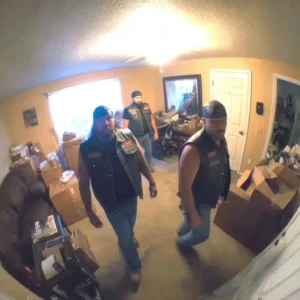

Cars lined up along the narrow road, tearing up the gravel drive. The septic system pushed past what it was designed to handle. And me, nowhere in sight.
“Why,” I asked slowly, “would I let people who didn’t want me at a wedding use my property to host other people’s weddings?”
My brother flushed. “This isn’t about the wedding,” he said. “You’re stuck on that.”
“It’s absolutely about the wedding,” I said.
“And about every decision before and after it that told me exactly where I rank in this family.”
My father sighed, the sound heavy with manufactured patience. “We can’t keep rehashing that,” he said. “We’re talking about the future now.
We’re offering you a chance to be part of the solution.”
“I was the solution,” I said, my voice steadier than I felt, “for years. You just didn’t call it that.”
They didn’t speak of the deception. They didn’t speak of the emails or the default avoidance strategy or the way my name had been leveraged without my consent.
Instead, they appealed to family, as if the word itself were a magic key that could unlock whatever they wanted. “Families help each other,” my mother said. “We’ve always believed that.”
“Families respect each other,” I said.
“You haven’t always believed that.”
Their requests never quite formed a direct question, but the expectation was unmistakable. Reopen the door. Restore what they had lost.
Resume the role they had depended on. For the first time, I didn’t feel torn. I didn’t feel guilty or cruel.
I felt clear. “The lake house will not be available to you,” I said, meeting each of their eyes in turn. “Not for pop-ups.
Not for events. Not for weekends away. Not in any capacity.”
My brother stared at me.
“So you’re really going to let everything fall apart,” he said. “Over hurt feelings.”
I thought of the invoices, the loans, the emails. I thought of the wedding photos.
“This isn’t about hurt feelings,” I said. “This is about recognizing that I am not your emergency fund, your business plan, or your exit strategy.”
My mother’s face crumpled into something between disbelief and offense. “After everything we’ve done for you,” she whispered.
I thought of the nights I’d spent on hold with their creditors, of the money I’d wired to keep their lights on, of the countless ways I’d rearranged my life to accommodate their emergencies. I didn’t list them. I didn’t defend myself.
“I’m not going to litigate who did what for whom,” I said. “I know what I’ve done. You know what I’ve done.
The lake house is my boundary. And financial ties have been severed, not paused. That’s not punishment.
That’s correction.”
Their expressions shifted again, cycling through shock, anger, and something that looked a lot like contempt. My father leaned back, crossing his arms. “You’ll regret this,” he said quietly.
“Maybe,” I said. “But if I do, it’ll be my regret. Not another bill with my name on it and someone else’s mess behind it.”
I didn’t bend.
I didn’t soften the edges to make it palatable. I simply held the line—the one I should have drawn years ago. When the meeting ended, they left with a silence that carried no understanding, only disappointment that their expectations no longer governed my choices.
I walked out of the library into a cool, overcast afternoon and didn’t look back. The moment didn’t feel triumphant. It felt final.
Days passed with a new kind of quiet. One that didn’t demand vigilance. I spent evenings at the lake house learning how to enjoy stillness without anticipating intrusion.
I planted herbs in old ceramic pots along the porch railing. I fixed the loose board on the dock that my father had sworn was “fine” for three summers in a row. Chloe visited often, bringing takeout and laughter that didn’t carry hidden costs.
We sat on the porch with blankets over our knees, watching the light change on the water, talking about everything and nothing. Victor sent updates only when necessary, respecting the boundaries I had set. A text here, a photo there—a screenshot of my parents’ house listed online with a caption: For sale, finally.
He didn’t ask me how I felt about it. He didn’t assume. Natalie and Steven finished the last of the paperwork, closing the chapter with precision.
Accounts were untangled. Automatic payments were canceled. My name came off documents it never should have been on.
The distance from my family didn’t feel like a loss. It felt like space. Space to build a life that didn’t depend on their approval or their comfort.
Space to choose what stayed and what no longer had a place beside me. In that space, I understood something I had never allowed myself to accept. Family is not defined by shared blood.
It is defined by shared respect. If someone repeatedly asks you to diminish yourself so they can stand taller, they are not your foundation. They are your burden.
One evening, as the sky faded from blue to a deep, velvety gray, I walked along the edge of the lake, the water calm beneath the fading light. A neighbor across the way waved from his dock. I waved back.
The air was cool and smelled of pine. My boots crunched on the gravel path. In the distance, a loon called.
I thought about the girl I had been at sixteen, sitting on this same shoreline, worrying about grades and college applications, determined to be good enough that my family would never have to worry about money. I thought about the twenty-five-year-old me who signed her first set of loan documents with shaking hands, believing she was helping everyone. I thought about the thirty-two-year-old woman standing there now, no longer willing to disappear so other people could feel comfortable.
The greatest consequence of everything that had happened wasn’t what they had lost. It was what I had gained. A life that finally belonged to me.
If my story made you pause, reflect, or recognize something in your own life, thank you for staying until the end. And before you go, tell me where you’re listening from. I’d love to know how far this journey reached.