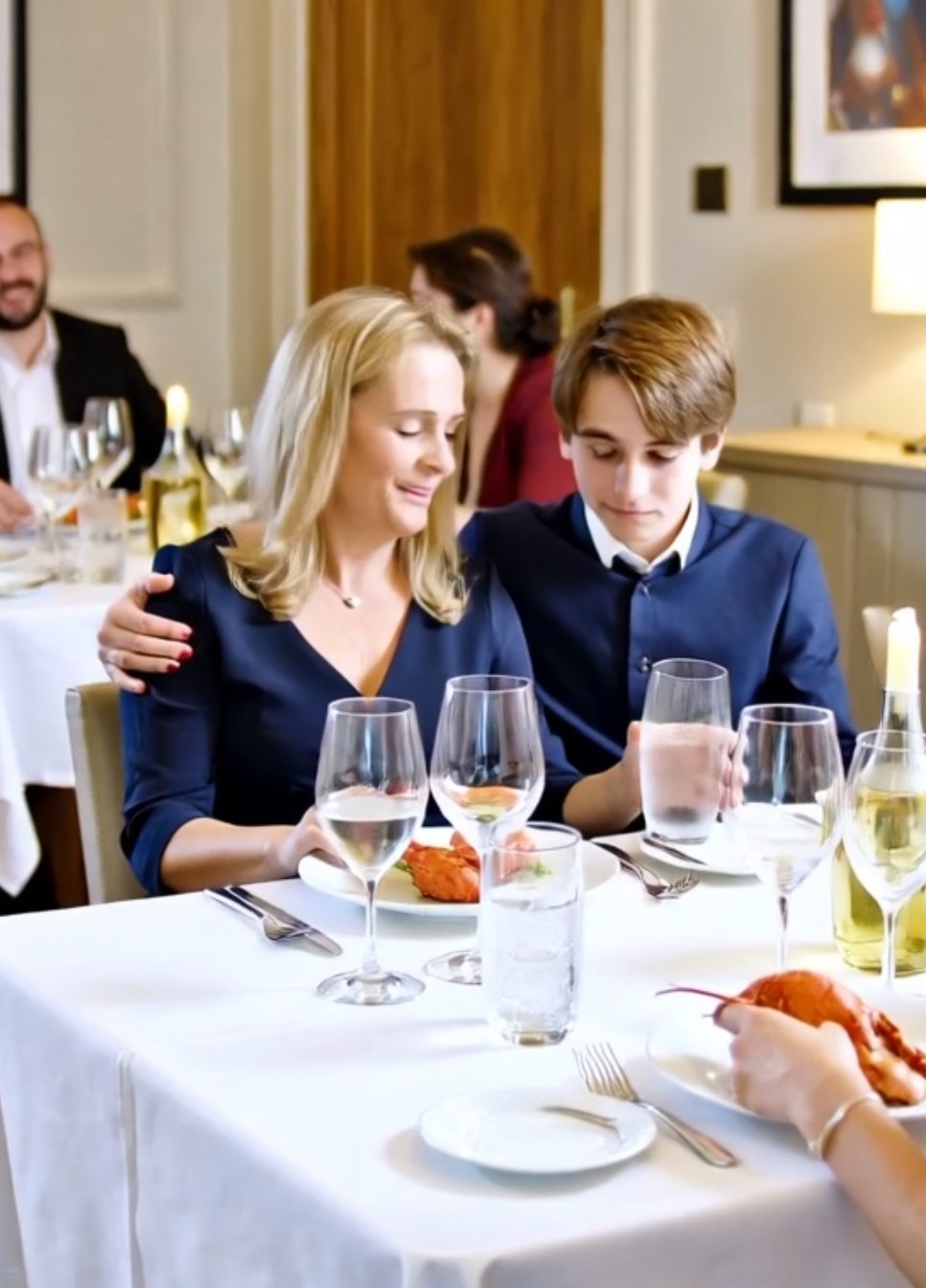
“She’s devastated. The girls are embarrassed to go back to school. People were staring at them in church.”
“That must be hard,” I said, keeping my voice even.
She looked up sharply. “You think this is funny?”
“No,” I said. “I think it’s predictable.
You’re worried about how they look. I’m worried about how my son feels.”
“He’ll be fine,” she said, waving that away. “Children are resilient.
Camille just got carried away. You shouldn’t have made such a scene.”
There it was again, that reflexive minimization. A lifetime of it.
“Mom,” I said. “She called your grandson an extra. She told a server not to feed him while his cousins ate lobster.
You backed her up. That’s not ‘carried away.’ That’s mean.”
She flinched, just a little. “You always take everything so personally.”
“It was personal,” I said.
“It was about my kid.”
She took a sip of coffee, buying time. “We all say things we don’t mean sometimes. You’ve said hurtful things too.”
“Probably,” I said.
“The difference is, if someone told me I made their child feel small, I’d be on my knees apologizing, not complaining about the bill.”
Her mouth tightened. “She said she would pay you back.”
“She did pay the bill,” I said. “That’s not what this is about.”
“Then what do you want?” she demanded, frustration finally cracking through the polished surface.
I paused, feeling the answer rise from somewhere quiet and deep. “I want you to understand that there are lines you can’t cross with Theo and still expect access to him. I want you to know that if you ever sit across from him and tell him he’s less than his cousins again, that will be the last holiday we spend in the same room.”
Her eyes widened.
“You can’t mean that.”
“I do,” I said. “I am not asking you to choose between your daughters or your grandchildren. I’m telling you that my son will not be sacrificed on the altar of Camille’s ego or your need for everything to look perfect.”
She stared at me over the rim of her paper cup, and for the first time I saw something like uncertainty in her expression.
“You’ve changed,” she said quietly. “No,” I said. “I just stopped pretending I don’t see what’s in front of me.”
That sentence sat between us like a third cup of coffee, full and undrinkable.
It was another hinge—one I knew we couldn’t walk back from. When we stood to leave, she reached for my arm. “You know I love Theo,” she said.
“I love you.”
“I believe you love the idea of us,” I said. “I’d really like to see you love us in practice.”
I walked out into the parking lot feeling shaky and strangely light at the same time. The courthouse flag was visible from where I stood, rippling against a clear blue sky.
For the first time, it didn’t feel like a backdrop. It just felt like part of the town I had quietly helped feed. Camille came to Meridian a week later.
She arrived before opening, when the chairs were still upside down on the tables and sunlight slanted through the front windows in long, dusty beams. Jenna caught my eye as the door chimed and mouthed, Your sister. Camille looked smaller out of costume—no full face of makeup, just a messy ponytail and an oversized sweatshirt that probably cost more than my first used car.
She stood just inside the doorway, arms wrapped tight around herself, eyes flicking to the bar, the host stand, the open kitchen, as if seeing them for the first time as mine. “Hi,” I said, wiping my hands on a bar towel. “Is it safe?” she asked, glancing around.
“Are your people going to film this and post it somewhere?”
I almost laughed at the choice of words—your people—but I let it go. “We’re closed,” I said. “No cameras.
Just my staff getting ready for service.”
She swallowed hard. “Can we talk?”
I gestured toward a booth near the window, the same line of sight we’d had the night of the dinner, only now the room was empty. She slid in on one side.
I sat on the other. For a minute, neither of us said anything. “I didn’t know you owned it,” she blurted out finally.
“I know,” I said. “Why didn’t you tell me?”
I thought about the email drafts I’d never sent, the times I’d almost said something at family dinners and then swallowed the words because I knew exactly how the conversation would go. The dismissive jokes about my “little restaurant project.” The comparisons to her husband’s “real job.”
“Because it shouldn’t have mattered,” I said.
“Respecting my kid shouldn’t depend on whether or not I sign someone’s paycheck.”
She winced. “I didn’t mean it like that.”
“You meant it exactly like that,” I said, still calm. “You meant, This night is about my daughters.
You two are extras. Keep quiet, eat less, take up less space.”
She opened her mouth, then closed it again. “I was trying to make them feel special,” she said after a moment.
“I wanted them to know how proud I am.”
“You can lift them up without stepping on him,” I said. “It’s not a zero-sum game.”
She stared down at the table. “The girls were so embarrassed,” she said.
“They said people at school were asking questions. Riley cried.”
“I’m sure it was rough,” I said. “Did you tell them why it happened?”
“I told them you overreacted,” she admitted.
“That you’d been stressed and snapped.”
“Did you tell them what you said?”
She didn’t answer. “That’s the difference between us,” I said quietly. “I told Theo exactly what happened.
I didn’t sugarcoat your words or mine. Because I need him to know that when someone hurts him, I don’t rewrite the story to protect the person who did it.”
Tears pooled in her eyes, mascara already smudged from wherever she’d been before this. “You always make me the villain,” she whispered.
“You cast yourself,” I replied. “I just stopped handing you other people’s lines.”
We sat in silence long enough to hear the ice machine dump a new load in the bar well. “I’m sorry,” she said finally, the words so soft I almost missed them.
“For what?” I asked. “For calling him an extra,” she said. “For making him feel small.
For…for not seeing what I was doing. For thinking being the host meant I got to decide who mattered most at that table.”
It wasn’t perfect. It wasn’t the sweeping, cinematic apology some people wait a lifetime for.
But it was more specific than anything I’d heard from her in years, and it was pointed at Theo, not just her own discomfort. That, too, was a hinge. “I believe you’re sorry,” I said.
“I also need you to understand that being sorry doesn’t magically reset everything. There are going to be boundaries now.”
She nodded, eyes shiny. “Like what?”
“Like this,” I said.
“If you want to see Theo, you don’t get to joke about him being lesser. You don’t get to rank your kids and mine out loud. You don’t get to use dinners as stages where you’re the only star.
If you slip, we leave. No scene. No argument.
Just…we’re gone.”
She swallowed. “You’d really do that?”
“I already did,” I said. “You just didn’t recognize it because I did it with a smile and a lobster platter instead of a screaming match.”
A reluctant, watery laugh escaped her, surprising both of us.
“Can I apologize to him?” she asked. “Not right now,” I said. “Not until I know you’re doing it for him and not because you’re uncomfortable.”
She nodded, accepting the boundary like a new language she was just starting to learn.
“I miss you,” she said quietly. “When did we get so far apart?”
I thought about it. “Probably around the time you decided there was only room for one main character in this family,” I said.
“The thing is, I’m not trying to steal your spotlight. I’m just done pretending I don’t deserve my own lighting.”
She wiped her cheeks with the sleeve of her sweatshirt. “You’re really good at this,” she said.
“At what?”
“At the speeches,” she said with a brittle smile. I shrugged. “Years of practice,” I said.
“Most of it in my own head.”