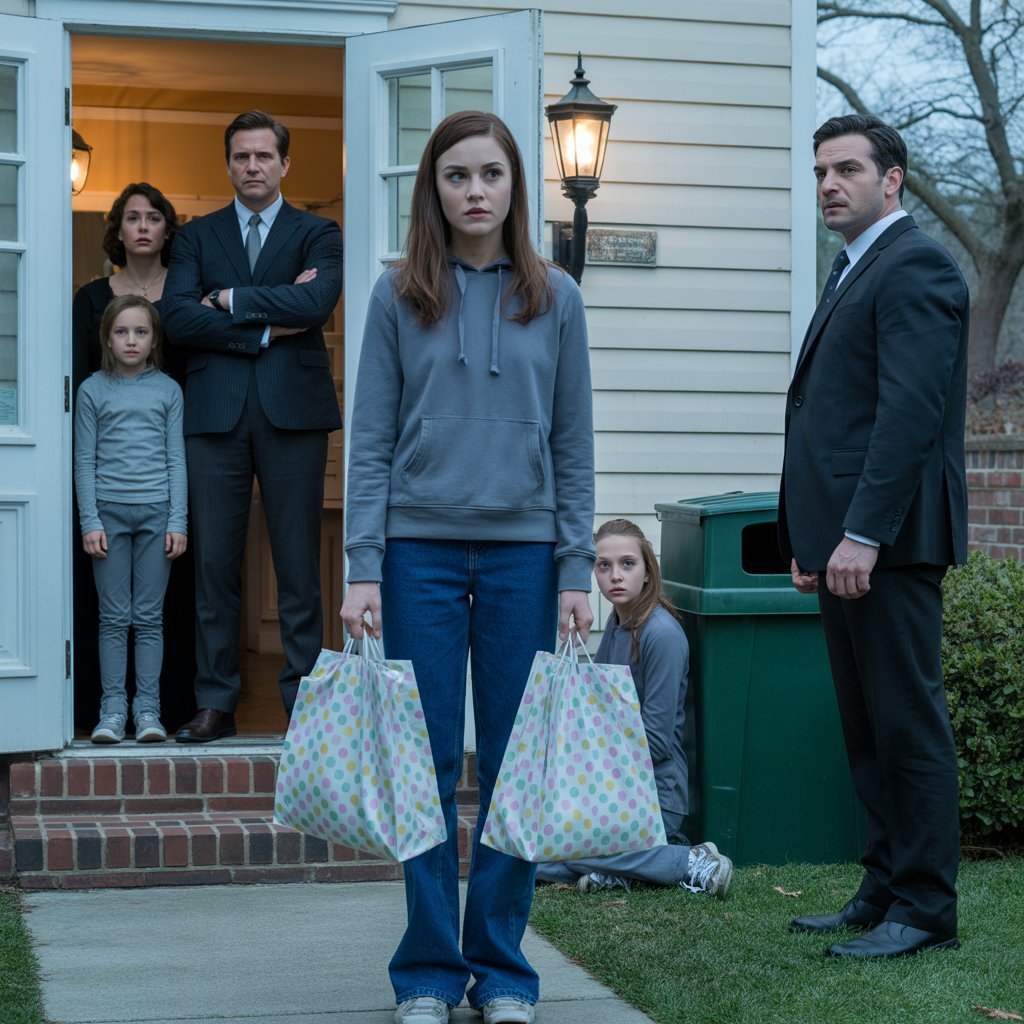
Years of her hissed insults echoed in the back of my head—mistake, parasite, dead weight.
Then I thought about sixteen-year-old me under the slide at Goodale Park, shivering and alone. The world had decided she was disposable. Only one person—who hadn’t even met me—refused to accept that verdict.
I set the letter down and stared at the ceiling for a long time.
I did not pick up a pen.
Instead, the next day, I called Lynn, my therapist, and read her the letter.
“What does your gut say?” she asked when I finished.
“My gut says screw her,” I said. “And my gut says I remember what it felt like when nobody answered.”
“Those are both valid,” she said.
I laughed humorlessly.
“Thanks. That’s helpful.”
She waited a beat.
“You’re not required to be her savior,” she said. “You’re not required to be anything to her. But if you choose to respond, it should be because it aligns with your values, not your guilt.”
My values.
I thought about that the rest of the week.
On Friday afternoon, I sat at my desk with a blank sheet of paper and wrote three sentences.
Michaela,
I’m glad you’re trying.
Here are three numbers for re-entry programs that work with people coming out of Marysville. They are not connected to me or to Beatatrice’s Home.
I wish you well.
– Riley
No promises. No invitations. No forwarded money.
Just a map, pushed an inch closer.
I mailed it to the return address and didn’t tell anyone I’d written back.
I don’t know what she did with it when it arrived. Maybe she tore it in half. Maybe she folded it under her pillow. Maybe she used it to call all three numbers the day she got out.
I can live with not knowing.
Boundaries don’t mean wishing someone harm.
Sometimes they mean wishing them healing without sacrificing your own.
You might also be wondering if I ever fell in love.
People always ask that when they hear my story.
They want to know if there’s a partner in the wings—a quiet billionaire, a soft-eyed social worker, a firefighter who looks good in a uniform.
Real life is messier than that. But yes. There was someone.
His name was Jonah.
I met him the way I meet most people now—over a conference table, under bad fluorescent lighting, with a stack of contracts between us.
He was a city attorney assigned to help us navigate zoning disputes for the new Dayton facility. I expected resistance.
Instead, I got a man in his mid-thirties with tired eyes, an even voice, and a tie that never quite sat straight.
He asked good questions. Not weaponized ones.
“Where do the kids go during the day?”
“What’s your contingency plan if a landlord backs out?”
“Do you have built-in funding to cover therapy beyond eighteen?”
Levi liked him immediately.
“He’s not just ticking boxes,” Levi said after their first meeting. “He’s trying to make sure we don’t get screwed later. That’s new.”
I pretended not to notice the way Jonah stayed a few minutes after each session, asking about the kids, about how I’d built the program.
One evening, when everyone else had filed out, he lingered in the doorway of my office.
“You ever take a day off?” he asked.
I raised an eyebrow.
“Define ‘day.’”
He smiled crookedly.
“Fair.”
He scratched his neck, looked almost nervous.
“There’s a coffee place a few blocks from here that isn’t terrible,” he said. “I’m heading there. You want to come supervise my caffeine choices?”
It was such an unpolished invitation that I said yes without thinking.
The coffee shop was small, with mismatched chairs and a chalkboard menu. No one there cared who I was. I liked that.
We sat at a corner table. He told me about growing up in a town smaller than Cedar Falls, about becoming a public defender because he couldn’t stand watching kids get steamrolled, about burning out and switching to city work so he could make changes before things went wrong instead of after.
I told him pieces of my story I hadn’t planned to.
Not the big viral moments. Not the trust or the gala.
The smaller things.
How the smell of wet cardboard still made my stomach clench. How I couldn’t fall asleep without checking that every door in the house was locked at least twice. How I sometimes woke up sure I could hear the sound of a trash bag sliding along hardwood.
He didn’t look away.
He didn’t say “I’m sorry” in that pitying tone people use when they want you to stop talking.
He just nodded.
“Yeah,” he said softly. “That tracks.”
We started seeing each other every few weeks after that. At first it was under the pretense of work—checking on permits, walking lots, arguing about fire code.
Then one Friday he showed up at my office doorway with two tickets in his hand.
“Don’t panic,” he said quickly. “They’re not for a gala.”
I laughed.
“Then what are they for?”
“Minor league baseball,” he said. “Out in Florence. Bad hot dogs. Mediocre pitching. Excellent excuse to sit in the sun and scream at strangers in uniforms. Thought the kids might like it. Thought you might like not reading a grant on a Friday night.”
We took twenty of our residents, two caseworkers, and enough sunscreen to bathe an elephant. The kids screamed themselves hoarse. Levi caught a foul ball bare-handed and milked the applause for twenty solid minutes.
At some point during the fifth inning, I looked over and saw Jonah watching the kids more than the game.
He had that look—the one people wear when they’re seeing something fragile and fierce at the same time.
“You’re staring,” I said.
“They’re loud,” he said.
“You’re smiling.”
He shrugged.
“They’re loud in a good way.”
That night, after we’d dropped the last kid off and the van was quiet, he turned to me in the front seat.
“I like who I am when I’m around you,” he said simply.
No grand declarations. No fireworks.
Just that.
It was enough.
There’s a temptation, when you’ve survived what I have, to treat love like a luxury you don’t have time for. To pour everything into the kids and the work and leave nothing for yourself.
But love—the healthy kind—isn’t a distraction.
It’s fuel.
Jonah never tried to fix me.
He didn’t flinch when I needed to cancel dinner because a call came in about a runaway. He didn’t sulk when I fell asleep on the couch halfway through a movie.
He just kept showing up, steady as gravity.
The first time Levi called him “Mr. Almost-Maybe,” I almost choked on my coffee.
“The kids are taking bets,” Levi said casually.
“On what?” I demanded.
“On how long it takes you two to admit you’re dating,” he said. “Relax. I put twenty on ‘after the next inspection passes.’”
He won.
If you’re hoping this is leading to a wedding, I’m going to disappoint you.
Not because there wasn’t love.
But because not every story needs a ring to count as whole.
Jonah and I never got married. We did something harder.
We stayed.
Through court hearings. Through zoning battles. Through mornings when I woke up convinced everyone in my life was going to vanish if I blinked.
He was there when Destiny walked across the stage at Hughes STEM High School, honor cords around her neck, hair braided with tiny silver beads.
He took the photo of Levi and me in the front yard of the mansion the day Levi left for his first semester at the University of Cincinnati, majoring in social work and minoring in public policy.
He sat in the third row the night I testified before the Ohio legislature in favor of expanded funding for youth housing, his hands folded loosely in his lap, eyes never leaving my face.
When the bill passed six months later, he didn’t say “I told you so” or post a picture or make a speech.
He walked into the kitchen while I was staring at the news alert on my phone, set a mug of coffee beside me, kissed the top of my head, and said,
“Good. That’s seventy less kids you’ll have to pull out of the cold on your own.”
Sometimes revenge looks like a courtroom.
Sometimes it looks like a man bringing you coffee in the middle of your own quiet revolution.
The last time I saw my father, I was twenty-five.