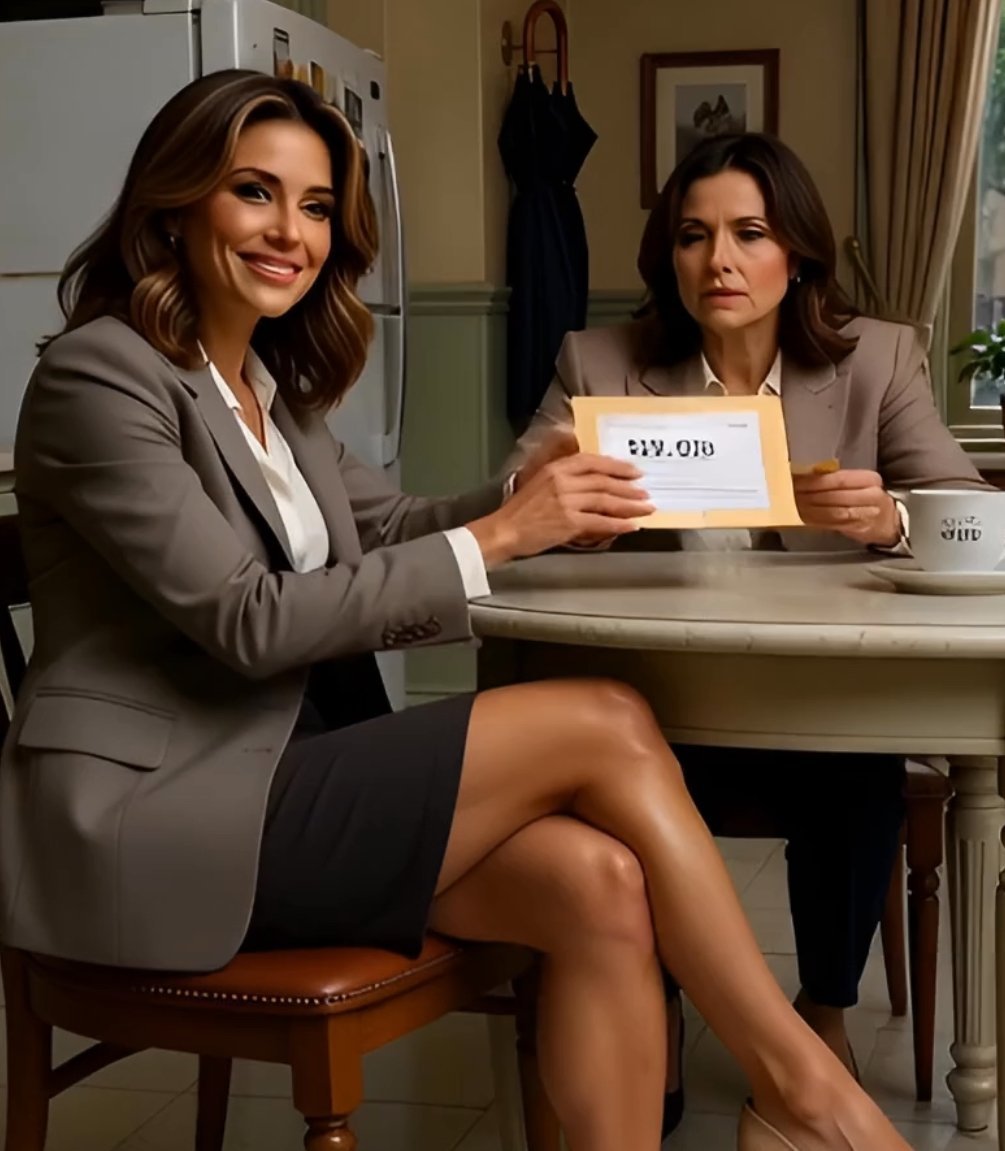
“I’ve made a generous offer,” she said, sliding a document across the table. “Despite everything, I’m willing to buy Claire out. Twenty million for the building.
That’s five million more than market value. All she has to do is sign.”
The room buzzed with excitement.
Twenty million—more money than any of us had ever dreamed of.
“Think of what you could do with that money, Claire,” Mom urged. “You could go back to school, travel, never worry about money again.”
“And the residents?” I asked.
“What happens to them?”
Sabrina shrugged.
“Not our problem once the sale goes through.”
There it was, I thought.
I looked around the room.
“In one sentence,” I said aloud, “everything wrong with this family’s values: not our problem.”
I stood up and pulled out my laptop.
“You want to talk about damage to this family’s reputation?” I said. “Let me show you what real damage looks like.”
Howard helped me connect to the room’s projection system. The first slide appeared—Grandma Edith’s photo.
“This is the woman who built our family’s legacy,” I began.
“She bought Maple Glenn in 1976 with every penny she’d saved—not as an investment, but as a mission.”
I clicked to the next slide.
“She’d been evicted three times as a child during the Depression. She knew what it meant to lose your home.”
Another click—photos of longtime residents.
“Mrs. Rodriguez has lived here for twenty-two years.
She raised three children in apartment 3C—all of whom graduated college.”
Click.
“Mr. Petrov fled the Soviet Union with nothing but the clothes on his back. Maple Glenn was his first real home in America.”
“So stories don’t pay bills,” someone muttered.
“No,” I said, “but apparently embezzlement does.”
I clicked again, displaying the forensic accounting report.
“Ninety-two thousand dollars stolen over two years.
Shell companies. Forged signatures. All while our grandmother was dying.”
“Alleged,” Sabrina’s lawyer protested.
“Documented,” I countered, showing bank records—every transaction traced, every false vendor identified.
“But that’s not the worst part.”
The next slide showed email exchanges between Sabrina and Apex Development.
“These emails date back three years.
While Grandma was suffering from cancer—while I was caring for her in the building—Sabrina was secretly negotiating to sell to developers.”
I clicked through email after email, each more damning than the last. The room grew quieter with each revelation.
“The old bat can’t last much longer,” I read from one email. “Once she’s gone, we can move forward with the full redevelopment plan.”
Gasps echoed through the room.
Even Sabrina’s supporters looked uncomfortable.
“That’s taken out of context,” Sabrina said, but her voice had lost its confidence.
“Then let’s add context.”
I played the audio recording—her admitting to planning manufactured pest scares, to forcing out families, to seeing residents as obstacles to profit.
When her voice on the recording said, “They’re not our problem,” I saw Mom flinch.
“But the real context,” I continued, “is this.”
I played the video Howard had revealed at the resident meeting: Grandma Edith’s final message.
The room watched in silence as Grandma—frail but fierce—looked into the camera.
“If you’re watching this,” she said, “it means Sabrina has shown her true colors. I’ve known for some time that she sees Maple Glenn as nothing but dollar signs. That’s why I’ve taken steps to protect it.”
She paused, as if she could see us.
“Claire, my darling, you understand what I’ve spent my life building.
It’s not about the property. It’s about the promise. The promise that everyone deserves a safe, affordable home.
That community matters more than profit. That we take care of each other.”
Grandma’s image held steady, seeming to look directly at each person in the room.
“To my family watching this,” she continued, “I know you’ll be angry. I know you’ll feel cheated out of money you think you deserve.
But ask yourself: what legacy do you want to leave?”
Her voice didn’t shake.
“Do you want to be remembered as the family who got rich by making others homeless, or the family who stood for something more?”
The video ended.
The silence was deafening.
“She was sick,” Sabrina said desperately. “Not thinking clearly.”
“Her medical records show she was completely lucid when this was recorded,” Howard interjected. “As three doctors have already testified.”
“This is what you’re protecting,” Uncle Richard accused, turning on me.
“This bleeding-heart nonsense that keeps us all poor.”
“Poor?” I laughed, but there was no humor in it. “You drive a BMW. You vacation in Europe.
You own three rental properties. You’re not poor. You’re just not as rich as you think you deserve to be.”
“And what’s wrong with wanting more?” Aunt Patricia demanded.
“Nothing,” I said, “unless more comes at the cost of destroying lives.”
I looked around the room.
“Grandma built something beautiful.
A place where refugees could find safety. Where single mothers could afford to raise their children. Where elderly people could age with dignity.”
I let the next part land.
“And you want to tear it down for condos that will sit empty—owned by foreign investors as tax shelters.”
“You’re being dramatic,” Mom said, but her voice wavered.
“Am I?” I pulled up local news articles.
“This is what happens when buildings like ours get redeveloped. Homeless encampments. Families sleeping in cars.
Children changing schools three times in a year because their parents can’t find stable housing.”
I turned to Sabrina.
“This is your legacy. This is what you want the Maddox name associated with.”
“The Maddox name should be associated with success,” she shot back, “with wealth and power and—”
“And embezzlement,” I interrupted, “because that’s what the headlines say now.”
I clicked to a screenshot of the coverage.
“Prominent lawyer charged with stealing from family property. Elder abuse alleged in real estate scheme.”
I looked at her.
“Is that the reputation you wanted?”
Sabrina’s lawyer whispered urgently in her ear, but she shook him off.
“You did this,” she said, her voice sharp with rage.
“You destroyed my career, my reputation—everything.”
“No, Sabrina.” I closed my laptop. “You did that the moment you decided stealing was easier than earning.”
I stood.
“I’m not selling. Not to you.
Not to developers. Not to anyone who sees homes as just investments.”
“Then you’re a fool,” she spat. “And when you’re old and still managing that decrepit building, remember you could have had millions.”
“I’ll remember that I kept families in their homes,” I said, “that I honored Grandma’s legacy, that I chose people over profit.”
I started for the door.
“And I’ll sleep perfectly well.”
“This isn’t over,” Sabrina called after me.
“The trial hasn’t even started. I’ll beat these charges. And when I do—”
I turned back.
“When you do,” I said evenly, “you’ll still be someone who tried to make families homeless for money.
No verdict can change that.”
I walked toward the door, Howard beside me, but Mom’s voice stopped me.
“Claire… wait.”
I turned.
Tears shone on my mother’s face—the first real emotion I’d seen from her in years.
“I remember when Mother bought Maple Glenn,” she said softly. “I was twelve. She was so proud.
Said it was proof that in America, even someone like her could make a difference.”
“She did make a difference, Mom,” I said. “To hundreds of lives.”
“I know.” Mom’s voice broke. “I just… somewhere along the way, I forgot that mattered.”
I crossed back to her and took her hands.
“It’s not too late to remember.”
The room erupted in arguments—some family members defending Sabrina, others beginning to question what they’d supported—but I didn’t stay to listen.
I’d said what I needed to say, shown what they needed to see.
As Howard and I waited for the elevator, he chuckled.
“Edith would have enjoyed that.
You played it perfectly.”
“I just told the truth,” I said.
“Sometimes,” Howard replied, “that’s the most powerful play of all.”
As we rode down, I thought about Sabrina’s threat.
This isn’t over.
She was right. The criminal trial was coming. She’d fight with everything she had.
But I had something she didn’t.
A building full of people who mattered.
A grandmother’s wisdom guiding me. And the knowledge that I was on the right side.
The war wasn’t over.
But this battle—this battle was mine.
The courtroom was packed on the first day of Sabrina’s trial. Media coverage had turned what might have been a routine embezzlement case into a symbol of the city’s housing crisis.