I had known Harold Peterson for so long that it was hard to imagine a time when he wasn’t a permanent part of the scenery of my life. When I first moved into our quiet neighborhood decades ago, Harold was a tall, remarkably strong man with broad shoulders and weathered hands that always smelled faintly of fresh sawdust and motor oil. He worked as a master carpenter, but to Harold, it was never just a job. He understood wood in a way that made it seem alive, running his calloused fingers over raw beams and nodding softly to himself as if the grain was sharing a secret only he could hear.
Over the years, I watched the slow, cruel theft of time change him in quiet, gradual ways. His thick brown hair went to gray, then to nearly white. His steady steps slowed, became careful, then became terribly unsteady. First came a cane, then a walker, and eventually the heavy metal wheelchair he had fiercely resisted but could no longer avoid.
His gentle wife, Margaret, faded even faster than he did. When she passed away, the house felt suddenly hollow, as though the very sound of laughter had left the property.
But the truest heartbreak wasn’t his aging body—it was his children. What started as a few visits a month became sporadic trips during major holidays, and then, eventually, they stopped coming at all. There was always a convenient excuse texted from a distance—work deadlines, kids’ sports, traffic, minor illnesses. There was always something in their busy, comfortable lives that seemed to matter more than their lonely father.
The front porch became the first visible sign of how dire Harold’s isolation had truly become. He had built that porch with his own two hands years ago: sturdy, wide steps and a smooth oak railing that felt entirely safe. But when the master craftsman can no longer hold a hammer, decay sets in fast. The boards rotted, the bottom step sagged into the dirt, and the safety railing broke off completely.
When Harold was forced into the wheelchair, a makeshift ramp appeared, crudely nailed together from scrap plywood and uneven two-by-fours. It was a precarious, terrifying structure. Every time Harold tried to mail a letter, I watched from my window, my heart in my throat as the flimsy ramp bent violently beneath his weight, the wet wood creaking like it might collapse into splintered pieces at any moment. Whenever I ran over to offer help, he always waved me off with a tired, proud smile, whispering that he never wanted to be a burden to anyone.
Then, the official city citation letter arrived.
I saw it in his trembling hands when he rolled back from the mailbox—his broad shoulders completely slumped, his face ghostly pale. The next morning, he sat on the rotting porch, staring blankly at the paper. The city code enforcement had inspected the exterior and declared both the porch and the makeshift ramp an immediate safety hazard. If major repairs weren’t completed within thirty days, they would condemn the property and legally force him out of his own home.
In a quiet, breaking voice, Harold told me about the phone calls he had made to his children that afternoon, begging for assistance. The aftermath was written in his eyes—a dimming of his spirit that I had never seen before.
“They told me it’s not worth investing money into an old house,” Harold whispered, staring at his lap. “They told me I should just let the city step in because it would ‘simplify things’ and make it easier to transition me into a state facility. They said the house is just going to be sold for profit after I pass away anyway, so why waste the cash now?”
It completely broke my heart. Those words weren’t just a refusal to fix a porch—they were a cold, calculated message that his safety, his dignity, and his entire life mattered far less to his flesh and blood than convenience and future inheritance.
That evening, looking through my kitchen window at midnight, I saw Harold’s living room lights still burning. He was sitting alone in the dark, clutching a framed photograph of his late wife Margaret against his chest, his shoulders shaking violently as he wiped away tears with the back of his hand. He was a man entirely abandoned by the life he had built.
I didn’t consciously plan what I did next. I just knew that sitting in my house doing nothing made me complicit in his heartbreak.
A few blocks away, on the industrial edge of town, sat an old warehouse belonging to a motorcycle club everyone in our town whispered about—the Wheelers MC. They were men covered in leather jackets, heavy tattoos, and roaring engines. People routinely crossed the street just to avoid walking past them. I was terrified, but I marched straight down the road anyway.
The clubhouse was surprisingly quiet when I stepped through the heavy metal door. A dozen massive, rough-faced men stopped talking, turning their eyes toward me in absolute silence.
I stood my ground, cleared my throat, and told them everything. I told them about Harold—the proud veteran, the master carpenter who had helped build half the community centers in our town, the man now facing eviction because his own children valued an inheritance over his life.
The club president, a massive man with a graying beard and a heavy leather vest, listened with an intense, unblinking focus. The moment I mentioned Harold’s full name, the atmosphere in the room violently shifted.
The president leaned forward, his voice deep. “Harold Peterson? The guy who used to own the mill on 5th Street?”
“Yes,” I stammered.
The president looked around at his men, his expression hardening into something fiercely protective. “Twenty-five years ago, my old man lost the use of his legs in a factory accident. We didn’t have a dime, and the insurance company completely screwed us. Harold Peterson showed up at our house on a Saturday morning with a truck full of lumber. He built my dad a massive, beautiful wheelchair ramp and refused to take a single dollar for it. He told my dad that a man’s mobility is his dignity.”
The president stood up, grabbing his keys. “Let’s go pay our debts,” he growled.
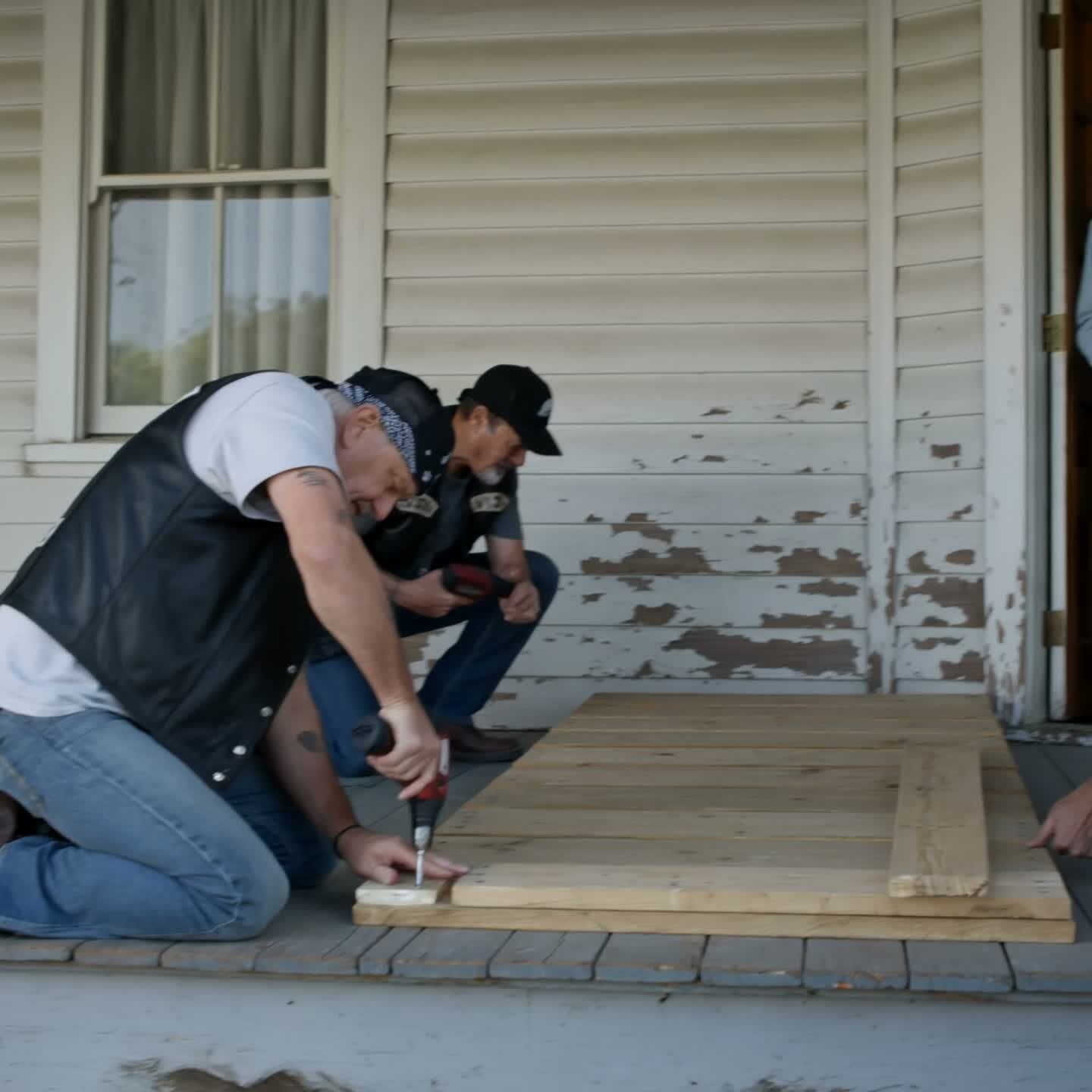
Within forty-five minutes, the quiet street outside Harold’s dark house was filled with the low, rumbling hum of trucks and motorcycles. Neighbors peeked through their blinds in absolute shock as dozens of large, tattooed men began unloading premium cedar lumber, industrial power tools, and massive floodlights into Harold’s yard. There was no loud shouting, no music, and no rowdiness—just the steady, professional rhythm of focused labor.
Harold rolled out onto his sagging threshold, utterly bewildered, his hands shaking as he insisted he couldn’t possibly pay them. The club president walked up the steps, dropped to one knee in front of Harold’s wheelchair, and smiled softly. “You already paid for this twenty-five years ago, corporate sir. Go inside and get some sleep. We’ve got the night shift.”
Over the next three days, the Wheelers MC completely transformed his property. They tore out the hazardous rotting wood and constructed a beautiful, wide porch with rock-solid safety railings and smooth, premium boards. They engineered a professional, ADA-compliant ramp with the perfect, effortless incline, heavy structural supports, and a specialized slip-resistant surface. They even installed automatic solar lighting along the path to ensure he could navigate safely at night. Every single screw was driven to last a lifetime.
On the second afternoon, Harold’s children apparently saw a neighbor’s post about the bikers on social media. His eldest son called Harold’s phone, screaming and threatening to file a legal injunction against the club for modifying the property. The bikers didn’t even bother to respond to the threats—they simply kept working in absolute, calm defiance.
When the final coat of sealant dried, the porch looked more magnificent than it had in decades. Harold rolled onto it slowly, his frail hands touching the smooth, sturdy railings, checking the solid boards beneath his wheels as if he was afraid the entire structure might vanish like a dream. Then, he let out a loud, booming laugh—a beautiful, resonant sound I hadn’t heard echo across the yard since Margaret was alive.