“That tracks. I’ve heard rumors. Conrad has been seen at the casinos down south more often than usual, and he’s been trying to leverage his own assets, but the banks are tapping him out.”
“He’s desperate,” I said. “And he thinks he can bully me into selling.”
“He can’t sell it legally,” Silas said, taking a sip of coffee. “The deed is in your name solely.”
“I know. But if he forges my signature, if he finds a shady notary… I’m going to be 3,000 miles away in Maine.”
Silas tapped his fingers on the table.
“We need a poison pill. Something that makes the land worthless to a developer even if they do manage to trick a title company.”
He pulled a file out of his briefcase.
“I’ve been looking at your research data.”
“The marbled murrelet. The birds?” I asked.
“Yes. You have documented a nesting pair on the North Ridge, right?”
“Yes. For three years.”
“Perfect.” Silas grinned. “We file an update to the existing conservation easement. We explicitly designate the North Ridge as a critical habitat for an endangered species. We file it with the U.S. Fish and Wildlife Service and the county records.”
“What does that do?”
“It freezes development,” Silas explained. “If a developer buys that land, they can’t cut a single tree within 500 feet of those nests without a federal permit. And getting that permit takes five years and a million dollars in environmental impact studies. Basically, the land becomes radioactive to anyone who wants to build a resort.”
“But it protects the birds,” I said, smiling for the first time in days.
“Exactly. It protects the birds, and it protects you. Even if your dad manages to sell it, the buyer will sue him for fraud the moment they realize they bought a bird sanctuary instead of a hotel site.”
I signed the papers right there on the greasy diner table. It felt like signing a declaration of war, but also a declaration of independence.
“File it,” I said. “Make it official.”
Maine was a shock to the system. I landed in Portland and drove three hours north to the research station. The landscape was harsher here—granite rocks, icy water, and a wind that felt like it had knives in it.
The research station was a collection of small cabins clinging to a rocky promontory. It was isolated, quiet, and exactly what I needed.
I met my team the first night. There were three of us: me, a geologist named Sarah, and a local boat captain and field specialist named Liam.
Liam was 32, with a beard that looked like it could sand wood, and eyes that were surprisingly kind. He helped me carry my gear into my cabin.
“You packed light for 18 months,” he noted, lifting my single duffel bag.
“I left in a hurry,” I said. “Needed to get away.”
“Family,” he guessed.
“Something like that.”
We fell into a routine quickly. Up at dawn. Out on the boat to measure sediment erosion, freezing our hands off collecting samples. Back to the station to enter data. It was grueling work, but it was honest.
Liam was a revelation. He was competent, quiet, and deeply respectful. We spent hours on the boat talking. He told me about his family. His parents lived two towns over. They ran a small bakery. He went to dinner there every Sunday.
“You should come sometime,” he offered one day as we were scrubbing down the deck. “Mom makes a blueberry pie that will change your life.”
“I don’t want to intrude,” I said.
“It’s not intruding,” he smiled. “It’s family. We just hang out. It’s no big deal.”
It sounded like a foreign language to me—family without drama, without demands, without improved asset value.
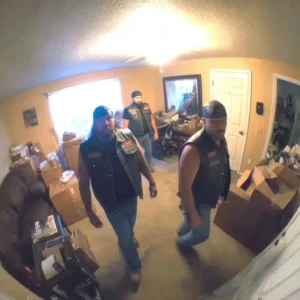
I checked my phone constantly during those first few weeks. I checked the camera feeds. The house in Washington sat empty, gray, and silent. No cars in the driveway, no movement inside.
I started to relax.
Maybe I had overreacted.
Maybe my refusal had actually worked and my father had moved on to some other scheme.
I was wrong.
About a month into my stay, the package arrived. It was a large box wrapped in brown paper. I opened it in the common room of the research station. Inside was a thick hand-knitted wool sweater, a box of expensive chocolates, and a card.
The card read: “Thinking of you in the cold. Keep warm. Love, Mom and Dad.”
I stared at it. My mother hadn’t knitted anything since 1995.
“Nice sweater,” Liam said, walking in with a mug of coffee. “From the folks?”
“Yeah,” I said, touching the wool. It was soft. “It’s weird.”
“Why weird?”
“They don’t do this. Gifts usually come with strings attached.”
That evening, my mother called. I hesitated before answering, watching the screen buzz. Finally, I picked up.
“Did you get the package, sweetie?” Her voice was chirpy, bright.
“I did, Mom. The sweater is beautiful. Did you make it?”
“I did. I’ve been taking classes. Your father and I have been making some changes. He’s joined a painting group. Can you believe it? Conrad painting landscapes.” She laughed. It sounded almost genuine.
“We just wanted to say we’re sorry, Morgan. About the last visit. We were stressed. Dad was… well, you know how he gets about money. But he sorted it out. We just want to be a family again.”
“He sorted it out?” I asked, skepticism creeping into my voice. “The liquidity issue?”
“Oh, yes. He found a private investor for one of his other projects. It’s all fine. We just miss you. We want you to focus on your work and not worry about us.”
I wanted to believe her. God, I wanted to believe her so badly. I was lonely in Maine despite Liam’s company. The little girl inside me who just wanted her mommy to love her woke up.
“Thanks, Mom,” I said softly. “I miss you, too.”
“We’ll check in on the house for you from time to time. Okay? Just to make sure the pipes don’t freeze.”
“No pressure. Just helping out.”
“Okay,” I said. “Thanks.”
I hung up, feeling lighter.
Maybe they really had changed. Maybe the scare of almost losing me had woken them up.
That was the beginning of the campaign.
For the next two months, they were perfect. Weekly calls. Little gifts. Paige even liked my posts on Instagram. It was a master class in manipulation.
Thanksgiving arrived in November. I couldn’t afford to fly back to Washington, and honestly, I didn’t want to risk breaking the fragile peace with my parents.
Liam invited me to his parents’ house.
“Come on,” he said. “It’s going to be loud, chaotic, and there will be too much food. You’ll love it.”
I agreed.
We drove to his parents’ house, a cozy, cluttered cottage that smelled of cinnamon and yeast. His mother, a short, round woman named Martha, hugged me the moment I walked in the door.
“You must be Morgan. Liam talks about you nonstop. Come in, you poor frozen thing. Here, have some cider.”
His father, a retired fisherman with a crushing handshake, slapped Liam on the back.
“Good to see you, son. The boat running okay?”
“Runs great, Pop.”
I sat in the corner of the kitchen watching them. They argued about football. They teased each other. They laughed, but there was no tension, no underlying current of transaction.
When Liam’s dad asked him about work, he listened. He didn’t ask how much money Liam was making. He didn’t suggest Liam should get a real job.
At dinner, they went around the table saying what they were thankful for.
“I’m thankful for this food,” Martha said, “and that Liam finally brought a girl home who eats carbohydrates.”
Everyone laughed. I laughed too, but my chest hurt.
When it was Liam’s turn, he looked at his parents.
“I’m thankful you guys helped me with the down payment on the new engine. I’ll pay you back next season. I promise.”
“Don’t worry about it.” His dad waved a hand. “It’s an investment in you. You’re our son. We’re a team.”
We’re a team.
I excused myself and went to the bathroom. I locked the door and turned on the faucet so they wouldn’t hear me sobbing. I cried for the family I never had. I cried because seeing what a healthy family looked like made my own reality unbearable.
My father didn’t see me as a team member. He saw me as an employee who was underperforming. My mother didn’t want to feed me. She wanted to leverage me.
I looked in the mirror. My eyes were red.