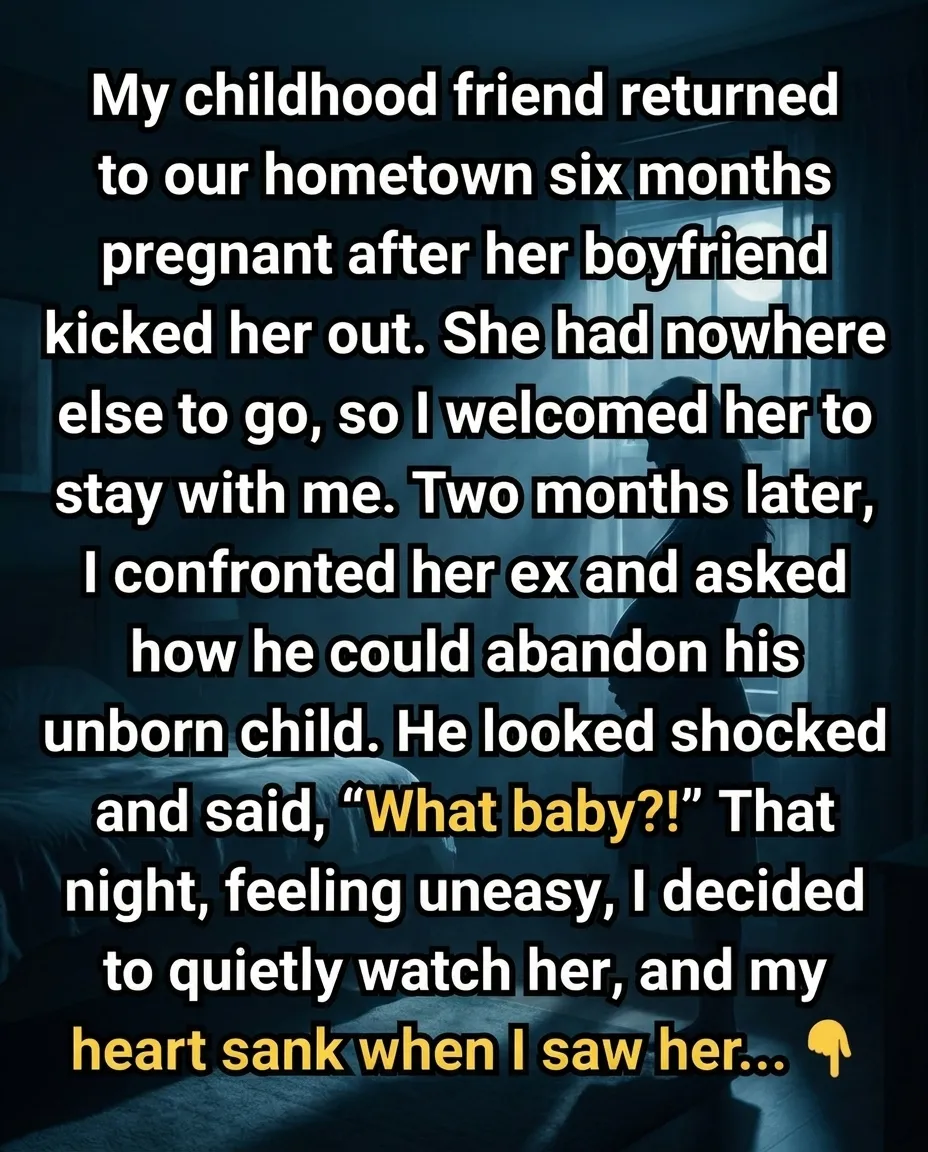
There are some friendships that are woven so deeply into your childhood that you assume they are completely indestructible. Sarah was that person for me. Growing up, she was the keeper of my every secret, the girl who could read my expression before I even finished speaking. Though life and distance had drifted us apart in our twenties, the foundational bond remained. So, when she appeared on my front porch on a rainy Tuesday evening—visibly shaking, weeping, and unmistakably six months pregnant—my maternal and protective instincts completely took over.
She collapsed into my arms, sobbing out a horrific story. She claimed her boyfriend had turned abusive the moment she hit her second trimester, ultimately throwing her out onto the street with nothing but a single suitcase. She said she had nowhere else to turn, no money, and just desperately needed a safe harbor for her unborn child.
Without a single shred of hesitation or doubt, I opened my home to her. I believed with all my heart that I was doing the right thing for someone who had once been closer than a sister.
The first few weeks felt fragile but profoundly rewarding. I dedicated myself to her care. I transformed my guest room into a peaceful sanctuary, bought her high-end prenatal vitamins, cooked iron-rich meals, and spent hours sitting on the sofa with her, discussing baby names and nursery themes. I threw my entire soul into supporting her through what I assumed was the most terrifying chapter of her life.
But looking back, the warning signs were subtly there from the very beginning.
Whenever a scheduled prenatal checkup rolled around, Sarah grew incredibly defensive. She fiercely refused to let me accompany her to the clinic, insisting that the trauma of her breakup made her prefer to face the medical staff entirely alone. She would walk out the door, take my car, and return hours later with vague updates about the baby’s growth.
I respected her boundaries without question. I thought I was honoring her privacy as a grieving, single mother. I had absolutely no idea that my respect was unknowingly protecting a monstrous, calculated lie.
The first real crack in her facade appeared entirely by accident. While pushing my cart through the organic section of our hometown grocery store one afternoon, I spotted a familiar face. It was Marcus—Sarah’s supposed abusive ex-boyfriend.
A hot, blinding fury surged through my veins. Out of pure instinct, I marched straight up to him, my voice shaking with rage as I confronted him right there in the aisle. “How could you live with yourself?” I snapped, loud enough for neighboring shoppers to turn around. “How could you throw a woman out on the street when she is six months pregnant with your child?”
Marcus stopped dead in his tracks. He didn’t look angry; he looked completely, utterly paralyzed with confusion. His jaw dropped, and he stared at me as if I was speaking a foreign language.
“What on earth are you talking about?” he asked, his voice entirely steady and bewildered. “Sarah and I broke up over a year ago because she was cheating on me. What baby? She isn’t pregnant. I haven’t seen or spoken to her in fourteen months.”
The absolute certainty in his eyes sent a freezing, sickening drop of dread straight into my stomach. The knot of doubt was planted, and by the time I drove back to my house, the paranoia was eating me alive.
That night, the horrific truth finally unraveled. It was roughly 11:00 PM, and the house was completely silent. I walked down the dark hallway to bring a fresh stack of towels to the linen closet. As I passed the guest room, I noticed the door wasn’t fully latched—it was sitting open by a mere fraction of an inch, casting a thin sliver of golden light onto the hallway carpet.
I paused, intending to quietly close it. But a strange movement inside caught my eye.
Through the narrow crack, I watched Sarah standing in front of the full-length mirror. She unzipped her oversized maternity hoodie and pulled up her shirt. My brain completely scrambled, struggling to process the visual reality of what my eyes were seeing.
With a practiced, casual familiarity, Sarah unclasped a thick, medical-grade silicone strap from around her waist. She lifted a heavy, realistic flesh-colored prosthetic—a false pregnancy belly—completely off her frame, revealing a perfectly flat, un-pregnant stomach beneath.
I stood there frozen in the dark hallway, the breath entirely sucked out of my lungs as the crushing weight of the deception hit me like a physical blow. Every tear she had cried on my shoulder, every conversation about baby kicks, every prenatal vitamin I had paid for—it had all been a meticulously staged, psychotic performance.
The next morning, the moment Sarah left the house to go on one of her “solo walks,” I marched into the guest room. I dropped to my knees and dragged a large, heavy plastic storage container out from beneath the bed.
I popped the latches open, and my stomach turned over in pure disgust. Inside was a complete toolkit of psychological warfare: a series of different-sized silicone bellies, meticulously labeled by month—7 months, 8 months, 9 months—designed to mimic the progression of a growing child. There were also falsified ultrasound printouts she had downloaded and edited from the internet.
She wasn’t running from an abuser. She was running from her own ruined life, using a manufactured tragedy to grift free rent, emotional labor, and financial support out of the one person she knew would never turn her away.
When she walked back through the front door an hour later, she didn’t find a welcoming friend. She found her suitcase sitting on the porch, and me standing in the doorway holding the 7-month silicone belly in my hand.
Her face turned a ghostly, horrific shade of white. She tried to stammer out an explanation, to spin a new web of lies, but I held up my hand and cut her off in absolute silence. There were no more chances to reinterpret the madness I had uncovered. I ordered her to take her bags and get off my property permanently.
It hurt in a way I never could have anticipated. The sting wasn’t just about the money or the broken trust; it was mourning the memory of the innocent childhood best friend I thought I knew. But as I watched her drive away into the distance, a profound clarity washed over me. True kindness and empathy do not mean abandoning your boundaries or allowing your soul to be hollowed out by a predator. Sometimes, the hardest, most courageous part of compassion is simply recognizing when your love is being exploited, and having the strength to close the door forever