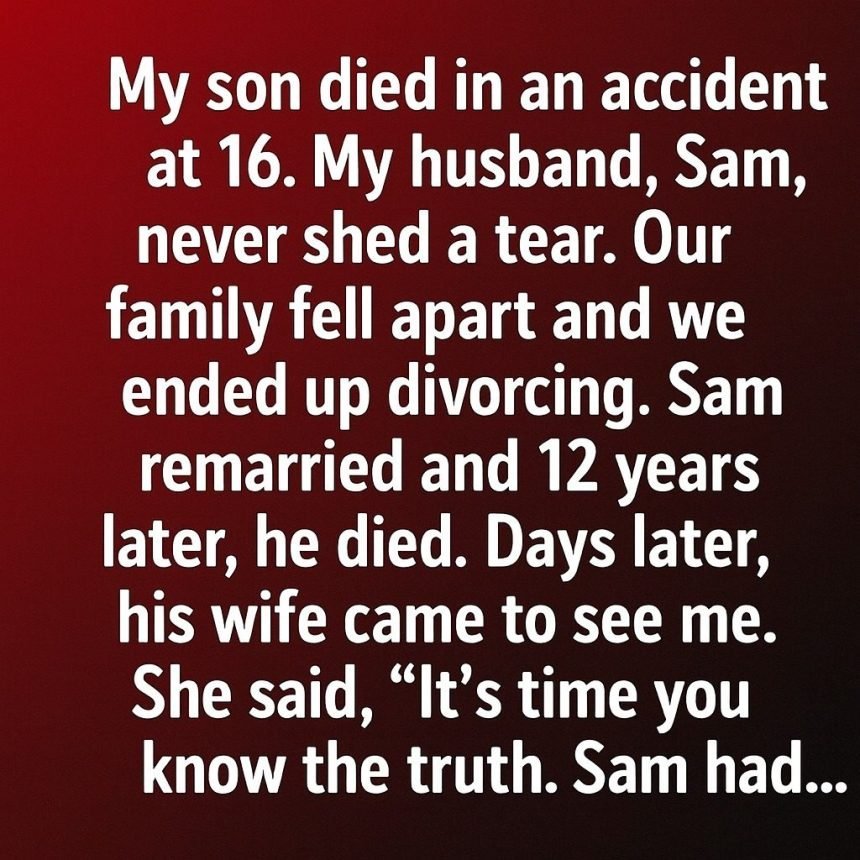
My son died in an accident at sixteen, leaving behind a silence that felt heavy enough to crush the foundation of our home. In the days that followed, the world blurred into a series of hospital hallways and funeral processions. Through it all, I looked at my husband, Sam, and felt a growing, icy terror. He didn’t shed a tear. Not at the site of the crash, not at the viewing, and not when we finally sat alone in the house that used to vibrate with our boy’s laughter.
I was breaking into a million pieces, weeping until I had nothing left to give, while Sam seemed to have turned into a statue. He retreated into his work, his movements mechanical, his eyes empty. To me, his silence wasn’t strength—it was a total absence of humanity. I began to view him not as a grieving father, but as a man who simply didn’t care, and that resentment curdled into a poison that eventually destroyed our marriage. We divorced, I retreated into a quiet town to escape the ghosts, and we became strangers living under the weight of a shared, unvoiced tragedy.
Twelve years passed. Time didn’t heal the wound, but it did dull the sharpness of the pain. Then came the phone call: Sam had passed away suddenly.
I attended the funeral as a ghost of his past, detached and hollow. But days later, his widow came to my home. She looked tired, her hands trembling as she wrapped them around a cup of tea.
“It’s time you knew the truth,” she whispered.
I braced myself, expecting a confession of an affair or a hidden life. Instead, she described a man I had never known. She told me that the night our son died, Sam had driven to a secluded lake—a place where they had spent countless afternoons fishing and laughing. He hadn’t been working; he had been mourning.
Every single night for over a decade, Sam had made that trek. He would sit under the same willow tree, talking to our son as if he were still there. He wrote letters. He left flowers. He wept until his throat was raw, but he always wiped his face clean before walking through our front door.
“He thought if he stayed strong for you, you’d have someone to lean on,” she said, her voice cracking. “He believed that if he broke down in front of you, the house would fall. He carried his sorrow in the dark so you could have a light to follow. But it tore him apart, piece by agonizing piece.”
I sat there in the stillness of my kitchen, the world shifting on its axis. The years of resentment didn’t evaporate—they were replaced by a profound, suffocating grief for the man I had wrongly judged.
That evening, I drove to the lake. The air was cool, smelling of pine and stagnant water. Under the willow tree she had described, I found a small, weathered wooden box tucked into the hollow of the trunk. Inside were twelve thick envelopes, one for every birthday our son never had. I opened the first one. “Happy 17th, son. The house is so quiet today, but I still see you in the hallway.”
As the sun dipped below the water, staining the horizon in shades of violet and bruised gold, I finally understood the terrifying, quiet magnitude of Sam’s love. I had spent years hating him for being made of stone, when all the while, he had been shielding me from the sheer, crushing weight of a grief he was convinced I couldn’t survive.
Love doesn’t always announce itself with a howl. Sometimes, it hides in the shadows, choosing to bear the burden of silence so that the person it loves doesn’t have to carry the weight alone. I had been looking for tears, but I had failed to see the sacrifice. In the silence of that lake, I finally said goodbye—not just to my son, but to the husband I had lost long before he died.