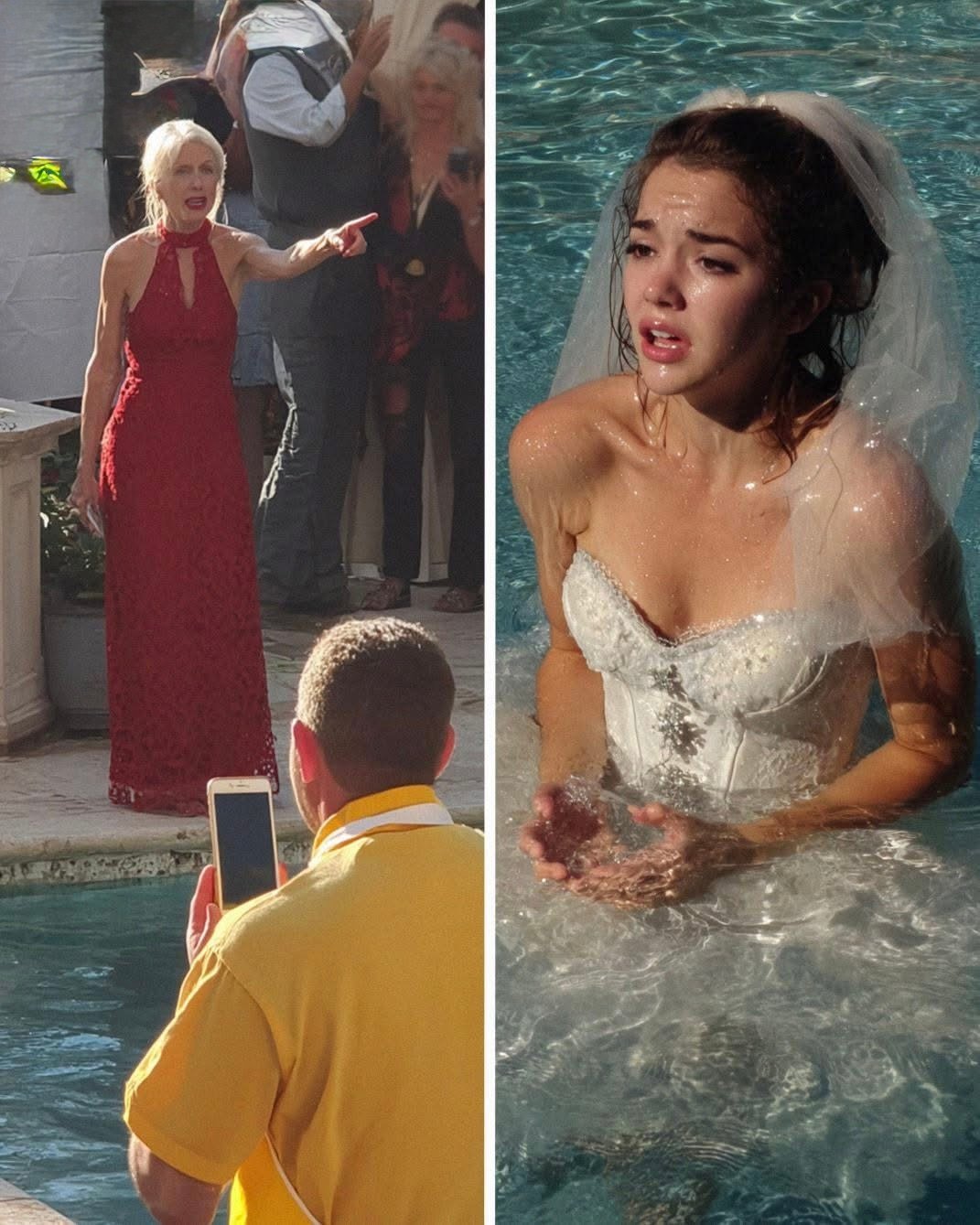
Ryan never left my side. He called my parents, texted Mia, and ignored every call from his mother. At one point, I watched his jaw clench as he held the phone up and saw her name on the screen.
“I’m blocking her,” he said. “This ends now.”
I typed on my phone and showed him: “Do you believe she meant to do it?”
He stared at the screen, then at me. “I don’t think she cared if it hurt you. That’s bad enough.”
The next day, after I was discharged, Ryan sat beside me at home while we replayed the moment in our heads over and over. I couldn’t stop thinking about the way she smiled, how deliberate her movements had been. It wasn’t an accident. I knew it. So did Ryan. But knowing and proving it were two very different things.
Until Mia sent us the video.
One of our guests had been livestreaming part of the reception to their family out of state. They’d caught everything: the push, the smirk, and the moment before I hit the water. It was all there.
I watched it once. That was enough. Ryan, though, watched it at least 10 times. When he turned to me, he looked like a different man.
“We’re pressing charges,” he said. “I’m not letting her get away with this.”
What followed was one of the hardest seasons of my life.
The legal process was slow, frustrating, and exhausting. Vivian’s attorney tried every trick in the book. At first, she claimed she had tripped. Then she said I was standing too close to the edge. Later, her story changed again: she’d only meant to “gesture playfully.”
Ryan and I kept our distance. She sent flowers, letters, even a package with an expensive silk robe and a note that read, “Let’s not ruin the family over a misunderstanding.” I didn’t open anything else after that.
Social media made things worse. Vivian went online to post some carefully crafted statements. She posed about how her daughter-in-law was “vindictive” and “exaggerating” what was “clearly an accident.” Vivian painted herself as an aging and “misunderstood” mother in distress, terrified she’d be separated from her only child.
Her lies didn’t matter once we got to court, a process that took months. We filed charges for assault and destruction of medical property, which she purposefully destroyed on my wedding day.
When the video played in front of the judge, there was no more spinning the truth. You could see her face, the intentional shove, and the moment she stepped back as I fell, not forward to help. Even the slight curve of her lips was visible.
The judge, who looked disgusted by what she saw, didn’t even hesitate. Vivian was found guilty. She was ordered to pay full restitution for the cost of my hearing aids, which were over $8,000, the best model for my condition. My mother-in-law (MIL) also had to pay additional damages for emotional and physical harm. The total came to $120,000.
She wept in court.
“You’re ruining my life!” she cried, mascara running down her cheeks.
Ryan stood beside me, unmoved. He looked her straight in the eye and said, “You did that yourself.”
Afterward, we walked out of the courtroom hand in hand. I didn’t look back.
That settlement money became the unexpected turning point in my story. You see, for years, doctors had told me that cochlear implant surgery could potentially help, but it was expensive. And even with insurance, the out-of-pocket costs were overwhelming. I never thought I could ever afford it.
Now I could!
The first appointment felt surreal. I sat in a small, quiet office while the audiologist explained the process. I had researched it for years, so I nodded through most of the information, but my heart wouldn’t stop racing.
Two months later, I had the surgery. Recovery wasn’t easy. I had headaches, vertigo, and days where the world felt too bright and too loud, even though I couldn’t hear yet.
Then came activation day.
I remember sitting in that chair, fingers clenched, palms sweaty. Ryan sat across from me, nervous but smiling. The audiologist said, “Alright, Allison, we’re going to turn it on. You might hear some static first.”
She pressed a button on her screen.
There was a burst of sound.
It wasn’t music or voices or anything I could recognize—just sharp, sudden life. Then, slowly, I heard something softer. A voice.
“Hey, baby,” Ryan said.
I gasped. It was his voice, clearer than I had ever heard it in my life.
Tears poured down my cheeks. I covered my mouth and whispered, “I can hear you. Like, really hear you.”
He came over, kissed my forehead, and said, “Now you’ll never miss a word.”
It has been a year since that day. A full, beautiful, noisy year.
Vivian has tried reaching out. She wrote apology letters—long, overwritten essays about love and regret. Ryan never opened them. He handed them to me and asked what I wanted to do.
I said, “She had her chance.”
He nodded and threw them away.
She also lost a lot more than the lawsuit. Her friends distanced themselves once the truth came out. Her social circle, the one she’d carefully cultivated for decades, crumbled. She is no longer invited to events or family functions.
Even some of Ryan’s cousins stopped talking to her after they saw the video and realized what she really was.
As for me? I found a new purpose.
I started a YouTube channel, just a small thing at first. This was where I talked about hearing loss, cochlear implants, and the truth about living with a disability. I made videos about confidence, gear reviews, and the emotional roller coaster of rediscovering sound.
I never expected it to grow, but it did. I now have tens of thousands of subscribers. I started getting messages from other people with hearing loss. I got them from parents of deaf children, and from people who thought they were alone until they found me.
One day, I got an email inviting me to speak at a disability rights conference. I almost deleted it, thinking it was spam. But it was real. I stood on a stage in front of hundreds of people, told my story, and ended with these words:
“Someone once tried to silence me. Instead, she made me louder than I’ve ever been.”
The applause? I heard every single clap.