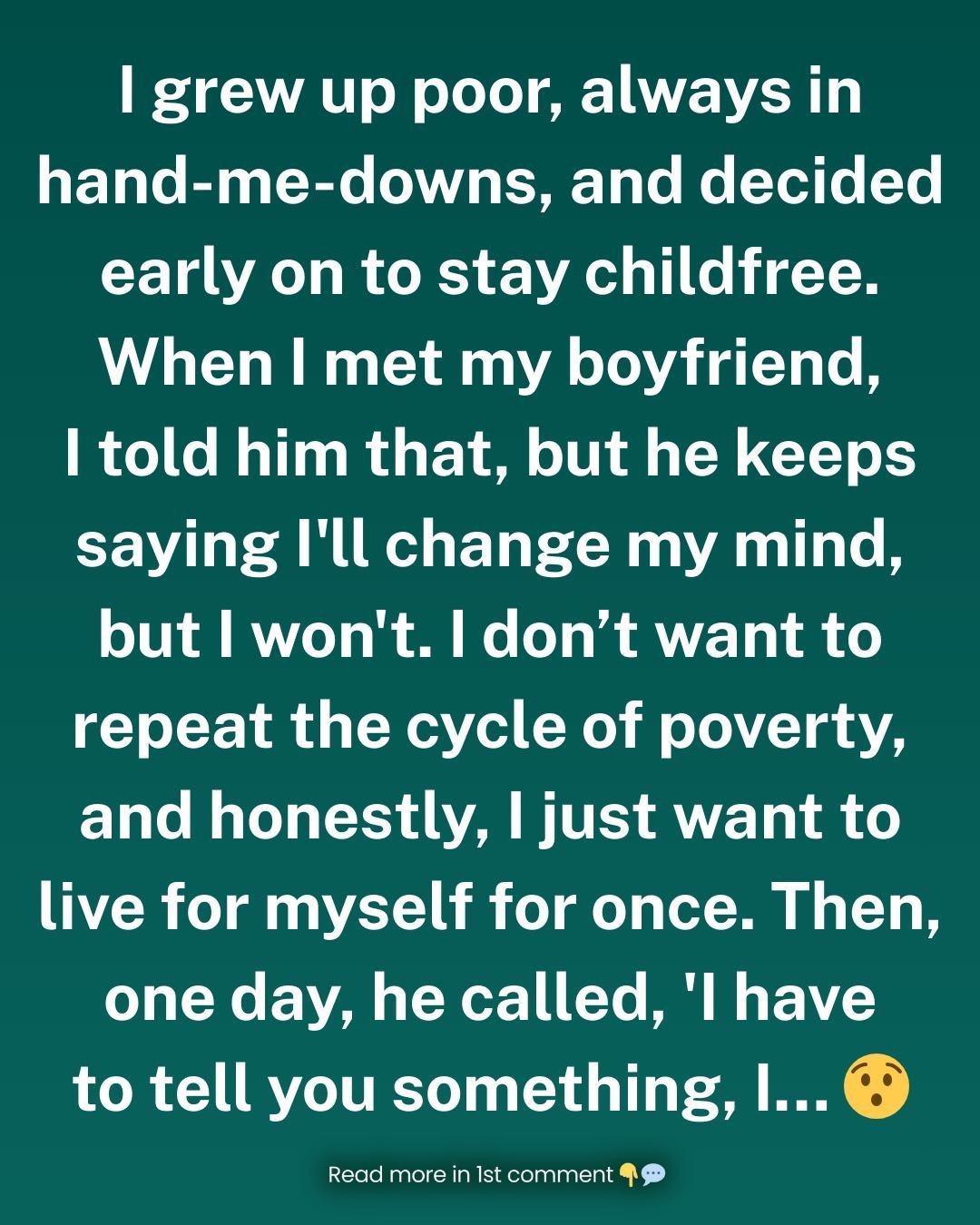
I grew up in the shadow of a childhood that wasn’t really mine. While other kids were learning to ride bikes or losing themselves in books, I was learning the temperature of baby formula, the cadence of lullabies for restless toddlers, and the grim math of managing a household on poverty-line wages. I was “Mom #2” by necessity, a role that robbed me of my own infancy and adolescence. I spent my formative years trading my potential for diapers and homework help, a cycle of exhaustion that I vowed would end with me.
Now, in my mid-20s, I have finally begun the slow, deliberate work of reclaiming my identity. I am a partner, an individual, and a person who finally has the space to breathe. But my boyfriend—a man I truly love and with whom I share a deep, comfortable laughter—seems to be operating under the assumption that my boundaries are merely a test of his patience.
I have been crystalline in my communication: I do not want children. I have explained that I have already lived through the sleepless nights, the emotional labor, and the suffocating stress of child-rearing. I have explained that I want a life that is mine—not one dictated by the demands of a dependent. Yet, he persists with the narrative that I will eventually “change my mind,” as if my deeply held conviction is nothing more than a stubborn mood.
The situation reached a breaking point when he arrived home, beaming with a pride that quickly curdled into dread for me. He hadn’t just brought home a puppy; he had brought home a prop.
“I have a surprise,” he said, his voice light and expectant. “I adopted a puppy so you could see how caring for someone else could change your mind.”
He wasn’t just offering a pet; he was staging a psychological experiment. He was using a living, breathing creature—one that requires constant, selfless attention—to try and rewrite my subconscious. He was betting that if he could just get me to provide the labor of caretaking, I would succumb to the biological pressure he assumes I’m suppressing.
The moment he said it, the air in the room grew heavy. My reaction wasn’t maternal joy; it was a profound sense of isolation. I looked at the puppy, who was innocent of the agenda behind his arrival, and felt a wave of frustration so intense it was nearly physical. It wasn’t about the dog. It was about the fact that my “No” had been treated as a “Not yet.”
The Anatomy of a Violation
What makes this a turning point—and arguably a deal-breaker—is not the dog itself, but the lack of respect behind the choice. When a partner attempts to use manipulation to override your life goals, they are fundamentally failing to see you as an equal.
Weaponizing Kindness: By bringing home a puppy, he played the “nice guy” card. If I expressed anger, I would look like the cold, unfeeling partner who hates animals. It was a tactical maneuver designed to force me into a corner where I had to choose between being the “mean girlfriend” or the “maternal nurturer.”
Infantilizing My Choices: He clearly views my decision to be child-free as a temporary glitch in my programming rather than a reasoned, adult choice. This is a patronizing stance that denies me the agency I have spent my entire life trying to secure.
The “Fait Accompli”: By forcing a high-stakes decision upon me in our shared home, he hoped that the logistical reality of the dog would make it impossible to say no. It is a classic move of “asking for forgiveness rather than permission,” a behavior that is toxic in any long-term partnership.
The Reckoning: Is This Reversible?
You are standing at a crossroads. The red flag here is not the puppy; the red flag is the mindset that you can be “convinced” out of your own life path.
If you decide to confront this, the conversation needs to be stripped of all hesitation. You cannot treat this as an argument about whether you like puppies; you must treat it as an argument about whether he respects your autonomy.
The “Truth-Telling” Conversation:
You need to sit him down and make it clear: “You brought this puppy here to test me. You tried to conduct an experiment on my life goals because you refuse to believe that I know my own mind. By doing so, you have communicated that you do not respect my No. I am not a project to be managed or a personality to be molded. If you are waiting for me to change my mind about children, you are wasting both of our time. We need to decide right now: are you in love with the woman standing in front of you, or the version of me you are trying to manufacture?”
Reclaiming Your Narrative
You have spent your entire life as “Mom #2.” You have been the nurturer, the stabilizer, and the provider for people who could not provide for themselves. You have earned the right to live for yourself.
Do not let yourself be “experimented” upon by the person who claims to be your biggest supporter. If your partner cannot see the value in a life that does not involve children, then he is not your partner—he is your opponent. You are not being “annoying” or “stubborn” by holding your ground; you are protecting the only life you have ever truly been allowed to own.
Ask yourself this: Can you envision a future where you are truly happy, or will you always be looking over your shoulder to see if he is trying to trick you into a version of motherhood you have already lived and rejected?