My daughter, Chloe, has always been the kind of woman who prides herself on carrying the weight of the world without uttering a single complaint. When she brought her third child home from the hospital, she insisted she had everything under control. She had a system, she had a routine, and she didn’t want to be a burden to anyone. I took her at her word. In fact, I used her independence as a convenient excuse to step back, protecting my own quiet retirement, my evening routines, and my absolute freedom.
But three weeks after she gave birth, the illusion of her strength completely shattered.
It was a rainy Friday evening, and I was sitting at my vanity, putting the finishing touches on my jewelry before heading out to a highly anticipated dinner party with old friends. My phone buzzed on the counter. It was Chloe.
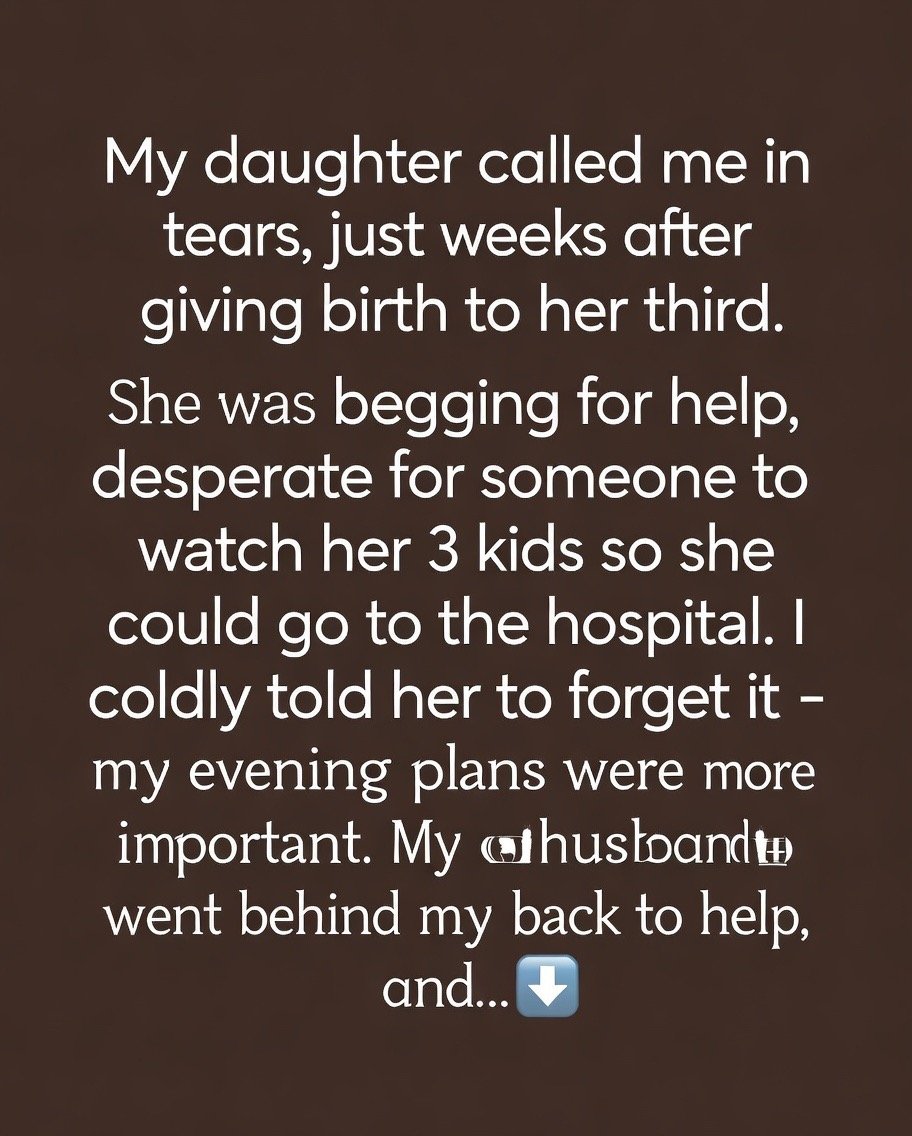
The moment I answered, my heart should have broken. Her voice was unrecognizable—a gasping, desperate sob that sounded completely unraveled by a primal terror.
“Mom… please,” she choked out, her breathing ragged while the screaming wails of her newborn and her two toddlers echoed like a storm in the background. “I can’t breathe. My chest feels so heavy, and my vision keeps going black. I need to go to the hospital right now. Please, can you just come over for a few hours and watch the kids? I have nobody else to call.”
I looked at my reflection in the mirror. I looked at my expensive dress. And in a moment of pure, unforgivable selfishness, a sharp wave of irritation washed over me. I convinced myself she was just being dramatic, succumbing to the standard stress of motherhood.
“Chloe, honey, you’re just experiencing normal fatigue,” I said, my voice dripping with a cold, dismissive detachment. “You need to take a deep breath and lie down. I have important evening plans tonight that I cannot cancel at the last minute. Call your husband’s family, or just push through until morning. You’ll be fine.”
I hung up the phone before she could reply. I buttoned my coat, entirely deaf to the quiet gasp of horror coming from the living room doorway. My husband, Robert, had heard every single word of the conversation. He didn’t yell at me, and he didn’t argue. He simply grabbed his truck keys off the counter, looked at me with a profound, crushing disappointment in his eyes, and quietly walked out the front door into the pouring rain.
I went to the dinner party alone. But the expensive food tasted like ash in my mouth, and the laughter of my friends felt like an indictment. The guilt was already beginning to bore a hole through my chest.
I returned to our empty, dark house at midnight. I sat on the edge of our bed, staring at the clock, waiting in agony. It was nearly 2:00 AM when the front door finally clicked open. Robert walked into the bedroom, his heavy boots dragging against the floorboards.
The moment I saw his face, the breath was completely sucked out of my lungs. He was ghostly pale, his broad shoulders were slumped, and his eyes were completely red-rimmed from crying.
“Robert…” I whispered, my hands shaking. “Is she… what happened?”
Robert sank into the armchair, burying his face in his calloused hands. When he finally looked up at me, his voice was a fragile, broken whisper that cut deeper than any physical blade ever could.
“She wasn’t exaggerating, Linda,” he choked out, a tear spilling down his cheek. “The second I unlocked her front door, I found her collapsed face-down on the kitchen linoleum floor, completely unconscious. The baby was screaming in the bassinet, and the toddlers were sitting beside her, crying and trying to wake their mommy up. I had to carry her to the truck myself.”
My jaw dropped, a hot wave of intense shame flooding my veins.
“The ER doctors said her body completely shut down from absolute, advanced physical exhaustion,” Robert whispered, his voice trembling with an immense weight. “She hasn’t slept for more than forty-five minutes at a time in twenty-one days, trying to manage a colicky newborn and two toddlers while her husband is deployed. Her blood pressure was dangerously low. She needed her mother, Linda. She begged for her mother… and you chose a dinner party.”
I lay awake all night long in the pitch black, staring at the ceiling, weeping silently into my pillow as the absolute monster of my own selfishness stared me down. I had chosen my own casual convenience over pure maternal compassion. I had brainwashed myself into believing that my job as a mother somehow ended the moment my children grew up and left my house. I had abandoned my child when she was drowning.
At the first crack of dawn, I drove to the county hospital, my chest tightening with a suffocating anxiety. I walked down the sterile, fluorescent-lit corridor of the maternity recovery ward, my hands trembling violently as I pushed open the door to her room.
The sight inside shattered my soul into a million pieces.
Chloe looked incredibly small, fragile, and utterly exhausted sitting in the center of that massive hospital bed. Her face was pale, devoid of its usual vibrant color, and an IV line was taped to her bruised arm. But tightly clutched against her chest, wrapped in a faded hospital blanket, was her sleeping newborn.
The moment the door clicked and her clouded eyes landed on my face, she didn’t yell at me. She didn’t throw my cruel words back in my face. Instead, a fresh wave of thick tears instantly filled her eyes. Her lower lip began to tremble violently.
But those tears weren’t born out of physical pain, or anger, or resentment. They were tears of pure, unadulterated relief because her mother had finally, truly come home.
I dropped my purse onto the floor, rushed across the room, and fell to my knees beside her mattress. I threw my arms around her fragile shoulders, burying my face in her hair, sobbing out an agony of apologies into her neck.
“I am so sorry, my beautiful girl,” I wept, holding her as tightly as I could without hurting her. “I am so incredibly sorry. I am here now. I am never going to leave you again.”
Chloe buried her face in my shoulder, her chest heaving as she finally let go of the immense, suffocating pressure she had been carrying entirely alone for weeks. “I was just so tired, Mom,” she whispered, her voice a tiny child’s whimper. “I just couldn’t do it by myself anymore.”
I stayed in that hospital room for two solid days, and when she was finally discharged, I moved straight into her house for a full month. I took over the absolute rhythm of her home. I handled the midnight feedings, scrubbed her floors, washed the endless mountains of laundry, cooked every single meal, and chased her toddlers through the yard so Chloe could shut her bedroom door, turn off her racing mind, and sleep for ten beautiful hours at a time.
During those long, quiet nights, rocking my crying grandson under the glow of the nursery lamp while my daughter slept peacefully down the hall, a profound clarity washed over my soul.
I learned a lesson that month that I should never have been foolish enough to forget. Family is not an inconvenient burden, an interruption to your personal schedule, or a chore to be managed from a safe distance. Family is a sacred, irreplaceable gift.
Our adult children do not need us to be perfect. They do not need us to have all the answers to the hardships of this heavy world. They simply need our absolute, unwavering presence. I made a solemn promise to my soul, to my husband, and to my beautiful daughter that I would never again elevate my own trivial plans above her cry for help. Because at the end of this short life, true love is never proved through empty words spoken from a distance—it is proved entirely through your fierce, immediate willingness to simply show up when the people you carry in your heart need you the most