
Part 1: The Woman They Refused to See
My name is Katherine Rose. I am thirty-six years old, and by the time this story reached its breaking point, I had spent fourteen years serving my country in naval intelligence, climbing from ensign to captain and ultimately taking senior command within a joint task force. None of that was hidden.
None of it was unclear. Yet for seven years my mother-in-law treated me as though I were some temporary guest in my own marriage, a woman attached to her son by paperwork rather than substance. She introduced me as Frank’s wife with some kind of administrative position, questioned my devotion whenever duty pulled me elsewhere, and slowly, persistently built a story around me that said I did not truly belong.
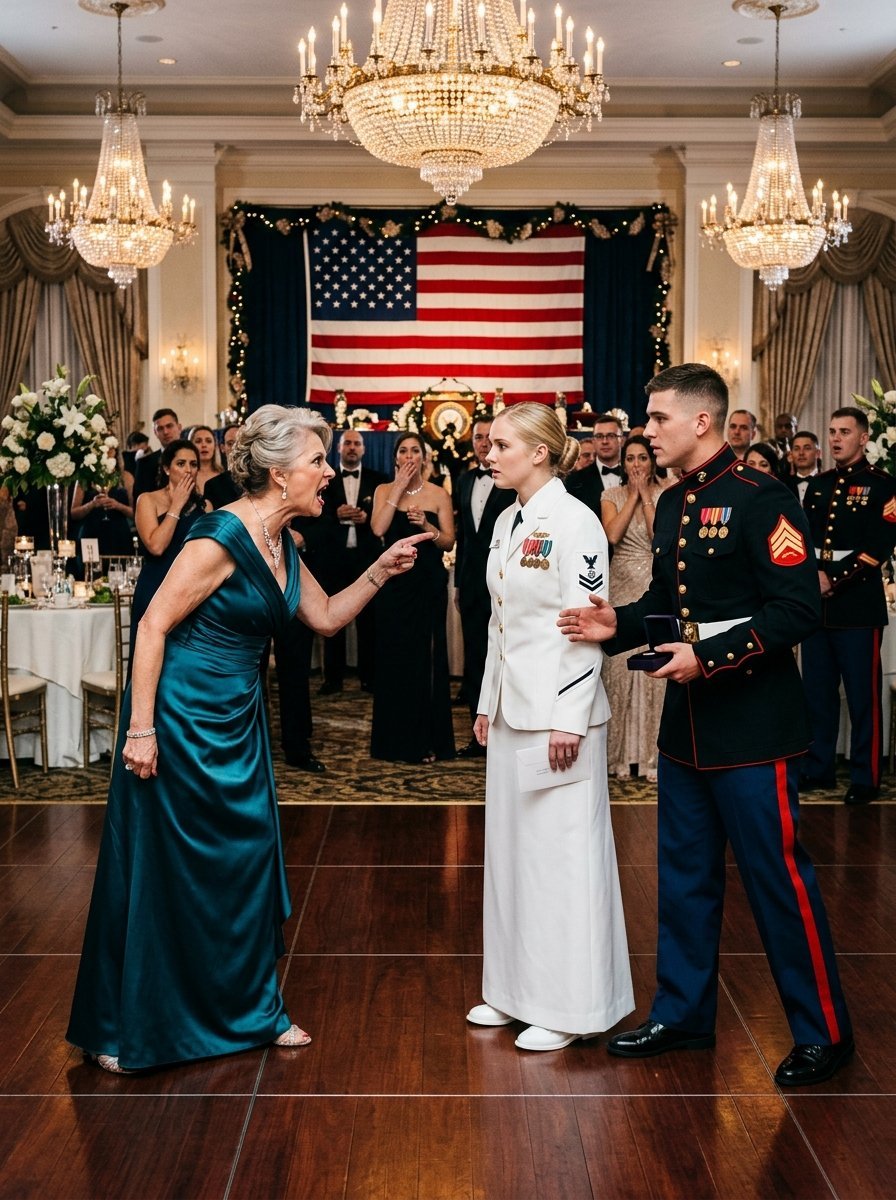
She told that story so often, and with such polished certainty, that people who knew better sometimes let themselves go quiet rather than contradict her. Then, at the annual military ball, she took hold of a military police officer and demanded that I be arrested for impersonation. The officer scanned my identification, and within seconds the entire ballroom was called to attention.
People ask whether I saw it coming.
The truth is yes and no. I knew Helen Hansen would always rather preserve her own version of reality than adjust it to fit facts. What I did not know was that she would eventually do it in a room full of officers who understood exactly who I was the moment they saw my uniform.
There is a difference between private contempt and public miscalculation. Private contempt can linger for years. Public miscalculation tends to detonate all at once.
Long before Helen ever entered my life, my father had taught me exactly what work and identity meant.
He kept navigation charts spread across the kitchen table in our house in Newport the way other men kept newspapers, flattened at the corners, studied with deep concentration, the sort of focus that quiets a room without requiring anyone to lower their voice. I was ten the first time I realized those charts were not decoration. They were his work.
My father, James Rose, was a Navy captain. When I asked him why one heading mattered more than another, he did not soften the answer for a child. He gave me the real explanation because he believed serious questions deserved serious answers.
My mother had left when I was seven, and I do not remember her with the kind of sharpness that suggests one dramatic wound. I remember her more like weather from a year you can no longer date precisely. She was there, and then she was gone.
What remained was my father, the kitchen table, and the steady understanding that competence was not a costume. It was a condition. You either showed up prepared, or you did not belong in the room.
He raised me alone inside a home where discipline did not feel imposed so much as ambient.
Dinner happened when dinner was supposed to happen. Shoes were lined up by the door. Conversation had structure.
You listened when someone else spoke. You did not waste words simply to reassure yourself of your own presence. My father was not cold.
He was exact. And when he told me, at twelve years old, that I could become anything I was willing to work for, he did not mean it as the kind of vague encouragement adults hand children because they think hope itself is a gift. He meant it literally.
Work was the mechanism. Willingness was the fuel. Everything else was scenery.
I entered the Naval Academy in Annapolis in the summer of 2008 at eighteen years old.
Plebe summer stripped away comfort the way it strips it from everyone, and because I was smaller than most of the men in my class, I learned quickly that I would have to be better, not louder. So I was. I found early that the academy rewarded consistency more than drama.
The people who burned hot and sought constant notice were often forgotten by second year. The ones who showed up every day prepared, clear-headed, and difficult to shake became the people whose names lasted. I studied harder than I strictly needed to because my father had taught me that the distance between adequate and excellent is where character reveals itself.
I graduated in 2012, and when my father pinned on my ensign’s bars at commissioning, he did not make a speech. He looked at me, his hands as steady as they had always been, and said only, “You know what to do.”
I did. My first assignment was in naval intelligence with the Pacific Fleet.
I learned quickly that intelligence work is not glamorous unless you misunderstand what matters. It is meticulous, often invisible, built on patience, discipline, and the ability to carry significant weight without needing recognition to make the burden feel real. The best work I did in those early years was work most people would never hear about.
I was promoted to lieutenant junior grade in 2014 and completed my first overseas deployment in the Western Pacific. By 2016, as a lieutenant, I was already carrying responsibilities above the shape of my rank, and the trajectory ahead of me had begun to sharpen in the eyes of the people above me, whether or not anyone in my personal life yet understood what that meant.
That was the year I met Frank Hansen.
Part 2: The Marriage and the Mother
I met Frank in October of 2016 at a Fleet Week reception in San Diego. I was there as part of an intelligence briefing delegation.
He was a surface warfare officer, thirty-one years old, polished without seeming vain, from a family in Greenwich that had money, expectations, and almost no organic relationship to military life. What I noticed first about him was not charm, though he had that in abundance. It was attention.
He asked me about my work before he asked me anything personal. That mattered. Most people led with the personal because they believed that was intimacy.
Frank led with the professional, which told me more about what he respected than any flirtation could have.
The year that followed was built out of time zones, deployments, compressed weekends, and interrupted calls. It was not easy, which may be one reason I trusted it. He understood the classified boundaries around my work and never pressed where he knew I could not speak.
He treated the limitations of my career as facts, not as personal inconveniences. I had spent enough years around people who either found my work theatrically impressive or quietly irritating to recognize the value of simple respect. Frank offered that, and in time I let myself believe it was enough foundation to build a life on.
He proposed in late 2018, shortly after I had been promoted to lieutenant commander.
He did not turn it into theater. He simply told me he wanted to build something with me and asked if I wanted the same. I said yes.
My father approved with his usual economy. Helen Hansen, Frank’s mother, approved too, but only for the length of a phone call. I would later understand that Helen’s warmth had always been the sort that appeared because a moment required it and vanished once the performance no longer served her.
The first time I met her in person, I brought flowers.
I offered my hand and smiled because I believed, sincerely, that the woman who had raised the man I loved might be someone I could know. She accepted the flowers. She accepted the handshake.
She played the role for a while. Then the questions began. Not questions about service or leadership or duty, but about family structure, money, my mother’s absence, whether my father had remarried, whether my childhood had really been stable.
Then came the question disguised as casual curiosity: “And you’ll keep working in that government job after the wedding?” She used the word job the way some people use a pin—small, precise, and meant to puncture.
Frank did not register it at the time. I did. Helen’s home in Greenwich was immaculate in the old-money way, elegant without appearing to try, every piece of furniture and artwork arranged to communicate cultivated authority.
Helen herself was the same. Graceful on the surface, exact in presentation, and never warm in any way that risked exposing something genuine beneath the polish. I saw quickly that she was not confused about who I was.
She had simply already decided what role I would occupy in her son’s life, and she had no intention of allowing evidence to complicate that judgment.