
The first year after my husband passed away felt like trying to walk through a life that no longer belonged to me. Every single room in our house echoed with a devastating, heavy absence. Every minor household chore and financial responsibility felt ten times heavier than it used to be. Three young children looked up at me every single morning for a stability and strength I wasn’t entirely sure I possessed, and the home we had once filled with laughter now felt far too large and quiet to carry all by myself.
In the middle of that silent, drowning struggle, my sister-in-law began showing up.
Every single Sunday morning, without a single fail, her car would pull into my driveway. She would walk through the back door with her arms completely full—bags of fresh groceries, containers of home-cooked meals prepared for the week, and a calm, quiet presence that I never explicitly asked for, but always desperately accepted.
At first, I told myself it was just a temporary arrangement. I convinced myself it was just a few weeks of sympathy help until I finally found my rhythm and got back on my feet.
But weeks quickly bled into months, and months turned into a full, uninterrupted year. Every single Sunday, she arrived at the exact same hour with the exact same gentle, unassuming smile. She would set my dining table, feed my children, wash the dishes, and leave quietly afterward without ever demanding a conversation or a favor in return.
I never stopped her from coming. But shamefully, I also never truly acknowledged her monumental effort.
Somewhere deep inside my grieving mind, my overwhelming gratitude got completely tangled up with an ugly, defensive pride. Every time she walked through my door with those grocery bags, a bitter voice inside my head whispered that she was looking down on me. Instead of simply saying the words “thank you,” I desperately convinced myself that I didn’t need saving. I wanted to prove to the world—and to her—that I was perfectly fine on my own.
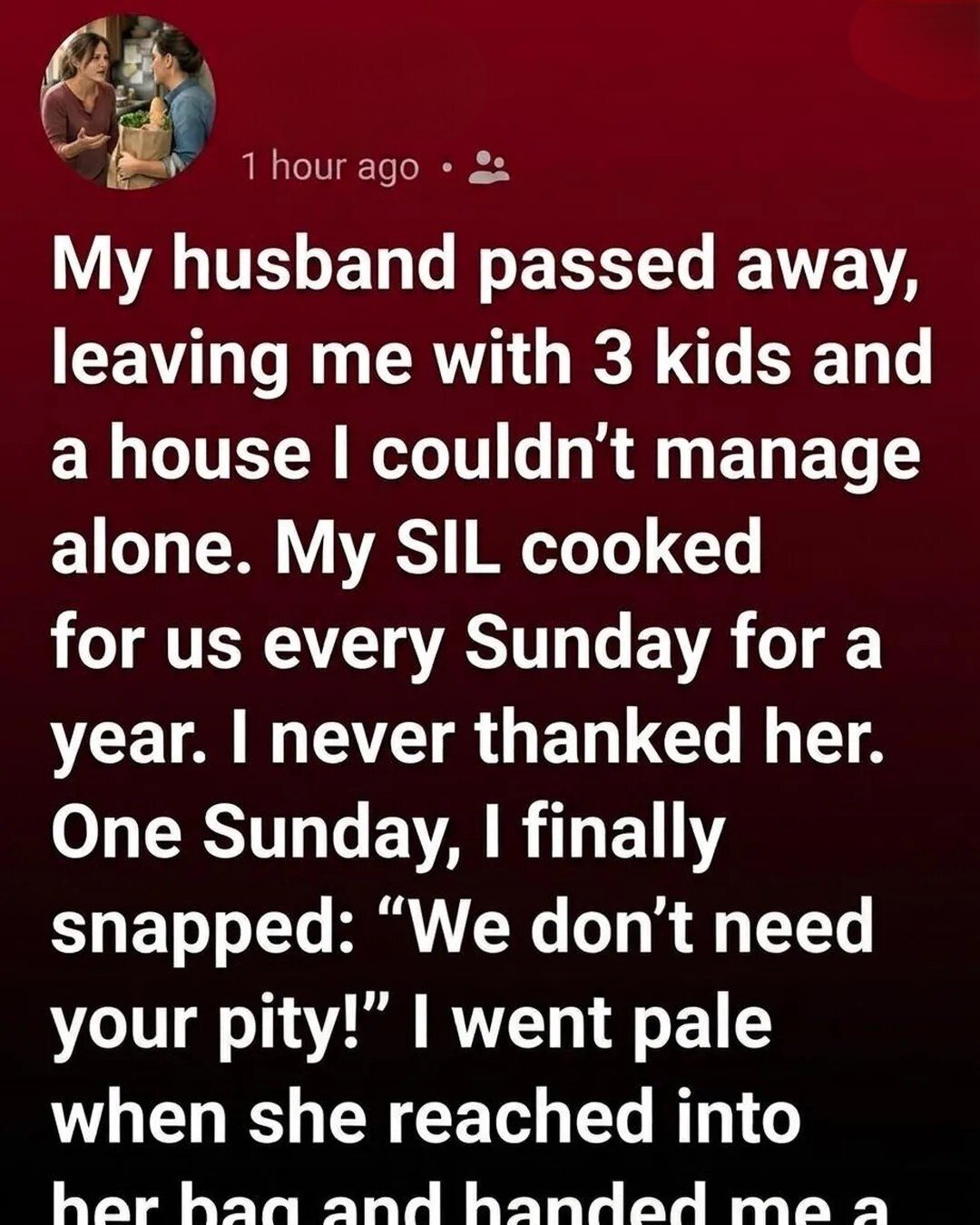
One humid Sunday afternoon, the suffocating weight of my hidden resentment finally spilled over. She was standing at my kitchen counter, carefully setting down a tray of roasted chicken she had spent her morning preparing.
I looked at the food, then looked at her, and heard myself snap with a cold sharpness I hadn’t planned: “You can take that back to your car. We don’t need your pity anymore.”
The entire room fell into a horrifying, frozen silence. My children stopped chewing, staring at me with wide, frightened eyes. Even I felt the immediate, ugly sting of what I had just shouted. I braced myself for her to yell back, to call me ungrateful, or to storm out of the house.
But she didn’t argue. She didn’t even try to defend herself.
Instead, she slowly took a deep breath, reached into her canvas purse, and pulled out a small, worn manila envelope. She placed it gently on the wooden table right in front of me, gave my children a soft look, and quietly walked out the front door.
Confused, defensive, and with my heart pounding against my ribs, I tore open the seal. Inside was not money, and it wasn’t a legal notice. It was a stack of small, handwritten index cards, each one meticulously dated over the past twelve months.
With trembling hands, I began to read them. They were short observations she had quietly written down after her weekly visits:
October 12th: Noticed Chloe smiled today while eating the blueberry muffins. The color is finally coming back to her cheeks.
January 14th: Saw Leo automatically taking out the trash without being asked. He is growing into a fine young man to help his mother.
March 3rd: Watched my sister-in-law scrub the kitchen floor tonight even though her eyes were completely bloodshot from exhaustion. She is the strongest woman I know.
At the very bottom of the very last note, written in her elegant script, were the words that broke through my defenses and shattered my pride forever: “This was never about pity, sister. This was love, in the only language I knew how to speak when the words failed us.”
I collapsed into my chair, holding those tiny pieces of paper against my chest as hot tears blurred my vision. My children rushed over, wrapping their small arms around me as I wept.
That day, I learned the hardest, most beautiful lesson of my life. True strength doesn’t mean locking your doors and trying to do everything entirely alone. Sometimes, the ultimate form of strength is simply having the humility to recognize the quiet, unconditional kindness that carries you when you are far too weak to carry yourself.